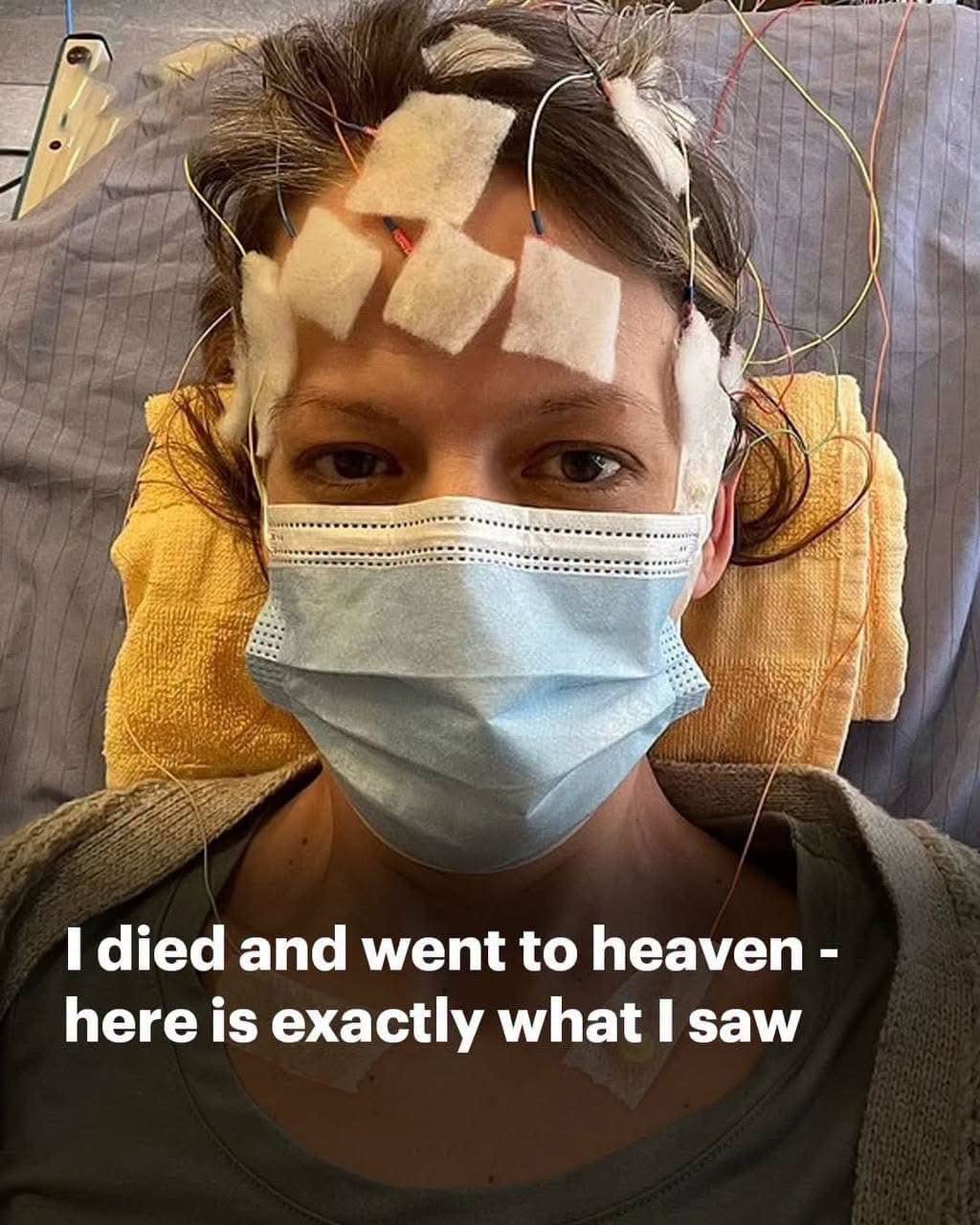
Julie Poole’s experience sits in that uneasy space between miracle and metaphor, where personal testimony, spirituality, trauma, and questions about meaning overlap. A survivor of brutal childhood abuse, she describes her near-death experience not simply as an escape from life, but as a summons back into it. In her account, the experience became a moment in which suffering was viewed from an entirely different perspective—a place where pain did not erase the value of her existence.
In the “spirit realm” she recalls, there was no judgment. Instead, she describes an overwhelming sense that her life still mattered, even after the experiences that had made her feel broken or powerless. The idea that suffering could become seed rather than scar became central to the way she understood what happened to her.
That interpretation is deeply personal. Near-death experiences are reported by people from many backgrounds, but their meaning varies enormously. Some understand them through religious beliefs, others through spiritual traditions, and others through psychological or neurological explanations. Poole’s account can therefore be meaningful without requiring every element of her interpretation to be treated as objectively established fact.
Her later vision of a “Golden Age” between 2012 and 2032 introduces another layer of uncertainty. She has presented this period as part of a broader spiritual or prophetic understanding of humanity’s future. Such claims cannot be verified in the same way as ordinary historical predictions, and readers may interpret them very differently depending on their beliefs.
Yet the symbolism of the idea can be considered separately from whether the prediction proves literally true. A period described as an approaching transformation can represent the hope that societies eventually confront problems they have ignored for too long. As institutions struggle, abuses become exposed, and previously hidden forms of wrongdoing enter public discussion, the language of systems falling apart can resonate with people who believe meaningful change requires uncomfortable truths to surface.
Poole’s suggestion that corrupt systems must fall can therefore be read not only as prophecy, but also as a moral demand. It expresses the belief that structures built on exploitation, secrecy, or abuse should not be protected simply because they are powerful or longstanding.
That interpretation also connects her spiritual story with the experience that shaped it. Having survived childhood abuse, she speaks from a perspective in which healing is not merely about forgetting what happened. It is about refusing to allow what happened to determine the entire meaning of a life.
Whether or not one believes in angels, spirit realms, or prophetic visions, that part of her message can be understood in human terms. Survival can itself become an act of resistance. Choosing to remain alive, to seek healing, and to treat others with conscience can transform the meaning attached to experiences that once seemed capable of destroying everything.
Her story therefore raises a larger question: what do people do with suffering after they survive it?
There is no universal answer. Some find meaning through faith, others through relationships, creative work, service, therapy, activism, or simply the decision to build a life that feels safe and worthwhile. None of those paths erases the original harm, but they can change what comes afterward.
In that sense, Poole’s story insists on a quieter kind of miracle. It is not necessarily the prediction of a perfect future or proof of another realm. It is the possibility that a person can endure something devastating without allowing it to become the final definition of who they are.
Her vision of a transformed world may be understood literally by those who share her spiritual beliefs, metaphorically by others, and skeptically by still others. But beneath those different interpretations is a more universal message: healing can create responsibility, survival can create purpose, and choosing to act with conscience can become its own form of transformation.
The most powerful part of the story may therefore not be what happened beyond life, but what she chose to do with the life she returned to.