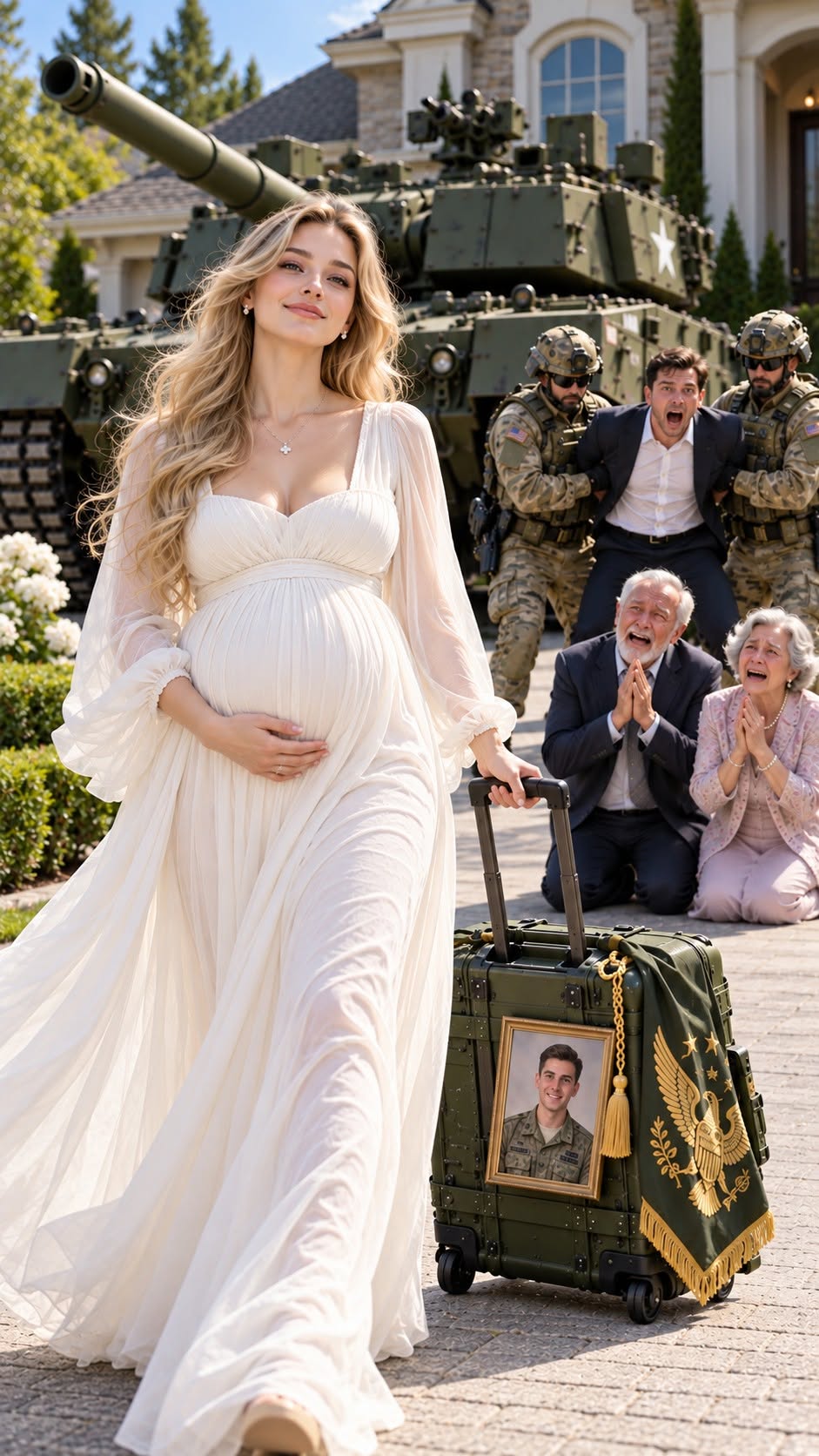
Chapter 1: The Knock That Stops the World
They say that when your world ends, the universe has the common decency to go quiet. I can tell you from brutal, firsthand experience that this is a lie. When my world ended, it was accompanied by the low, steady hum of the kitchen refrigerator, the distant, frantic bark of a neighbor’s golden retriever, and the sharp, deeply authoritative knock on my solid oak front door at exactly six-forty in the morning.
I had been standing in the master bathroom, holding a plastic stick with two pink lines on it.
I was twenty-eight years old, married to Captain David Vance, an officer in the United States Army Special Forces. We had been trying for a baby for two agonizingly long years. Two years of negative tests, forced smiles, and quiet heartbreak. The sight of those two bold lines had literally brought me to my knees on the cold, hexagonal tile. Tears of pure, unadulterated joy were streaming down my face, hot and fast. I had my phone in my hand, my thumb hovering over his contact name, ready to send a pre-arranged, coded message to his encrypted satellite phone. “The eagle has landed.” It was our stupid, wonderful inside joke.
Then, the knock.
It wasn’t a delivery driver’s polite tap. It was a knock that demanded to be answered.
I walked to the front door, still holding the pregnancy test deep in the pocket of my oversized, gray cardigan. I opened the door to find the bright, crisp morning sun illuminating two men standing on my porch. They were dressed in pristine, olive-drab dress uniforms, every ribbon and medal perfectly aligned. Their faces were carved from unyielding stone. The chaplain stood slightly behind the casualty assistance officer, his hands clasped tightly in front of him.
“Mrs. Hannah Vance?” the taller officer asked, removing his service cap.
I didn’t hear the rest of the sentence. I didn’t hear the sterile, carefully rehearsed words killed in action, or ambush, or heroic sacrifice. I only heard a high-pitched, deafening ringing in my ears as the entire foundation of my life collapsed into fine dust around me. In the span of fifteen minutes, standing in my own foyer, I had become both a mother and a widow.
The ensuing week was a surreal, suffocating blur of rigid military protocol, endless paperwork, and a grief so profound it felt like I was drowning in wet concrete. But the true nightmare didn’t begin with the heavy, flag-draped casket; it began with the people standing rigidly beside it.
David’s family had always treated me like a temporary, mildly irritating fixture in his life. To his mother, Margaret, a woman who wore her old Southern money like armor, I was a distraction from his glorious military career. To his older brother, Travis, a man whose ambition vastly outpaced his actual talent, I was a direct obstacle to the financial umbilical cord he had enjoyed before David married me and merged our finances.
At the funeral in Arlington National Cemetery, the summer air was thick with the smell of damp, overturned earth and polished brass. When the honor guard fired the twenty-one-gun salute, the sharp, synchronized cracks echoing violently over the rolling green hills, Margaret did not flinch. She did not weep. She stood behind her dark, oversized Chanel sunglasses, her posture rigid, her lips pressed into a thin, bloodless line.
Travis stood next to her, constantly pulling back his cuff to check his gold Rolex, his eyes darting around the crowd as if calculating the net worth of the generals and politicians in attendance. His wife, Mallory, was busy whispering furiously into her phone, complaining about the humidity ruining her expensive blowout.
When the commanding officer finally handed me the folded American flag, kneeling before me on the grass with genuine tears in his own eyes, I clutched the heavy cotton to my chest, pressing it right over the secret growing inside my womb. Margaret leaned over to me. I thought, for a fleeting, desperately naive second, she was going to offer comfort, a shared moment of devastating loss.
Instead, she whispered, “We need to discuss the estate tomorrow morning. Don’t make any plans.”
They didn’t ask how I was breathing. They didn’t care that I hadn’t eaten solid food in three days. Grief, to the Vance family, wasn’t a sacred process of mourning a lost son and brother; it was a highly anticipated business opportunity. And with David permanently out of the picture, they saw their ultimate payday approaching.
The very next morning, at exactly nine o’clock, the heavy tires of a luxury SUV crunched aggressively on the gravel driveway of the small, blue craftsman house David and I had bought in Alexandria, Virginia.
I was sitting on the living room floor, surrounded by ghosts. I had surrounded myself with his scuffed combat boots, his favorite cedar-scented candles, and a framed photograph of us laughing at his grandfather’s lakeside cabin in Maine.
I heard the heavy footsteps march up the porch steps. The front door swung open without a knock.
Travis walked in as if he owned the place, wearing a sharp, tailored Italian suit that I knew for an absolute fact he couldn’t afford on his failing firm’s salary. Margaret followed, dressed in immaculate, dramatic black mourning attire, looking less like a grieving mother and more like a corporate liquidator arriving to strip the copper wire from the walls. Mallory trailed behind them, carrying a thick, legal-sized leather binder.
“You have thirty days to vacate,” Travis announced, his voice entirely devoid of any warmth or preamble. He didn’t look at the framed photo of his brother resting on the floor. He didn’t look at me. He looked critically at the crown molding.
I slowly stood up, my joints aching from sleeping on the floor. I was still wearing the oversized Army t-shirt David had slept in the night before his final deployment. My hand instinctively drifted toward my stomach, resting there lightly. Breathe, I told myself. Protect the baby. Protect David’s legacy.
“Good morning to you too, Travis,” I said, my voice eerily calm despite the roaring in my ears.
Margaret stepped forward, her eyes scanning the living room with sheer, unadulterated disdain. “Don’t be difficult, Hannah. It’s unseemly. This house belongs to the Vance family. You were only his wife.”
Only his wife.
The words hung in the air, toxic, heavy, and deliberately cruel. I looked at the three of them, a pack of well-dressed wolves circling what they perceived to be a wounded, defenseless lamb. But they had absolutely no idea who they were dealing with. And more importantly, they had no idea what David had known before he boarded that transport plane.
Travis dropped the heavy leather binder onto my coffee table with a loud thud. He unclipped a silver Montblanc pen from his breast pocket and held it out to me.
“Sign these,” Travis commanded, tapping the top page. “It’s a comprehensive power of attorney, along with a waiver for the military death gratuity and the SGLI life insurance payout.”
I stared at the pen, my blood running cold. “The Servicemembers’ Group Life Insurance?”
“Yes,” Mallory chimed in brightly, tapping her manicured nails on the leather cover. “Half a million dollars, plus the hundred-thousand-dollar death gratuity. Travis is a certified financial advisor, Hannah. He’s going to personally manage the funds to ensure Margaret is taken care of in her old age. It’s what David would have wanted.”
What David would have wanted.
It was their favorite, most heavily used weapon. They used that phrase to justify absolutely everything, from demanding unpaid loans to guilting David into skipping our first wedding anniversary to fly out and fix Travis’s broken sports car.
“And the house?” I asked softly, my eyes narrowing just a fraction.
“We’re selling it,” Travis said, offering a predatory, gleaming smile. “The market in Alexandria is incredibly hot right now. We can liquidate this property and the lakeside cabin in Maine within six weeks. You’ll get a small stipend to help you relocate to an apartment, of course. We aren’t monsters.”
I looked down at the stack of paperwork. They wanted everything. The blood money from my husband’s ultimate sacrifice, the roof over my head, and the sanctuary he had loved in Maine. They wanted to erase my existence completely, effectively resetting the family dynamic to the way it was before I existed.
I slowly reached out, my fingers brushing against the cold silver barrel of the pen Travis was holding. But I didn’t take it from him.
“I need to make a phone call,” I whispered, looking up.
Travis’s smile vanished instantly. His brow furrowed in irritation. “There’s absolutely no need to drag expensive lawyers into this, Hannah. It’s standard military procedure for the family of origin.”
“I’m not calling a civilian lawyer,” I said, looking out the large front bay window as a sleek, black government sedan with tinted windows pulled silently up to the curb. “I’m calling the man David told me to call if you ever tried this.”
The heavy oak front door creaked open, and a man in a sharply pressed Army service uniform stepped onto the porch. A thick, reinforced metal briefcase was securely locked to his wrist with a steel cable.