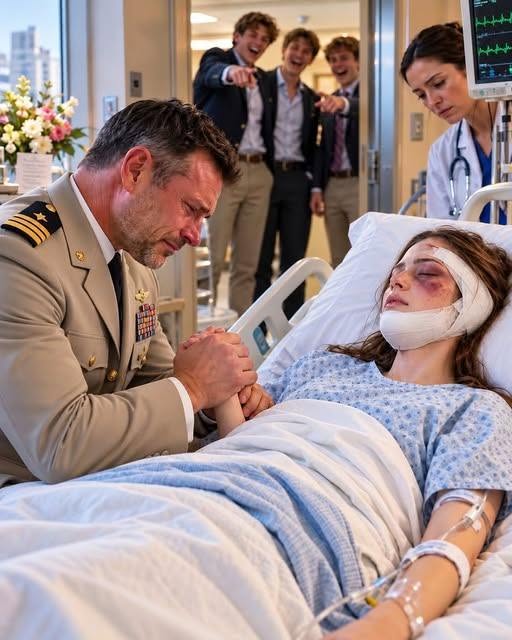
Four wealthy boys shattered my daughter’s jaw in six places, then laughed that their families had enough money and political influence to make the attack disappear.
By the time I reached the hospital, the cameras had “malfunctioned,” witnesses suddenly remembered nothing, and even the police were afraid to ask questions.
What those boys didn’t know was that Nora’s grieving father had once been known by another name—the Phantom Commander.
The ER lights buzzed above me as the surgeon placed Nora’s X-ray on the screen.
He pointed to fracture after fracture.
“Mr.
Miller, this wasn’t meant to scare her,” he said quietly.
“Someone wanted to destroy her.”
Behind the curtain, my nineteen-year-old daughter lay with her jaw wired shut, both eyes dark with bruising and dried blood tangled in her hair.
I took her hand.
“Daddy’s here.”
Her fingers tightened weakly around mine.
That almost broke me.
To everyone else, I was David Miller—a widower, security consultant, and quiet father who never talked about his scars.
Nora knew I had served in the military.
She never knew the truth.
Once, I had been Commander David Vance, leader of Task Force Vanguard.
In certain circles, they called me the Phantom Commander because there were no photographs, no public medals, and almost no records anyone could verify.
When Nora was born, I buried that life.
For nineteen years, being her father had been enough.
Then the hospital called.
Campus security claimed every camera near the attack had failed.
Emergency phones were down.
No witnesses.
No usable footage.
Every system had somehow broken at exactly the right moment.
Too clean.
Too fast.
Someone had started erasing evidence before Nora even reached the ER.
A nurse handed me her torn sweatshirt sealed inside an evidence bag.
Caught beneath the ripped fabric was a bloodstained piece of paper.
Four names.
Chad Kensington.
Brantley Sterling.
Wyatt Holbrook.
Preston Caldwell.
I knew the families immediately.
Construction money.
Political power.
Defense contracts.
Private banking.
Those boys hadn’t chosen Nora because they thought no one cared about her.
They chose her because they thought their last names made consequences impossible.
The detective who arrived barely looked toward my daughter.
“No witnesses, no footage,” he said.
“There may not be much we can do.”
His hands trembled when he mentioned Holbrook and Caldwell.
Someone had already reached him.
“Then I suppose your investigation is finished,” I said.
Relief crossed his face.
He thought I was surrendering.
Men had made that mistake before.
I stepped into the hallway and opened the hidden compartment inside my wallet.
A black challenge coin slid into my palm.
A silver eagle.
Four words:
**VANGUARD NEVER DIES.**
On the back was a number I hadn’t called in nineteen years.
I dialed.
One ring.
Silence.
Then:
“Commander?”
I looked through the glass at Nora.
“Major Bishop.”
His breathing stopped.
“I never thought this number would ring again.”
“My daughter was attacked.”
His voice changed instantly.
“Names?”
I gave him all four.
Keyboard clicks began.
“What do you need?”
“Everything.
Their families, money, university contacts, political ties, contracts, police connections, judges, deleted footage—everyone protecting them.”
A pause.
Then Bishop asked the question I had hoped never to hear again.
“Should I activate the team?”
I closed my eyes.
“The Phantom Commander isn’t coming back.”
I looked at Nora.
“A father is.”
A chair scraped on Bishop’s end.
“Task Force Vanguard awaits your orders, sir.”
Then the typing suddenly stopped.
For several seconds, Bishop said nothing.
“Commander…”
His voice had gone tense.
“There’s something you need to see about the fourth boy.”
“Speak, Bishop,” I said, my voice barely louder than the hum of the fluorescent fixtures.
“Preston Caldwell,” Bishop replied, his keystrokes firing off in rapid, jagged bursts.
“His father isn’t just Julian Caldwell of Caldwell Defense Dynamics.
Julian Caldwell is the primary private contractor currently bidding on the next-generation integrated logistics backbone for United States Special Operations Command.”
I stood still.
The hospital corridor smelled of antiseptic, cold floor wax, and the dry, metallic copper of my daughter’s dried blood still clinging to my knuckles.
“Go on.”
“Sir, the server that scrubbed the university’s feeds forty minutes ago wasn’t local IT.
It was routed through an off-grid proxy running out of the Caldwell compound in Arlington.
But that’s not the problem.”
Bishop inhaled, the steady military rhythm of his breath hitching slightly.
“When they initiated the wipe on campus, they ran an automatic facial and biometric cross-check on the victim’s immediate emergency contact. *You.*”
The glass between me and Nora vibrated faintly from an HVAC vent overhead.
Inside, her swollen eyelids twitched under the harsh triage glare.
“They pinged the DOD central registry,” Bishop whispered.
“The system returned a triple-red flag.
Level Zero clearance.
It locked out the Caldwell algorithms, but the query alone sent an automated breach alert directly to Julian Caldwell’s personal encrypted terminal.
Commander… they didn’t know who Nora was when those boys beat her in that parking deck.
But they know who *you* are now.”
“Then they know what’s coming,” I said.
“They’re scrambling,” Bishop muttered.
“I’m looking at live satellite feeds over the Caldwell estate right now.
Two unmarked private security transport vans just left their motor pool.
Local dispatch records in Cook County just wiped three preliminary radio calls regarding the incident.
And Detective Miller—the one standing twenty feet from you?”
I glanced down the hall.
Detective Miller was huddled near the emergency bay vending machines, clutching his burner phone to his ear, his face gray and slick with cold sweat.
“He just received a wire confirmation,” Bishop said coldly.
“Fifty thousand dollars from an offshore account in Grand Cayman.
In exchange, the bloody note recovered from Nora’s sweatshirt is supposed to be marked as ‘lost chain of custody’ before it reaches the precinct lockup.”
I looked at the black challenge coin in my hand.
The silver eagle felt cold against my palm.
Nineteen years of pretending to be David Miller—a man who worried about property taxes, leaky gutters, and college tuition.
A man who sat in the bleachers with a thermocup of coffee, cheering for his daughter’s track meets, swallowing down the instinct to measure every room’s fatal funnels and exits.
“Bishop.”
“Sir?”
“Don’t touch the wire,” I said.
“Let Miller take the money.
Let them believe the machine still works the way they built it.”
“And the team?”
“Rendezvous protocol Obsidian.
Tell Miller-One, Scribe, and the Ghost to pack heavy.
I don’t want a strike team.
I want an audit.”
A grim, sharp chuckle came through the encrypted link.
“Understood, Commander.
What are your rules of engagement?”
I looked through the glass one last time.
Nora’s small hand rested against the white hospital sheet, her knuckles bruised where she had tried, hopelessly and furiously, to fight back against four athletic, entitled predators in a dark stairwell.
“They broke six bones in her face because they thought their money made them invisible,” I said, turning away from the window.
“Let’s show them what real ghosts do to an empire.”
PART 2: THE ANATOMY OF A RECKONING
Chapter 1: The Ledger of Blood
The linoleum floor of St.
Jude’s Memorial Hospital reflected the buzzing green tint of dying fluorescent ballasts.
It was 0314 hours.
Down the hallway, Detective Miller finished his call by the soda machine, wiped his sweaty palms along the thighs of his poly-blend slacks, and dropped his burner phone into his overcoat pocket.
He didn’t look at me as he turned on his heel and moved toward the glass double doors leading out to the ambulance bay.
In his mind, he was already fifty thousand dollars richer, a minor clerical slip away from paying off his second mortgage or his mistress’s condominium in Schaumburg.
He pushed the door bar.
The hydraulic arm hissed.
Outside, the Chicago night was an iron kettle of freezing rain and diesel fumes.
Before Miller could clear the yellow safety curb, a matte-black Ford Transit van—no plates, no city transponder, its grille guard crusted in road salt—glided across the wet asphalt like a barge through still water.
It didn’t brake; it cut the wheel hard, pinning Miller against the concrete pillar of the parking garage elevator.
The side door slid open three inches on nylon rollers.
A gloved hand reached out, snagged the lapel of Miller’s trench coat, and dragged the two-hundred-pound detective into the dark interior of the chassis with the effortless mechanical lever-action of an industrial press.
The door clicked shut.
The van rolled on toward Congress Parkway, tires barely hissing on the slush.
I didn’t watch it go.
I had seen the grab from the corner of my eye through the frosted emergency room glass while adjusting Nora’s saline drip.
“Scribe,” I whispered into the flesh-colored acoustic transducer tucked behind my right ear.
“In custody, Commander,” came the response.
The voice was like dry leaves being crushed under a tank tread.
Master Sergeant Michael “Scribe” Chen, the archivist of Vanguard.
A man who had interrogated Ba’athist intelligence directors in subterranean concrete pipes outside Tikrit without ever raising his voice above a library murmur.
“Miller is in the back.
Pulse is one-forty.
Bladder control is failing.
We’re taking him to the salt docks at Calumet.”
“Keep him intact,” I said, my fingers resting lightly over the bruised, cold knuckles of my daughter’s left hand.
“He’s not the target.
He’s the receipt.”
“Copy, six.
Bishop has the uplink running.
You need to see the campus package.”
I pulled my civilian phone from my jacket.
The screen flashed once, bypassed the commercial operating system, and loaded a raw, unrendered video stream pulled from an encrypted cache twenty levels below the university’s public safety server.
Bishop had bypassed the Caldwell family’s proxy wipe by running a magnetic-domain recovery tool on the physical hard drives of the campus security hub.
When wealth buys an erasure, it usually hires contractors who rely on remote software scripts.
They overwrite the pointer files and assume a local administrator won’t notice.
They don’t expect someone to clone the raw flash memory sector by sector from an unlisted satellite van parked three blocks away.
The screen flickered.
Timecode: 2342 hours.
The east stairwell of the Crown Memorial Library.
Nora appeared first.
She was carrying her heavy canvas book bag, her dark hair pulled back in the green scrunchie I had bought her at a gas station outside Galena during our last road trip.
She was wearing her gray track hoodie—the one with the frayed cuffs she refused to throw away because she’d won her first four-hundred-meter hurdle championship in it.
Then the four came down from the third-floor landing.
They didn’t walk like boys.
They walked like owners.
Chad Kensington led them.
Tall, broad, his shoulders filled out by three seasons of varsity crew and an unlimited tab at the River North steakhouses his father’s construction conglomerate built.
Behind him was Brantley Sterling, twirling a brass key fob on his pinky finger—the Sterling banking dynasty’s prodigal third son, whose trust fund was larger than the municipal budget of Peoria.
Next was Wyatt Holbrook, wearing a camel-hair coat over a designer track suit, his father sitting on the State Supreme Court nominating committee.
And bringing up the rear was Preston Caldwell.
He wasn’t laughing like the others.
He had his hands jammed into the pockets of a waxed Barbour jacket, his jaw set in that cold, flat line of second-generation sociopathy that comes from growing up in homes where federal subpoenas are handled by the domestic staff.
Nora tried to step around them.
She didn’t drop her head.
That was my fault; I had raised her to look every man in the eye.
I had taught her that bullies were just frightened boys in better boots.
I had forgotten that in the world of men who buy senators, a refusal to bow is treated as an act of treason.
Kensington caught the strap of her bag.
He pulled.
She stumbled, caught her balance, and swung her elbow back, catching him cleanly across the bridge of his nose.
Good form.
Compact.
Hip rotation.
Kensington roared, stumbling back into the cinder block wall, blood blooming across his teeth.
That was when the sport ended and the slaughter began.
Sterling caught her from behind, locking his arms under her armpits in a full nelson, his silver watch catching the stairwell bulb.
Holbrook didn’t hesitate; he kicked the back of her right knee until the joint popped, dropping her to the concrete.
And then Preston Caldwell took off his heavy signet ring—the heavy gold seal bearing the three-crested hawk of Caldwell Defense Dynamics—and slipped it over his middle knuckle like an iron knuckle-duster.
He hit her six times while the other three held her against the riser.
*One.* The left zygomatic arch caved in.
*Two.* The lower mandible sheared along the midline.
*Three.* Her head struck the steel tread of the step, leaving a thick, black smear of blood that the university’s janitorial crew had already bleached away three hours ago.
On the video, Caldwell stopped, shook the blood from his fingers, and pulled a hundred-dollar bill from his money clip.
He tucked the bill into the torn collar of her sweatshirt, leaned down until his mouth was two inches from her swollen ear, and whispered something.
Then they walked down the stairs, stepping over her canvas bag, their laughter echoing through the hollow concrete shaft until the fire exit banged shut.
My screen went black.
I stood there in the green hospital glare.
My heart wasn’t racing.
My breath wasn’t short.
My body had entered that ancient, terrifying stillness that Task Force Vanguard used to call *The Deep Cold.*
It’s the psychological state where the nervous system stops recognizing human beings as people and begins calculating them as structural engineering problems—mass, velocity, structural failure points, and the amount of hydraulic force required to collapse a trachea.
“Bishop,” I said.
My voice was so quiet the cardiac monitor beside Nora’s bed didn’t register an elevated frequency.
“Listening, Commander.”
“The hundred-dollar bill.”
“Recovered from the evidence bag before Miller tried to drop it,” Bishop answered instantly.
“We ran the serial number through the Secret Service currency tracking database.
It was drawn from an ATM inside the executive dining room at the Chicago Union League Club yesterday afternoon at fourteen hundred hours.”
“Cardholder?”
“Julian Caldwell.”
“Good,” I said.
“And what did Preston whisper to her?”
Bishop hesitated.
Across twenty years of black operations, from the mountains of Tora Bora to the black sites along the Dnieper, I had never heard Major Bishop hesitate.
“He told her,” Bishop said, his voice dropping into a register that was almost sick with sorrow, “‘Tell your daddy that the Caldwells don’t pay rent to ghosts.’”
I closed my eyes for two seconds.
The room, the hospital, the city of Chicago—everything narrowed down to the diameter of a twelve-gauge bore.
They knew.
This hadn’t been an assault born of drunken privilege in a library stairwell.
It had been a message.
Chapter 2: The House on the Ridge
The Kensington estate was not a house; it was a fortress of limestone and iron set on twelve wooded acres along the bluff in Lake Forest.
It had three automated security gates, a six-foot dry-stone wall topped with non-lethal pulse sensors, and a private patrol contract with Titan Tactical Solutions—a mid-tier security firm staffed by washed-out suburban cops who liked the black uniforms and the twenty-eight dollars an hour.
At 0440 hours, the rain had turned into a thick, clinging freezing sleet that coated the branches of the ancient burr oaks like cracked glaze.
A black Mercedes-AMG G63 sat in the circular pea-gravel driveway, its exhaust thrumming in low, rhythmic pulses that vibrated the mullioned glass of the three-car carriage house.
The driver was Chad Kensington.
He was twenty-one years old, wore a gray cashmere crewneck with the sleeves pushed up to his forearms, and had a white butterfly bandage taped across the bridge of his broken nose.
In the passenger seat sat a girl with long, honey-blonde hair, weeping quietly into a silk scarf.
“I told you to shut up about it, Chloe,” Chad snapped, revving the engine until the twin side-pipes barked against the stone retaining wall.
“My old man already talked to the dean.
The girl fell down the stairs.
She was drunk.
She had an illegal prescription in her bag.
The police report is being filed as an accidental fall during a campus protest.”
“Chad, there was blood everywhere,” the girl sobbed.
“Her face… her mouth was full of—”
“I said drop it!”
He reached across the console, his large, athletic hand clamping down on her wrist with enough force to turn her skin white.
“Do you know who Preston’s father is?
He’s on the board of trustees at Northwestern!
He’s getting me into the Kellogg School without an interview!
If you open your mouth to your little sorority sisters, I swear to God I’ll tell your father who really bought that cocaine in Miami last spring.”
The girl choked on her tears, pulling her wrist back against her chest.
Chad grinned, that wide, lazy, arrogant grin of a boy who had spent his entire life learning that there was no mess too large for his father’s checkbook to sweep into the sewer.
He dropped the Mercedes into gear and let off the brake.
The truck didn’t move.
The engine revved, the four-wheel-drive system clicked, but the heavy chassis settled down on its suspension as if it had been welded to the earth.
Chad frowned.
“What the hell?”
He looked into his driver-side mirror.
Standing directly behind the five-ton luxury SUV was a man.
Not a security guard.
Not a police officer.
The man was six-foot-two, wearing a faded black oilskin barn coat, dark canvas work trousers, and heavy Vibram-soled combat boots crusted with dried road salt.
He had a six-ton hydraulic bottle jack sitting on the gravel beside his boot, and an eight-foot piece of rusted railroad iron jammed between the rear axle of the Mercedes and the heavy stone lintel of the carriage house foundation.
A lever.
A fulcrum.
A simple mechanical lock.
Chad kicked his door open.
“Hey!
You senile piece of trash!
Get the hell away from my truck before I call security and have them put a hole in your chest!”
The man in the barn coat didn’t run.
He didn’t even look up until he had wiped his grease-stained thumbs on an old blue bandana.
When he raised his head, the yellow halogen floodlights from the carriage house caught his face.
Chad froze.
The breath died in his throat.
He had seen that face once before, four hours ago, on a small, laminated photograph pinned to the corkboard in the university security office beside the name: *Nora Miller — Emergency Contact: David Miller (Father).*
In the photo, the man had looked tired, ordinary, the kind of suburban father who bought his jeans at Costco and coached middle school soccer.
The man standing in the pea-gravel did not look like he had ever coached soccer.
His eyes were gray—not the gray of river stones, but the gray of steel plates after an artillery strike, flat and empty, reflecting the rain without taking any of it in.
A jagged, faded white scar cut from the corner of his left eye, down through his cheekbone, vanishing into the line of his jaw.
“You,” Chad whispered, his voice cracking.
“You’re… you’re her old man.”
“Get out of the car, Chad,” I said.
The boy laughed, but the sound was thin, like paper tearing in the wind.
He reached into the door pocket of the Mercedes, his fingers wrapping around the grip of a customized SIG Sauer P320 with a gold-tin barrel—the birthday present his uncle had bought him when he made the varsity crew team.
“You’re on private property, old man,” Chad said, bringing the gun up, his hand shaking just enough to rattle the sights against the door frame.
“I have the right to defend myself!
Get on the ground!
On your knees or I’ll blow your damn head off!”
I took one step forward.
The movement was not fast.
It was simply inevitable.
In the language of Task Force Vanguard, there is a term called *The Fatal Funnel.* It is the three-foot corridor through which an amateur attempts to project lethal force before his brain realizes that distance is an illusion.
Chad pulled the trigger.
He had never fired a weapon at a human being who was closing the gap.
He had only fired at paper silhouettes at thirty feet in indoor ranges with electronic ear protection and a bottle of mineral water sitting on the shelf.
He anticipated the recoil.
He pushed his hands forward.
The bullet struck the pea-gravel eight inches to the left of my right boot, kicking up a shower of wet limestone dust.
Before the casing had even hit the hood of the Mercedes, my left hand closed over the slide of the P320, my thumb jamming into the ejection port, catching the brass before it could clear the extractor.
*Mechanical failure induced.*
With my right hand, I didn’t strike his face.
That would have been mercy.
I drove the heel of my palm upward into his right elbow, hyper-extending the joint until the radial head sheared out of its ligamentous bed with a sound like a green hickory branch snapping under a boot.
Chad screamed—a high, wet, girlish wail that cut through the Lake Forest trees.
The gun fell into the gravel.
I caught him by the back of his cashmere crewneck, pulled him out of the cab like an empty sack of grain, and slammed him face-down onto the hood of his eighty-thousand-dollar truck.
The girl in the passenger seat shrieked, scrambled out her door, and ran into the woods, her silk scarf catching on the bare branches of the rhododendrons.
“Listen to me, Chad,” I said, my mouth an inch from his left ear.
My voice was calm, almost gentle.
“The human mandible has two points of structural weakness: the subcondylar region and the parasymphysis.
When you hit Nora with that ring, you sheared both.”
“My father!” he howled, his face pressed against the cold aluminum hood, snot and tears mixing with the rain.
“My father will kill you!
Do you know who my father is?
He’s Richard Kensington!
He builds the federal courthouses!”
“I know who your father is,” I said.
I reached down, took his right hand—the hand he had used to hold Nora’s hoodie—and laid his fingers flat across the raised chrome lettering of the *G63* badge on the fender.
“And your father is about to learn that buildings fall down when the foundation is rotten.”
I brought my elbow down.
*One.*
*Two.*
*Three.*
The metacarpals didn’t just break; they flattened into the sheet metal.
Chad didn’t scream this time.
His body went rigid, his eyes rolled back until only the whites were showing, and he slipped down the side of the fender into the wet pea-gravel, his breath coming in short, unconscious gasps.
I picked up his customized SIG Sauer, cleared the stove-piped round, dropped the magazine into my pocket, and threw the empty frame through the driver-side window of the Mercedes.
Then I tapped my ear.
“Bishop.”
“Kensington’s father just got the alert,” Bishop said from the van three miles away.
“The Lake Forest estate security system flagged the discharged round.
Titan Tactical is dispatching three cars from their depot on Route 41.”
“Let them roll,” I said, walking toward the gate.
“Call the Ghost.
Tell him to start the foreclosure on Kensington Construction.”
“The foreclosure?”
Bishop’s voice carried a rare trace of dark humor.
“Sir, Kensington has twelve major commercial builds active in the city right now.”
“Not anymore,” I said, stepping through the broken gate into the darkness of the road.
“Tell the Ghost to pull the structural steel certifications.
All of them.”
Chapter 3: The Ghost in the Exchange
At 0515 hours, the thirty-second floor of the Sterling Bank Building on LaSalle Street was silent.
The cleaning crews had already finished vacuuming the broadloom carpets in the private wealth management suites, leaving behind the faint smell of chemical lemon and ozone.
In forty-five minutes, the first junior analysts would arrive with their venti coffees and their iPads, preparing for the opening of the London currency desks.
Brantley Sterling sat in his corner office, wearing the same clothes he had worn to the library stairwell: designer denim, Belgian loafers, and a three-thousand-dollar suede overshirt.
He had a line of Peruvian flake laid out on the surface of his antique mahogany desk, alongside a silver straw and an iced bottle of Dom Pérignon.
He was twenty-three, with the pale, weak jaw of his great-grandfather and the arrogant slouch of a boy who had never been told that his inheritance was finite.
He snorted the line, threw his head back against the leather headrest, and let out a long, ragged exhale.
“Stupid bitch,” he muttered to the empty room, touching his knuckles where Nora’s teeth had scraped his skin through his gloves.
“Should have just kept her mouth shut.”
The computer monitors on his desk flickered.
Brantley didn’t notice at first.
He reached for his champagne flute, his eyes fixed on the ceiling molding.
Then the lights went out.
Not just the lamps in his office.
The entire floor.
The entire tower.
The floor-to-ceiling windows overlooking LaSalle Street suddenly framed a canyon of darkness as three square blocks of the Financial District died simultaneously, the streetlights below flickering out like blown candles.
The emergency exit signs didn’t kick on.
The auxiliary diesel generators in the sub-basement didn’t turn over.
“What the hell?”
Brantley set the glass down, his heart tripping on the cocaine.
“Maintenance!
Hey!
Carlos!”
The heavy oak door of his private office didn’t swing open; it clicked shut.
A soft, green illumination blossomed in the center of the dark room—not from an emergency beacon, but from the phosphor display of a military-grade Toughbook terminal that had been set on the conference table without making a sound.
Sitting behind the terminal was a man who looked like he had been constructed out of dry leather, wire, and gray hair.
Warrant Officer Jacob “The Ghost” Vance.
No relation to me by blood, but my executive officer for seven years in the Balkans and the Levant.
The man who had once shut down the entire electrical grid of Belgrade using two rolls of carbon-fiber wire and a stolen Serbian postal van.
“Morning, Brantley,” the Ghost said.
His voice sounded like two dry grinding stones.
Brantley scrambled out of his chair, knocking over the champagne bottle.
The cold wine soaked into his Belgian loafers.
“Who are you?
How did you get in here?
There are four armed guards in the lobby!”
“There were four,” the Ghost corrected, typing with his left hand while his right hand rested over the receiver of a suppressed MP5K hanging across his chest on a single-point sling.
“Now there are four men sleeping peacefully in the mailroom with zip-ties around their ankles.
Don’t worry.
They’ll have headaches, but they’ll live to collect their pensions.”
“My father—”
“Your father, Harrison Sterling the Fourth, is currently on a private jet somewhere over Greenland, returning from a banking summit in Zurich,” the Ghost said, not looking up from the glowing green screen.
“He has approximately forty-eight minutes of satellite communication left before his aircraft enters Canadian airspace.”
The Ghost tapped the Enter key.
Across the four high-resolution Bloomberg screens mounted on Brantley’s wall, numbers began to run backward.
Not red numbers.
Not market drops.
*Cancellations.*
“Let’s talk about the Sterling Family Trust, Brantley,” the Ghost said, pulling a pair of wire-rimmed reading glasses from his pocket and perching them on his scarred nose.
“Total asset valuation: two point four billion dollars.
Sixty percent held in municipal bonds.
Thirty percent in commercial real estate along the Magnificent Mile.
Ten percent in cash reserves held at the Bank of Nova Scotia.”
He glanced up over his glasses.
“Except that your great-grandfather had an old partner in nineteen-ninety-four.
A man named David Vance.
Task Force Vanguard’s primary operational account was chartered under a blind custodial trust through your family’s private bank.”
Brantley blinked, the cocaine buzz turning into a cold, greasy sickness in his stomach.
“What… what are you talking about?”
“I’m talking about Section Nine of your bank’s corporate charter, son,” the Ghost said.
“The clause your daddy didn’t tell you about because he assumed the Phantom Commander was dead in an unmarked grave in Diyarbakir.”
The Ghost reached into his pocket and pulled out an antique brass key—the sister key to the one that had opened the vaults in Geneva twenty-four hours ago.
“The Sterling Bank didn’t make two billion dollars by being clever,” the Ghost whispered.
“They made it by holding the operational reserves for twelve black-budget units that officially never existed.
Every time we went into a country without a flag, your grandfather took a three percent custodial fee to launder the extraction funds.”
The monitors began to scream with the electronic alerts of seventy-four separate institutional margin calls.
“And under the terms of that custodial agreement,” the Ghost said, standing up and towering over the trembling boy, “the principal guarantor reserves the right to declare the bank insolvent if the management commits an act of unprovoked hostility against the operational command.”
“I didn’t…
I didn’t attack a command!”
Brantley shrieked, backing against the mahogany bookcase until the leather-bound volumes of the *Harvard Law Review* dug into his spine.
“It was just a girl!
A stupid scholarship student who wouldn’t move her bag!”
The Ghost stopped two feet from him.
In the dark of the thirty-second floor, with the city blacked out behind him, the old warrant officer looked like an inquisitor who had stepped out of the fifteenth century.
“Her father is the command, you little parasite,” the Ghost said softly.
He reached out with one gloved hand, took Brantley by the throat, and lifted him six inches off the floor until his Belgian loafers kicked uselessly in the air.
“And your family’s bank just bounced.”
The Ghost didn’t hit him.
He simply carried him across the office, opened the floor-level service window that the window washers used, and held him out over the thirty-two-story drop above LaSalle Street.
The freezing Chicago wind hit Brantley like a hammer, blowing his silk overshirt open, freezing his tears against his cheeks.
Below him, the dark canyon of the street was empty, the wet asphalt waiting like a black slate.
“Please!”
Brantley wept, his hands clawing at the Ghost’s wrist.
“Please!
Don’t drop me!
Don’t kill me!”
“Kill you?” the Ghost asked, sounding genuinely surprised.
“Why would I kill you?
If I drop you, your death is over in four seconds.
That’s not how Vanguard conducts an audit.”
The Ghost pulled him back inside and dropped him onto the soaked broadloom carpet like a pile of dirty linen.
“You’re going to live, Brantley,” the Ghost said, packing his Toughbook into his canvas rucksack.
“You’re going to live in a two-bedroom rental in Cicero with your mother while your father spends the next twenty years testifying before the Senate Banking Committee about whose money he was really laundering in Zurich.”
The Ghost walked to the door, paused, and looked back at the boy shivering in the champagne-soaked wool.
“And Brantley?”
The boy looked up, his face twisted in horror.
“Nora Miller had a four-point-zero GPA in biochemistry,” the Ghost said.
“She was going to cure pediatric leukemia.
You broke her jaw because she wouldn’t look at your watch.”
The door clicked shut.
The emergency sirens on the street below finally began to wail.
Chapter 4: The Judge’s Dinner
By noon, the rain had stopped, leaving behind an overcast sky the color of a bruised knee.
Justice Ronald Holbrook sat in the private dining room of the Chicago Athletic Association, looking down at an untouched plate of pan-seared walleye.
He was sixty-two years old, with the silver hair of a statesman and the heavy, drooping jowls of a man who had spent thirty years having other people stand up when he entered a room.
Across from him sat his son, Wyatt, wearing a tailored navy blazer, his hands tucked beneath the linen tablecloth.
“You’re certain about the cameras?” the Judge asked, his voice low, modulated for courtrooms and smoke-filled backrooms.
“Preston said his father handled it,” Wyatt replied, though his leg was bouncing beneath the table with a frantic, nervous rhythm.
“Julian Caldwell has the entire campus police department under a maintenance contract.
He said the footage was overwritten twice.”
“And the girl?”
“She’s in the hospital,” Wyatt muttered, looking down at his fork.
“Wired shut.
They said she won’t be able to talk for two months.”
The Judge let out a long, slow breath through his nose, reached for his water glass, and took a measured sip.
“You’re a fool, Wyatt,” the Judge said, without a trace of anger.
“A crude, undisciplined fool.
If you wanted to teach a common girl a lesson, you don’t do it with your fists in a public stairwell.
You have the university revoke her housing grant.
You have the academic integrity board find an anonymous report of plagiarism in her midterms.
You ruin her life cleanly, where there’s no blood to photograph.”
“Dad, she hit Chad!”
“I don’t care about Chad Kensington!” the Judge snapped, his knuckles whitening on the stem of his glass.
“Richard Kensington is a vulgar bricklayer with a line of credit.
I care about my appointment to the Seventh Circuit!
The confirmation hearings begin in three weeks!
If some liberal tabloid gets hold of an incident report involving four white boys from Lake Forest beating a veteran’s daughter—”
“A veteran’s daughter?”
Wyatt asked, frowning.
“Who cares?
He’s some rent-a-cop consultant.
He lives in a brick ranch in Berwyn.”
The heavy oak door of the private dining room opened.
A waiter entered, carrying a covered silver service platter.
He was dressed in the traditional black vest and long white apron of the club, but he walked with a strange, heavy tread—not the glide of a server, but the grounded, measured stride of an infantryman carrying forty pounds of dry ammunition through swamp water.
“We didn’t order dessert, waiter,” the Judge said, without looking up.
The waiter set the silver platter in the center of the white linen cloth between the two men.
“Compliments of the house, Your Honor,” a voice said.
The Judge froze.
He looked up at the waiter’s face.
It was Major Bishop.
Bishop’s hair was sheared down to the scalp, his square jaw set like an iron wedge, his gray suit fitting him with the unnatural tightness that comes when a man has fifty-four inches of chest and no neck to speak of.
“Who are you?” the Judge demanded, his judicial authority kicking in like a trained reflex.
“I am a justice of the Illinois Appellate Court.
This is a private room.”
“I know who you are, Ronnie,” Bishop said, pulling a wooden chair back from the neighboring table and turning it backward.
He sat down, resting his massive forearms across the backrest.
“I have your dossier right here in my head.
Nineteen-ninety-eight: you took four hundred thousand dollars in cash from the operating engineers’ union to dismiss the racketeering indictment against the concrete cartel.”
The Judge’s face went from pale to the color of cold tallow.
“Two thousand and four,” Bishop continued, his voice conversational, rhythmic, like a priest reciting the stations of the cross.
“You let Julian Caldwell’s defense logistics firm bypass the state environmental review for their munitions depot in Joliet.
In exchange, Caldwell bought your wife that horse farm in Barrington through an off-grid LLC in Delaware.”
“This is outrageous,” Wyatt shouted, jumping up from his chair.
“Call security!
Dad, call—”
Bishop didn’t even look at the boy.
His right hand shot out with the speed of an uncoiling viper, catching Wyatt by the necktie, twisting the silk, and slamming the boy’s chest flat against the table.
The water glasses shattered, the silver silverware clattered, and the untouched walleye flew into the Judge’s lap.
“Sit down, Wyatt,” Bishop said, not breathing hard.
“The men are talking.”
He released the tie.
Wyatt fell back into his chair, gasping for air, clutching his bruised windpipe, his face purple with terror.
The Judge didn’t shout.
He didn’t move.
He sat there with walleye sauce on his trousers, staring at the scarred man who had just dismantled his son with two fingers.
“What do you want?” the Judge whispered.
Bishop reached forward and lifted the silver dome from the platter.
Sitting on the polished silver base was not a dessert.
It was an audio cassette tape—the old, magnetic kind used in mini-dictaphones in the nineteen-nineties—and a thick, yellowed legal document bearing the seal of the United States Foreign Intelligence Surveillance Court.
“Your appointment to the Seventh Circuit is off, Ronnie,” Bishop said.
“The Chairman of the Judiciary Committee received a hand-delivered courier envelope twenty minutes ago.
It contains the complete financial records of your wife’s horse farm, including the checks signed by Julian Caldwell’s chief financial officer.”
The Judge looked at the tape as if it were a coiled cottonmouth.
“That’s… that’s impossible.
Those records were sealed by a federal magistrate in ninety-nine.”
“I was the federal magistrate’s driver that night, Ronnie,” Bishop murmured with a thin, chilling smile.
“Vanguard doesn’t throw away paper.
We just wait until the interest compounds.”
Bishop stood up, smoothing the front of his apron.
“Wyatt,” Bishop said, looking down at the shivering boy.
Wyatt flinched, pulling his shoulders toward his ears.
“You have six hours to report to the Cook County Central Detention facility on twenty-sixth street,” Bishop said.
“You will surrender yourself to the desk sergeant.
You will state, on the record, that you participated in the aggravated battery of Nora Miller.”
“And if he doesn’t?” the Judge croaked, his hands trembling on the table.
Bishop looked at the old man with eyes that had seen mass graves in three hemispheres.
“If he doesn’t, Ronnie,” Bishop said softly, “the Phantom Commander will come to your house in Barrington tonight.
And he won’t bring a silver platter.”
Chapter 5: The Glass Citadel
The Caldwell Defense Dynamics headquarters in Arlington did not look like an office building; it looked like an anti-tank bunker that had been redesigned by an Italian architect.
It sat on twenty acres of manicured, razor-wire-ringed berms, its gray titanium panels absorbing the late afternoon light.
It had its own satellite uplink, its own tactical helipad, and three separate subterranean levels designed to withstand a direct strike from a five-hundred-pound bunker-buster.
Julian Caldwell sat in his fourth-floor executive office behind a desk made from a single slab of brushed ballistic steel.
He was fifty-eight years old, dressed in a bespoke charcoal three-piece suit from Savile Row, his silver hair cropped close in the style of the Marine colonels he hired to run his logistics pipelines.
He had spent thirty years moving weapons across borders that didn’t appear on tourist maps, turning four million dollars in surplus Vietnam-era helicopter parts into a nine-billion-dollar private defense empire.
Across from him, pacing the imported limestone floor with a crystal glass of Scotch in his hand, was his nineteen-year-old son, Preston.
Preston wasn’t crying like the others.
He was angry.
His face was flushed with the arrogant, venomous fury of a prince whose hunting dogs had been kicked by a tenant farmer.
“Kensington’s boy is in the hospital with two broken hands,” Preston sneered, taking a heavy swallow of the Scotch.
“Brantley Sterling is hiding in his basement with the blinds drawn, and Wyatt’s old man just resigned from the appellate bench!
It’s ridiculous!
It’s one man!
One sixty-year-old retired vet who thinks he’s Rambo!”
Julian Caldwell didn’t look up from his tablet.
He was reading a private secure transmission that had just bypassed his company’s primary firewall—a transmission that bore the digital watermark of Task Force Vanguard.
“Shut up, Preston,” Julian said.
His voice was cold, thin, and dangerously quiet.
“Dad!
We have fifty private tactical operators on the payroll downstairs!
We have ex-SAS, ex-DEVGRU, guys who did twelve tours in the sandbox!
Why are we letting this old bastard walk through the city like he owns it?
Call the tactical team!
Put a hit out on him!
Tell them to dump his body in the canal!”
Julian slowly set the tablet down on the steel desk.
When he raised his eyes, Preston stopped pacing.
For the first time in his life, Preston saw something in his father’s face that he had never seen before.
Not when the SEC audited their books.
Not when the Senate investigated their defense contracts in Yemen.
It was absolute, unadulterated terror.
“Do you know why this company exists, Preston?”
Julian asked.
His voice was barely a whisper, yet it filled the massive room like gas leaking from a pipe.
“Because… because you built it,” Preston stammered.
“You bought the logistics contracts—”
“I didn’t build anything,” Julian said, his knuckles turning white as he rested them against the steel desk.
“In nineteen-ninety-six, I was a captain in the Marine Corps Logistics Command in Kuwait.
I was twenty-eight years old.
I was caught selling three thousand cases of night-vision scopes to an Iranian broker through a front company in Dubai.”
Preston’s mouth opened slightly.
“What?”
“I was forty-eight hours away from being court-martialed and spending forty years in Fort Leavenworth,” Julian continued, his eyes locked onto his son.
“And then a man walked into my holding cell at three in the morning.
He had no name on his uniform.
He had no insignia on his shoulders.
He threw an NDA on the table and told me that if I wanted to stay out of a cage, I was going to become the logistical contractor for a unit that didn’t exist.”
Julian stood up, his tall frame trembling beneath the Savile Row wool.
“Every dollar this company has made,” Julian hissed, “every warehouse in Joliet, every private jet, every trust fund you’ve used to buy your little sports cars and your country club memberships—it was funded by the Phantom Commander’s budget!
We were his supply train!
We were his laundry service!”
Preston backed away, his glass of Scotch slipping from his fingers, shattering across the gray limestone.
“Then… then why did you tell me to do it?”
Preston whispered, his face draining of color.
“In the stairwell… you told me to send him a message!
You gave me the hundred-dollar bill!
You said we were going to break his hold on the board!”
“Because they told me he was dead!”
Julian roared, slamming both hands onto the desk with a concussive boom that rattled the glass walls.
“The Pentagon reported that Vanguard was wiped out in an ambush outside Erbil six months ago!
The contracts were being liquidated!
I thought the slate was clean!
I thought we were finally free of the ghost!”
He took two ragged breaths, his chest heaving.
“And then you hit his daughter with my signet ring.”
The lights in the executive office didn’t go out.
Instead, the four massive flat-panel displays on the wall switched simultaneously from the stock tickers to a live feed of the building’s subterranean security bay.
The five-inch reinforced steel doors of the underground loading dock—doors rated to withstand a rocket-propelled grenade—hung open at an angle, their hydraulic rams sheared clean off their mounts by an industrial cutting charge.
Lying in the center of the concrete bay, arranged in two neat, symmetrical rows of twelve, were twenty-four men.
They were Julian Caldwell’s elite private operators—the ex-DEVGRU, the ex-SAS, the men who drew thirty thousand dollars a month to protect the Caldwell citadel.
None of them were dead.
Every single one of them was stripped to his tactical undershirt, zip-tied hand and foot, with his own combat boots placed neatly beside his ear like a pair of bookends.
Walking through the center of the bay, carrying an old canvas tool bag in his right hand, was David Miller.
He wasn’t wearing body armor.
He wasn’t wearing a helmet.
He wore his faded barn coat, his work trousers, and his salt-stained boots.
He looked up at the security camera mounted above the elevator bank.
He didn’t speak.
He simply raised his left hand, tapped the face of his cheap analog watch once, and stepped into the private executive lift.
The elevator status light on Julian Caldwell’s wall began to climb.
*B2…
B1…
1…
2…
3…*
Preston scrambled backward, his boots sliding through the spilled Scotch, until his back struck the panoramic glass overlooking the highway.
He reached into his Barbour jacket, pulling out a small, chrome-plated .380 automatic, holding it with both hands, sobbing hysterically.
“Get behind the desk, Preston,” Julian said, his voice entirely dead.
“Dad!
Shoot him!
We have to shoot him!”
“Get behind the desk,” Julian repeated.
“And put that toy away before he takes it from you and makes you eat it.”
The elevator doors chimed.
A soft, clean, electronic chime—the kind that announces room service in a five-star hotel.
The brushed-steel doors slid back on their tracks.
I stepped out into the executive office.
The room smelled of twenty-year-old single malt, expensive wool, and the sharp, chemical stench of a young man who had just lost control of his bowels.
I didn’t look at Preston.
I looked at Julian Caldwell.
The logistics captain who had spent thirty years pretending that his stolen billions had made him an emperor.
“David,” Julian whispered.
He didn’t raise his hands.
He stood straight behind his ballistic steel desk, his head bowed, his hands resting flat against the metal.
“The boy didn’t know.
I swear to you on my father’s grave… the boy didn’t know what you were.”
I set the canvas tool bag on the edge of his desk.
The zipper was open.
Inside was the hundred-dollar bill from Nora’s collar, smoothed out, sealed in a clear plastic evidence bag, alongside a single piece of paper bearing the signature of the President of the United States, dated October 14, 2002.
*THE VANGUARD RETENTION COVENANT: PARAGRAPH FOUR.*
“The covenant is broken, Julian,” I said.
My voice was quiet, rhythmic, empty of everything that made a man human.
“You used my daughter’s blood to test the wire.”
Julian closed his eyes.
Two tears slipped down the deep lines around his mouth, dripping onto the Savile Row wool of his lapel.
“Take the company,” Julian whispered.
“Take every stock certificate.
Take the trust in Delaware.
Take the house in Arlington.
Just… leave the boy.”
From behind the pillar, Preston let out a ragged shriek, bringing the .380 up with both hands, his finger jerking on the trigger.
“Die, you old bastard!”
I didn’t draw a gun.
I took three paces.
The first step cleared the corner of the desk.
The second step intercepted the line of fire, my left palm slapping the side of the .380’s slide, redirecting the muzzle into the reinforced ceiling just as the round fired with an ear-splitting *CRACK*.
The third step brought my body into his.
I didn’t hit him with my fist.
I didn’t break his jaw.
I drove my thumbs into the pressure points behind his ears, lifting his two-hundred-pound athletic frame off the floor, and drove him backward through the four-thousand-dollar glass display case containing his varsity rowing trophies.
The glass exploded in a shower of diamond fragments.
Preston fell into the wreckage, his clothes shredded, his skin bleeding from twenty shallow cuts, screaming like an animal caught in a combine.
I knelt over him, my knee pinning his right shoulder to the limestone, my fingers closing around his throat with exactly three pounds of pressure—the pressure required to restrict the jugular without damaging the larynx.
“Preston,” I said softly.
He stopped screaming.
His bloodshot eyes locked onto mine, dilated with a terror that went deeper than pain, deeper than fear.
“You told Nora,” I whispered, “that the Caldwells don’t pay rent to ghosts.”
I reached into my pocket and pulled out his heavy gold signet ring—the one Bishop had recovered from the university parking deck.
I slipped it over my right middle finger.
The three-crested hawk of Caldwell Defense Dynamics caught the recessed halogen lights of the ceiling.
“You were wrong, Preston,” I murmured.
I raised my fist.
Julian Caldwell fell to his knees beside the desk, clutching my coat hem, weeping like a broken child.
“David!
David, please!
Not his face!
Don’t destroy his face!
He’s my only son!”
I looked down at the billionaire contractor kneeling in the broken glass.
Then I looked at the boy under my knee.
“The surgeon at St.
Jude’s said Nora will need three reconstructive procedures,” I said, my voice steady as an iron plumb line.
“The first one is next Thursday.
It will cost two hundred and forty thousand dollars.”
I leaned down until my lips were an inch from Preston’s bloody ear.
“Your father is going to sign the check,” I whispered.
“And then, Preston… you’re going to walk into her hospital room, wearing an orange jumpsuit, with your hands shackled to your waist.”
I stood up, leaving the signet ring sitting in the center of the boy’s chest.
“And if you look away from her eyes for one second,” I said, “the Phantom Commander will come back for the rest of the bill.”
Chapter 6: The Salt on the Bread
It was 0740 hours when I walked back through the double doors of St.
Jude’s Memorial Hospital.
The morning shift was arriving.
Nurses in colorful scrubs were carrying their travel mugs, laughing about the traffic on the Eisenhower Expressway, complaining about the wet slush on their shoes.
None of them looked at the quiet man in the faded barn coat sitting in the vinyl chair outside Room 412.
The door clicked open.
Dr.
Aris, the maxillofacial surgeon, stepped out into the hallway, pulling his surgical mask down around his neck.
He looked exhausted, his scrub shirt dark with sweat between the shoulder blades, but his eyes were clear.
“Mr.
Miller?”
I stood up.
“Yes, Doctor.”
“The swelling has stabilized,” he said, offering a tired, professional smile.
“We were able to set the mandibular fractures without an external fixator.
She’s strong, David.
Very strong.
She’s awake, and she’s asking for you.”
“Thank you, Doctor,” I said.
I opened the door and walked inside.
The room was quiet, lit by the pale morning light filtering through the blinds.
The cardiac monitor hummed its steady, seventy-beat-per-minute rhythm.
Nora lay propped up on three pillows.
Her face was still swollen, the purple bruising turning to a dull, sickly yellow around her temples, her jaw wrapped in white compression bandages that held the wires in place.
Her left eye was open.
When she saw me, her fingers moved against the white cotton sheet.
I pulled the bedside chair close, sat down, and took her hand in both of mine.
Her skin was warm now.
The cold had left her.
“Hey, kiddo,” I whispered.
She couldn’t speak through the wires, but her thumb stroked the rough callus on the side of my palm—the rhythm we had used since she was six years old.
*Three taps.
A pause.
Two taps.*
*I’m here.*
On the small bedside table, sitting beside her water cup and her medicine schedule, was an envelope made of heavy, cream-colored parchment.
It had no postage stamp.
It had no return address.
Inside were four official state documents:
The voluntary surrender and confession of Chad Kensington, signed at the Lake Forest police station at 0500 hours.
The resignation of Justice Ronald Holbrook from the appellate bench, citing “unforeseen health complications,” accompanied by Wyatt Holbrook’s signed admission of aggravated battery.
The immediate, permanent liquidation of the Sterling Family Trust’s domestic holdings, filed with the Secretary of State in Springfield.
And at the bottom, signed with a hand that had shaken so violently the ink had blotted twice, was an irrevocable transfer deed for the entire physical assets of Caldwell Defense Dynamics, assigned to a blind medical research foundation named after Nora Miller.
Nora looked at the envelope, then up at my face.
Her gray eyes—my eyes—searched the scars on my forehead, the tired hollows beneath my lids, and the tiny speck of dried red limestone dust still clinging to the cuff of my barn coat.
She squeezed my hand twice.
*Who are you?* the silence asked.
I didn’t tell her about Task Force Vanguard.
I didn’t tell her about the thirty-two stories above LaSalle Street, the broken Mercedes in Lake Forest, or the twenty-four men sleeping on the concrete in Arlington.
I reached out, gently smoothed a stray strand of dark hair away from her bandaged forehead, and leaned down until my chin rested against the top of her head.
“I’m just your dad, Nora,” I whispered into her hair.
“Just your dad.”
Behind me, the phone in my pocket vibrated once.
A text message from an unlisted transponder:
*OBSIDIAN PROTOCOL COMPLETE.
THE CONTRACTORS ARE SILENT.
THE EMPIRE IS AUDITED.*
*ONE QUESTION REMAINS, COMMANDER.*
*THE FIFTH NAME ON THE SECURE REGISTRY HAS JUST LOGGED ON IN WASHINGTON.*
*THE DIRECTOR WANTS TO KNOW IF VANGUARD IS RETIRING FOR GOOD…
OR IF WE’RE HEADING FOR THE CAPITAL.*
I didn’t reach for the phone.
I let it vibrate until the screen went dark.
I stayed in the chair, holding my daughter’s hand, watching the gray winter clouds finally begin to break over the city, waiting for the sun to rise.
PART 3: THE ARCHITECT OF THE GHOSTS
Chapter 1: The Ash on the Potomac
The phone in my pocket did not vibrate a second time.
In the doctrine of Task Force Vanguard, an unanswered transmission was not an oversight; it was a tactical statement.
Silence meant the perimeter had expanded.
Silence meant the guns were no longer tracking targets in the brush—they were zeroed on the command tent.
Outside Room 412 of St.
Jude’s Memorial, the city of Chicago woke under a ceiling of white, salt-bitten clouds.
Delivery trucks groaned along Congress Parkway, their air brakes venting into the freezing morning mist.
Through the half-drawn blinds, the skyline stood like an array of chipped teeth, gray and indifferent to the blood drying on suburban driveways thirty miles north.
Nora had fallen asleep.
The intravenous cocktail of hydromorphone and saline had finally unknotted the muscles along her neck, smoothing the sharp lines of agony that had aged her nineteen-year-old face by a decade.
Her breathing was low, liquid, whistling faintly through the arch of the surgical archwires holding her fractured mandible together.
I released her hand, leaving the heavy cream-colored envelope containing the four confessions resting flat on the bedside stand beneath her plastic water carafe.
I stepped into the corridor.
The smell of antiseptic and burnt coffee hit me with familiar neutrality.
At the end of the hall, near the fire door, stood a man in an olive-drab canvas utility jacket over a charcoal turtleneck.
He was holding two paper cups from the auxiliary cafeteria.
Major Bishop didn’t look like a soldier on active duty.
He looked like an ironworker whose shift had ended four hours ago—broad across the collarbones, his knuckles scarred from thirty years of cold machinery, his close-shorn scalp showing the pale, crooked seam where an AK-47 round had grazed his parietal bone outside Fallujah in 2004.
He handed me one of the cups without a word.
The coffee was scalding, black, and tasted of chicory and stale urn water.
“Scribe has the transport running in the basement dock,” Bishop said, his voice pitched just under the hum of the overhead ice machine.
“The fourth boy, Preston, is in federal custody at the Dirksen Building.
The U.S.
Attorney’s office accepted the transfer forty minutes ago.
No bail.
No sealed docket.
The clerk who tried to route the file to Judge Holbrook’s former bench was reassigned to the municipal impound lot before sunrise.”
“And the fifth name?”
I asked.
Bishop took a slow sip, his eyes tracking the floor nurse pushing a medication cart twenty yards away.
“He didn’t log in through a civilian relay, Commander.
He used the STU-III cryptographic node inside the Old Executive Office Building.
Terminal Zero-Seven.
That’s the dedicated direct link to the Office of the Deputy Director of National Intelligence.”
“Marcus Hayes,” I said.
Bishop’s throat clicked as he swallowed.
“Director Hayes himself.
He pulled Nora’s biometric file nineteen minutes after the assault in the library stairwell.
Not through the Caldwell servers.
Through the primary satellite feed from the National Reconnaissance Office.”
“He was watching,” I murmured.
“He wasn’t just watching, David,” Bishop said, dropping the formal title for the first time since my call thirty hours ago.
“He authorized the campus surveillance bypass six hours before those four boys ever walked down that stairwell.
The Caldwell kid didn’t buy that IT scrub with his father’s money.
The script came directly out of Fort Meade.
It was an NSA tier-one sanitation protocol.”
I stared into the dark liquid of the paper cup.
Nineteen years ago, when Task Force Vanguard was struck from the congressional defense registry, three men held the master decrypt keys to our identities: myself, Major Bishop, and Colonel Marcus Hayes—the unit’s Pentagon liaison, the man who handled our operational funding through black-budget appropriations buried inside Navy logistics bills.
When I walked away—when I buried Commander David Vance in an empty grave in Arlington and took my infant daughter to a clapboard house in Berwyn—Hayes was the one who signed the classified non-disclosure covenant.
He was the one who shook my hand on the tarmac at Andrews Air Force Base and said, *“You disappear, David.
Raise the girl.
As long as you stay in the dark, the country stays whole.”*
“Why now?”
I asked.
“Because the retention covenant had an expiration clause,” Bishop replied, his voice flat, devoid of emotion.
“Twenty years.
In thirty-six days, the statutory classification on Operation Winter Solstice lapses under the Presidential Records Act.
Unless the original operational commander signs a reaffirmation of national security privilege… every after-action report, every casualty ledger, and every wire transfer from nineteen-ninety-six to two-thousand-four becomes subject to congressional subpoena.”
I looked through the small glass square of Room 412.
Nora lay completely still beneath the coarse wool hospital blanket, her dark hair spilled across the bleached pillowcase like ink on snow.
They hadn’t targeted her to test Julian Caldwell’s power.
They hadn’t beaten her because four rich boys were drunk on an unearned kingdom.
They had beaten her because they needed the Phantom Commander to make a call.
They needed me to break radio silence, pull my team out of the shadows, and commit an act so violent, so undeniable, that Marcus Hayes could use the entire apparatus of the state to erase Vanguard once and for all—not as heroes who carried the nation’s darkest secrets, but as domestic terrorists who had lost their minds in the suburbs.
“Bishop,” I said.
“Sir?”
“Tell Scribe to pull the bird out of Glenview.”
“The Black Hawk?”
“The Black Hawk,” I said, crushing the paper cup in my left hand until the hot coffee ran between my scarred fingers and dripped onto the linoleum.
“We’re going to Washington.”
Chapter 2: The Corridor of Quiet Men
The aircraft was not registered with the Federal Aviation Administration.
It bore no roundels, no tail numbers, and no national markings.
It was an MH-60M DAP—Direct Action Penetrator—finished in non-reflective radar-absorbent matte black, its twin turboshaft engines muffled by experimental infrared suppression shrouds that reduced its acoustic signature to the low, guttural thrum of a distant tractor trailer.
We flew at two hundred feet above the snow-crusted timber of the Allegheny Mountains, skimming the ridges beneath the radar floors of the Cleveland and Pittsburgh air traffic sectors.
In the cabin, the only light came from the dull amber backlighting of Scribe’s tactical terminal.
Scribe sat on an aluminum jump seat, wearing a pair of wire-rimmed glasses held together at the bridge by green parachute cord.
His fingers danced across a customized mechanical keyboard that clicked with the dry, rhythmic cadence of an automatic weapon firing single rounds.
“Hayes isn’t at the Pentagon,” Scribe said without looking up from the screen.
“And he’s not at his farm in Middleburg.
He moved his operational staff to the bunker beneath the Naval Observatory two hours ago.
He’s invoked the continuity-of-operations protocol under Directive Fifty-One.
He’s claiming an imminent operational compromise by a rogue paramilitary unit.”
“He’s talking about us,” Bishop said, checking the bolt carrier group of an un-serialized, suppressed SIG MCX carbine.
“He’s talking about you, Commander,” Scribe said, turning the terminal toward me.
On the screen was an official Department of Justice bulletin, stamped with the seal of the Federal Bureau of Investigation, categorized as *CODE RED: IMMEDIATE DOMESTIC INTERCEPTION.*
My photograph was on the left—not the tired, lined face of David Miller the Berwyn security consultant, but the official naval intelligence portrait of Commander David Vance from 2002.
Clean-shaven, jaw like an iron wedge, the gray eyes staring straight through the camera lens with the chilling indifference of a man whose name did not appear on any military roster.
Beneath the photo was the charge sheet:
*SUSPECT: VANCE, DAVID L. (ALIAS: MILLER, DAVID)*
*STATUS: FORMER SPECIAL FORCES OPERATIVE / PSYCHOPATHIC CLASSIFICATION: CLASS FOUR.*
*INCIDENT: MULTIPLE HOMOCIDES, TERRORISTIC THREATS, EXTORTION OF DEFENSE OFFICIALS.*
*DIRECTIVE: TERMINATION AUTHORIZED ON SIGHT.
NO SURRENDER PROTOCOL.*
And attached to the bulletin was a live satellite tracking map of St.
Jude’s Memorial Hospital in Chicago.
Surrounding the medical center were sixteen red icons—units from the FBI’s Hostage Rescue Team and private tactical contractors from Caldwell Defense Dynamics operating under federal special deputation.
“They breached the hospital twenty minutes after we cleared the helipad,” Scribe murmured.
“They took the entire fourth floor.
They have Nora.”
The air inside the MH-60 seemed to freeze, turning into a solid mass of nitrogen and kerosene vapor.
Bishop stopped his weapon check.
His hand remained frozen on the charging handle of the MCX, the steel teeth of the bolt resting halfway out of the ejection port.
I didn’t move.
My hands lay flat on my knees, resting against the worn denim of my trousers.
“Who’s commanding the hospital detail?”
I asked.
“Colonel Gregory Vance,” Scribe said.
The name dropped into the cabin like a lead plumb line into an abyss.
“Gregory,” Bishop whispered, his face darkening with an expression that was almost revulsion.
“Your brother?”
“My cousin,” I corrected quietly.
“The one who stayed behind when Vanguard was formed.
The one who took Hayes’s money to build the private training facilities in North Carolina.”
I closed my eyes.
The pieces of the past nineteen years didn’t just align; they snapped together with the sickening mechanical certainty of an iron bear trap springing shut in the brush.
Gregory had never forgiven me for walking away with Nora.
He believed the Vance name belonged to the state.
He believed that the power we held during the early days of the war was an empire to be inherited, not a burden to be buried in an unmarked grave.
“Gregory didn’t take her to a federal lockup,” I said.
It wasn’t a question.
“No,” Scribe replied, tapping three keys.
A new satellite coordinate flashed on the screen—a series of high-resolution thermal images showing a concrete facility built into the side of Catoctin Mountain, three miles north of Thurmont, Maryland.
“Site Bravo.
The old continuity-of-government communications bunker beneath the presidential retreat.”
“He took her to Hayes,” Bishop said, his knuckles whitening on his carbine.
“They’re using her as the anchor.
They know you won’t strike the bunker with standoff munitions if the girl is inside the blast radius.”
“They don’t want to kill her,” I said, opening my eyes.
The Deep Cold was gone now, replaced by something far more dangerous: the absolute, mathematical certainty of a father who has calculated the cost of the entire world and found it lacking.
“They want the signatures.
They want the reaffirmation of the retention covenant.
Hayes needs my thumbprint on the master archive, and Gregory wants the legal ownership of the black-budget shell corporations that funded our offshore facilities.”
I stood up in the shaking cabin of the helicopter, gripping the nylon overhead strap as the pilot banked hard around the eastern slope of South Mountain.
“Scribe,” I ordered.
“Commander?”
“Send the message to Terminal Zero-Seven.”
“What message, sir?”
I pulled the black challenge coin from my pocket—the silver eagle, the four words: *VANGUARD NEVER DIES.*
“Tell Marcus Hayes,” I said, “that the Phantom Commander is five minutes out.
And tell him to make sure the tea is hot.”
Chapter 3: The Iron in the Mountain
Site Bravo did not have gates; it had blast walls of three-foot reinforced basalt aggregate set into the natural granite of the mountain, shielded by twelve feet of earth and covered in hemlock and mountain laurel to defeat satellite thermal mapping.
The only entrance was an eighty-yard tunnel of corrugated steel, wide enough for two armored Suburbans, sealed at the inner terminus by a fifty-ton vault door manufactured by the York Safe and Lock Company in 1952.
The helicopter did not land in the clearing.
At three hundred feet, two miles out, the MH-60 entered an aggressive autorotation flare, dropping through the freezing mist like a falling anvil.
The pilot flared the rotor disc fifty feet above the canopy of the hemlocks, and three lines dropped from the cabin doors.
We didn’t slide down the fast-ropes with the theatrical speed of Hollywood soldiers.
We moved with the heavy, calculated economy of men who knew that sixty pounds of ordnance on a cold shoulder will tear a rotator cuff if your boots hit the granite at the wrong angle.
My boots struck the snow with a dull, muffled *crunch*.
Bishop landed three yards to my left, his SIG carbine already sweeping the eastern tree line.
Scribe dropped behind me, carrying the tactical server in an airtight Pelican case strapped across his chest like an iron breastplate.
The MH-60 didn’t linger.
The pilot pitched the nose down, pulled maximum collective, and vanished over the ridge toward the Potomac, the sound of the rotors swallowed by the howling mountain wind within ten seconds.
The woods were silent.
Not even the crows were flying.
Ahead of us, sixty yards through the hemlocks, the green steel mouth of the intake tunnel loomed in the gray gloom, flanked by two infrared surveillance towers disguised as weather-monitoring stations.
“Towers are dark,” Scribe whispered, his tablet screen reflecting pale green off his spectacles.
“I looped the microwave telemetry from the Fort Meade relay.
For the next eight minutes, the security desk inside believes the perimeter is clear and the temperature is twenty-four degrees with light snow.”
“Guards at the portal?”
Bishop asked.
“Two,” Scribe replied.
“Private security from Caldwell Dynamics’ elite roster.
Both carrying HK416s, Level Four ceramic plates, full tactical comms tied to the interior command center.”
“Non-lethal,” I said.
Bishop glanced at me through his shooting glasses, his eyebrows drawn together in a question he didn’t dare speak aloud.
“They’re working for a paycheck, Bishop,” I said, my voice cutting through the cold like an iron wedge.
“They don’t know who’s inside that mountain.
They think they’re guarding a retired four-star admiral against a terrorist cell.
Save the brass for the men who signed the checks.”
We moved through the snow in a staggered wedge, our boots stepping in the natural depressions left by the wind around the roots of the hemlocks.
The two guards were standing inside the concrete alcove of the intake portal, their rifles hung across their chests on single-point slings, stamping their insulated boots against the freezing gravel to keep the circulation in their toes.
They never heard the snow crunch.
Bishop took the guard on the left.
He came around the concrete retaining wall like a shadow falling across stone, his left arm hooking the man’s chin while his right hand drove the palm of his heavy glove into the base of the skull, compressing the cervical spine just enough to trigger an instantaneous vasovagal blackout.
The guard went limp without dropping his rifle; Bishop caught the weapon by the receiver before the sling could snap tight.
I took the second man.
He saw Bishop’s shadow a fraction of a second before the strike, his head snapping to the left, his hand reaching for the bolt of his 416.
I didn’t hit him.
I stepped inside the arc of his barrel, drove my shoulder into his sternum, and pinned him against the cold aggregate wall.
My thumb found the carotid notch beneath his jawline, pressing inward with four pounds of constant hydraulic pressure.
His eyes went wide, reflecting the gray sky of Maryland, then fluttered shut as his cerebral blood flow stopped.
He slid down the concrete, his knees folding beneath him like an empty coat.
I dragged him inside the heated security vestibule, laid him beside his partner, and took his electronic keycard from the lanyard around his neck.
“Scribe,” I said.
Scribe stepped to the internal access terminal, swiped the keycard, and plugged a ribbon cable from his Pelican case directly into the diagnostic port beneath the numeric keypad.
“Vault door is closed,” Scribe muttered, his fingers flying across the keys.
“Fifty tons of hardened nickel-steel.
Hydraulic deadbolts engaged from the inside.
We can’t blow it with linear shaped charges without bringing the entire mountain down on top of Nora.”
“We don’t blow it,” I said.
I pulled the black challenge coin from my pocket.
On the rim of the coin, almost invisible to the naked eye, was a series of fifteen micro-milled notches—the analog mechanical cipher my grandfather had designed for the original continuity bunkers during the Berlin Crisis.
I pressed the edge of the coin into the narrow clearance between the keypad’s brass frame and the granite wall.
I twisted ninety degrees clockwise.
Inside the wall, twenty feet of mechanical linkages—linkages that had remained dry, oiled, and unmonitored by digital sensors for seventy years—slid back with the deep, concussive *CLACK-CLANK* of a bank vault opening in 1950.
The fifty-ton steel door did not swing.
It rolled back into the mountain on heavy bronze casters, releasing sixty years of dry, filtered air that smelled of ozone, floor wax, and the cold tobacco of men who had been dead since the Cuban missile crisis.
“We’re in,” Bishop whispered.
I stepped through the portal into the light.
Chapter 4: The Court of the Damned
The central command bunker of Site Bravo was not a military operations room.
It had been constructed in the style of an underground executive club: paneled in dark walnut veneer, carpeted in deep crimson wool, and illuminated by recessed brass fixtures that cast a warm, golden glow over leather Chesterfield sofas and oil paintings of naval engagements from the War of 1812.
At the far end of the room, behind a massive partner’s desk of polished mahogany, sat Marcus Hayes.
He was seventy-two years old, his silver hair brushed back from a high, aristocratic forehead, dressed in an immaculate charcoal flannel suit from a tailor on K Street.
A wool lap blanket was draped neatly across his knees, and a bone-china cup of Earl Grey tea rested beside a leather-bound folio containing the master archives of Task Force Vanguard.
Standing to his right, in the rigid, unbending parade rest of an active-duty brigadier general, was my cousin, Gregory Vance.
Gregory was fifty-two, his face a younger, harsher version of my own—the same high cheekbones, the same gray eyes, but his mouth was twisted by thirty years of bureaucratic ambition into a permanent, sneering line of condescension.
He wore full service dress blues, three rows of ribbons on his chest, and an un-holstered M17 pistol resting on the blotter six inches from his right hand.
And between them, sitting in a heavy, straight-backed oak library chair, was Nora.
Her face was pale as marble, the purple bruising around her eyes standing out like charcoal marks against snow.
Her jaw was still wired, her hands rested quietly in her lap, and her gray eyes were fixed on the double doors of the bunker.
She didn’t flinch when the fifty-ton steel door rolled back.
She didn’t cry out when Bishop and Scribe fanned out into the room, their carbines held at the low-ready, clearing the corners with the silent, rhythmic discipline of wolves entering a den.
She simply looked at me.
And through the swelling and the surgical wire, her bruised lips moved, forming the words she had used since she was six years old:
*Daddy’s here.*
“David,” Marcus Hayes said, his voice as smooth and unhurried as twenty-year-old single malt poured over crystal.
He didn’t reach for a weapon.
He didn’t look at Bishop’s rifle.
He picked up his teacup, took a delicate sip, and set it back on the saucer without a click.
“You’re five minutes ahead of schedule.
Scribe must have found the secondary fiber link through Hagerstown.”
I walked down the center aisle of the crimson carpet, my boots leaving gray prints of melted mountain slush in the wool.
I stopped six feet from the desk, directly opposite the barrel of Gregory’s pistol.
“Marcus,” I said.
“Put the weapons on the carpet, David,” Gregory barked, his hand dropping toward the M17.
“You’re standing inside a Level-One continuity facility without presidential authorization.
That makes every man in this room an illegal combatant under the Military Commissions Act.
I have a company of military police staging at Camp David right now.
You are thirty seconds away from being erased from the historical record.”
I didn’t look at Gregory.
To me, he didn’t exist.
He was a clerk with ribbons, an administrative parasite who had spent the war writing procurement justifications while other men died in the dust of foreign valleys.
I looked at Marcus Hayes.
“You used my daughter, Marcus,” I said.
My voice was very low, very quiet, carrying the heavy, acoustic density of an executioner reading a warrant.
“I used the asset that was available, David,” Hayes replied, leaning forward on his elbows, his pale blue eyes searching my face with the detached curiosity of a chess grandmaster examining an unexpected pawn sacrifice.
“For nineteen years, you sat in that miserable little brick house in Illinois, pretending to be a civilian.
You watched your country rot from the inside out.
You watched politicians auction off the logistics networks we bled to secure.
You watched men like Julian Caldwell turn our black-budget corridors into private real estate syndicates.”
He gestured to the leather-bound folio on the desk.
“In thirty-six days, the retention covenant expires,” Hayes continued, his voice rising, gaining that dark, messianic resonance that had once swayed presidential cabinets.
“A special congressional committee has already been empaneled.
They intend to open every file.
They want the names of the foreign ministers we removed in two-thousand-one.
They want the accounts we used to fund the northern alliance.
They want to put the United States military on trial for winning the war they didn’t have the stomach to fight!”
“And you thought breaking Nora’s face would fix that?”
I asked.
“I needed you back, David!”
Hayes roared, his aristocratic composure cracking for the first time, slamming his fist onto the mahogany desk.
“I needed the Phantom Commander!
The only man whose signature carries the legal authority to seal those files under the National Security Act of nineteen-forty-seven!
I sent Caldwell’s boy to deliver an ultimatum.
I didn’t tell him to destroy her face—the boy is an arrogant, undisciplined animal, like all of his class.
But it worked, didn’t it?
You came out of the ground.”
“I came out of the ground,” I agreed softly.
“Then sign the reaffirmation,” Gregory said, stepping forward, his pistol coming up, level with my chest.
“Sign the transfer of authority, David.
Name me the operational successor to Vanguard.
Let us take the private contractors, the logistics lines, and the off-grid assets, and put them under permanent military control.
We can save this country from the politicians.
We can finish what we started thirty years ago.”
I looked at my cousin.
“You really don’t know, do you, Gregory?”
I asked.
Gregory’s brow furrowed.
“Know what?”
“You think this was about an audit,” I said, turning my eyes back to Hayes.
“You think Marcus brought you here to make you his general.”
A sudden, sharp chill seemed to settle into the warm room, cutting through the smell of Earl Grey and old leather.
Marcus Hayes did not speak.
His hands remained resting on the edges of the desk, but his jaw had tightened until the tendons stood out like piano wires against his withered throat.
“Scribe,” I said.
Scribe didn’t raise his weapon.
He set his Pelican case on the leather sofa, clicked the latches open, and plugged an auxiliary video feed into the bunker’s main wall-mounted display—the massive six-foot screen that displayed the strategic command map of North America.
The screen flickered.
It didn’t show troop movements or DEFCON status indicators.
It showed an old, black-and-white surveillance recording dated November 14, 2004—the night Task Force Vanguard was officially disbanded at Andrews Air Force Base.
On the screen was a younger Marcus Hayes, standing inside a private hangar beside a commercial Gulfstream jet bearing the registration of a Swiss trading consortium.
And standing beside him, handing him an aluminum flight case containing fifty million dollars in bearer bonds, was Julian Caldwell.
*”The Commander is retiring to Illinois,”* Hayes’s voice said on the twenty-year-old tape, clear and crisp through the bunker’s speakers. *”His files will remain in the vault at LaSalle Street.
As long as David believes the covenant protects his daughter, he will never look at the logistics manifests from Erbil.
The secondary arms shipments to the Balkans will clear the port of Constanța by Tuesday.”*
Gregory’s hand trembled.
The pistol dipped two inches.
He looked from the screen to the old man sitting behind the desk.
“Marcus…”
Gregory whispered, his voice cracking.
“What… what was in the Erbil manifests?”
“Shut up, Gregory,” Hayes hissed, not looking at him.
“Tell him, Marcus,” I said, taking one step closer to the desk.
“Tell him why Vanguard was really struck from the registry.
Tell him why eighteen of our men died in that riverbed outside Fallujah while our radio calls were routed to an unanswered switchboard in Arlington.”
“It was an operational necessity!”
Hayes snarled, his face twisting into an expression of raw, venomous hatred that stripped away fifty years of diplomatic breeding.
“The war was ending!
The funding was drying up!
Do you know what happens to a nation when three hundred thousand covert operators come home with nothing to do and no enemy to fight?
We had to build the infrastructure!
We had to secure the private pipelines so the apparatus would survive the peace!”
“You sold the target coordinates to Caldwell,” I said.
“You let our own supply trains get ambushed so Caldwell Defense Dynamics could claim two billion dollars in emergency replacement contracts from the Pentagon.”
Gregory backed away from the desk, his eyes wide, his service dress blues suddenly looking like a clown’s suit.
“You… you killed Team Three?
You killed Miller and Henderson?”
“They were soldiers, Gregory!”
Hayes shouted, rising from his chair, his lap blanket falling to the floor.
“They died for the future of the republic!
And your cousin… your saintly, moral cousin… he walked away!
He took his files, he took his child, and he left us to manage the rot alone!”
Hayes turned on me, his eyes burning with madness.
“You think you won, David?
You think four confessions in Chicago change anything?
Look at the screen!”
He hit a button on his desk console.
The strategic display shifted to a live commercial news broadcast from Washington.
A CNN breaking news banner was running across the bottom of the screen:
*BREAKING: PENTAGON CONFIRMS ARMED BREACH AT CATOCTIN MILITARY INSTALLATION.
ROGUE SPECIAL OPERATIONS VETERAN SOUGHT IN CONNECTION WITH DOMESTIC TERRORISM CONSPIRACY.
FEDERAL AUTHORITIES AUTHORIZE MAXIMUM CONTAINMENT MEASURES.*
“The perimeter is sealed, David,” Hayes laughed, a high, triumphant rattle in his chest.
“There are two companies of the Eighty-Second Airborne landing at Thurmont right now.
In ten minutes, this bunker will be flooded with non-persistent nerve agent through the ventilation intakes.
You, your men, and your broken little girl will be found dead beside the bodies of a retired Director of National Intelligence and a decorated Brigadier General.”
He smiled—a wide, ghastly grin of an old man who had already made his peace with the grave.
“A tragic murder-suicide,” Hayes whispered.
“The final, violent psychotic episode of the Phantom Commander.
And the files… the archives of Vanguard… will be burned in the cleanup before sunrise.”
Chapter 5: The Master Cipher
The room was completely still.
The only sound was the faint hum of the air-filtration units and the rhythmic, low whistling of Nora’s breath through her wired teeth.
Bishop didn’t move.
Scribe didn’t move.
I stood there, looking at Marcus Hayes, and then—for the first time in nineteen years—I smiled.
It was not a warm smile.
It had no humor in it.
It was the cold, terrifying expression that Task Force Vanguard had seen only once before: on the night we breached the compound at Abu Ghraib to extract the names of the men who had betrayed our country for oil leases.
“You always were an arrogant bureaucrat, Marcus,” I said.
Hayes’s smile faltered.
“What?”
“You built your entire career on paper,” I said, walking slowly toward Nora’s chair.
“You thought that because you had a security clearance, you understood how the machine worked.
You thought that because you signed the budget authorizations, you were the engineer.”
I stopped beside Nora.
I reached down and gently, tenderly, rested my hand on her shoulder.
Her hand came up, her bruised fingers wrapping around my wrist with that same, familiar, three-tap rhythm.
*I’m here.*
“Do you know why I let Julian Caldwell’s boy walk away from that parking deck alive?”
I asked, looking back at Hayes.
“Because you were weak,” Hayes sneered, though his eyes darted nervously toward Scribe’s terminal.
“No,” I said.
“I let him live because I needed him to run to his father.
And I needed Julian to call you.
And I needed you to come to this mountain.”
I looked up at the ceiling of the bunker—at the heavy concrete arches that had been poured during the Truman administration.
“Site Bravo is not a continuity bunker, Marcus,” I said.
Hayes froze.
“What are you talking about?
This facility was commissioned in nineteen-fifty-one by the National Security Council—”
“This facility was decommissioned in nineteen-ninety-four,” Scribe interrupted from the couch, his fingers clicking twice on his keyboard.
“It was removed from the federal registry during the base realignment closures.
For the past thirty years, this property has been owned by a private agricultural land trust registered in the State of Maryland.”
The screen on the wall shifted again.
The CNN news broadcast vanished.
In its place was a live, high-resolution feed from the Oval Office.
Sitting behind the Resolute Desk was not a panicked president surrounded by military advisors.
It was the Attorney General of the United States, flanked by the Chairman of the Joint Chiefs of Staff and six federal prosecutors from the Special Operations Division of the Department of Justice.
And on the desk before them lay a red leather binder containing every wiretap, every bank record, and every encrypted email Marcus Hayes had sent from Terminal Zero-Seven for the past twelve years.
“Good morning, Director Hayes,” the Attorney General said through the bunker’s speakers, his voice echoing off the walnut paneling with the cold weight of the law.
“We’ve been listening to this conversation since you authorized the NSA intercept script at nineteen-hundred hours yesterday evening.”
Marcus Hayes’s knees buckled.
The teacup on his desk rattled as his hand struck the saucer, spilling cold Earl Grey across the white linen blotter.
“No…”
Hayes whispered, his face turning the color of wet limestone.
“No… that’s impossible.
The line was encrypted… it was an air-gapped terminal…”
“It was an air-gapped terminal because I installed it, Marcus,” Bishop said from the door, lowering his carbine to his hip.
“In nineteen-ninety-nine.
When we set up the Vanguard communications net.
Did you really think we would give our political liaison a key to the house without putting a microphone under the floorboards?”
Gregory Vance dropped his M17 pistol.
The heavy polymer frame struck the crimson wool with a dull, pathetic *thud*.
The General took two steps backward, his hands held high in the air, his face gray with the sudden, absolute realization that his thirty-year military career had just ended on a treason indictment.
“David,” Gregory stammered, his eyes wide and wet with terror.
“David, listen to me…
I didn’t know about Fallujah.
I swear to Almighty God, I didn’t know about Fallujah!
Marcus told me it was an operational failure—”
“Shut up, Gregory,” I said without looking at him.
“Take off your stars.”
Gregory stopped breathing.
“What?”
“Take off the rank,” I said, my voice cutting through the room like a cold chisel through iron.
“You dishonored the uniform the day you let a politician use your family’s name to murder soldiers.
Take them off before I take them off for you with a trench knife.”
Gregory’s trembling fingers reached for his shoulder boards.
One by one, the three silver stars came off his service dress blues, falling into the spilled tea on the mahogany desk like cheap lead fishing sinkers.
Marcus Hayes didn’t beg.
He sank down into his leather executive chair, pulling his wool lap blanket back over his shaking knees, his eyes fixed on the empty space between our boots.
He looked like what he had always been: a small, hollow man who had tried to build an empire out of other men’s blood, only to find that the blood had washed away the mortar.
“The Eighty-Second Airborne isn’t coming, Marcus,” I said, leaning over the desk until my face was six inches from his withered cheek.
“The military police at Camp David are currently escorting the Federal Bureau of Investigation’s Hostage Rescue Team down the mountain road.
You have about four minutes before they breach that vault door.”
Hayes slowly raised his eyes.
“What are you going to do with me, David?” he whispered, his voice cracking into a dry rattle.
“Are you going to shoot me?”
I reached down, picked up his bone-china teacup, and poured the remaining cold tea onto the leather-bound folio containing the master archives of Vanguard.
The ink smeared, the old names blurring into black stains across the parchment.
“I’m not going to shoot you, Marcus,” I said.
“A bullet is an honorable end for a soldier.
You’re going to sit in a federal courtroom in Alexandria, Virginia.
You’re going to look into the cameras every day for six months while the families of Team Three listen to your voice on those tapes.”
I straightened my back, adjusting the collar of my barn coat.
“And then,” I said, “you’re going to spend the rest of your life in a concrete box in Florence, Colorado, wondering why you ever thought a ghost could be bought.”
Chapter 6: The Long Way Home
The vault door rolled open for the second time at 0930 hours.
The men who entered did not carry suppressed carbines.
They wore dark blue windbreakers with the yellow letters *FBI* stenciled across their backs, accompanied by two Navy captains from the Judge Advocate General’s Corps and four civilian paramedics carrying a medical transport gurney.
They didn’t arrest us.
The lead agent—a quiet, gray-haired man named Miller who had served with Vanguard in Bosnia thirty years ago—walked up to me, looked at the silver stars lying in the spilled tea, and brought his right hand up to the brim of his cap in a slow, rigid, textbook salute.
“Commander Vance,” Agent Miller said.
“David Miller,” I corrected him softly.
“Just David Miller.”
He lowered his hand, his eyes softening.
“The transport is waiting on the lower pad, sir.
Direct flight back to Chicago.
Dr.
Aris is standing by at St.
Jude’s to finish the facial reconstruction.
We have three federal judges ready to sign the final expungement orders for your daughter’s records.”
“Thank you, Tom,” I said.
The paramedics moved toward Nora, but she raised her hand, stopping them.
She looked at me.
I walked over to her chair, bent my knees, and scooped her up into my arms just as I had when she was eight years old and had twisted her ankle in the gravel pit behind our house in Berwyn.
Her head rested against the rough canvas of my barn coat, her cheek pressed against the worn silver zipper, her arms wrapping around my neck with all the strength left in her nineteen-year-old body.
She didn’t weigh sixty pounds anymore.
She was a grown woman, a student of science, an independent life that had nearly been snuffed out by the vanity of monsters.
Yet as I carried her through the crimson-carpeted bunker, past the weeping general and the broken director, her breathing against my neck was the only sound in the world that mattered.
We walked out through the fifty-ton vault door.
We walked through the sixty-yard corrugated steel tunnel.
And when we emerged into the gray light of Catoctin Mountain, the snow had stopped falling.
The clouds were breaking over the eastern ridge of the Appalachians, revealing a sky of clear, pale winter blue that smelled of pine needles, wet granite, and the deep, clean cold that follows an artillery strike.
Bishop and Scribe were standing by the tail rotor of the waiting medical helicopter, their rucksacks packed, their carbines cased in civilian canvas bags.
Bishop looked at Nora, then at me.
“Where to now, Commander?” he asked, pulling his watch cap down over his scarred forehead.
“Home, Bishop,” I said, stepping onto the metal skid of the aircraft.
“To Berwyn.
The gutters need cleaning, and Nora has a biochemistry midterm in three weeks.”
Bishop smiled—a rare, genuine expression that pulled the jagged shrapnel scar on his cheek into a sharp crescent.
“Understood, David,” he said.
He reached into his pocket, pulled out his own black challenge coin—the silver eagle, the four words: *VANGUARD NEVER DIES*—and held it out over the cold granite of the mountain.
He uncurled his fingers.
The coin fell through thirty feet of mountain air, striking the stones with a single, sharp *clink*, then vanished beneath a drift of melting white snow.
The turboshaft engines whined, the rotor blades bit into the freezing air, and the helicopter lifted into the morning sky, turning its nose toward the flat, honest expanse of the Midwest.
Behind us, the bunker of Site Bravo sank into the timber, just another cold hole in the earth where men who thought they were kings went to be forgotten.
In my arms, Nora sighed, her eyes closing as the warmth of the cabin heater finally chased the mountain frost from her skin.
I held her tight against my ribs, feeling the steady, rhythmic beat of her heart against my chest.
The Phantom Commander was dead.
The empire was audited.
And her daddy was taking her home.