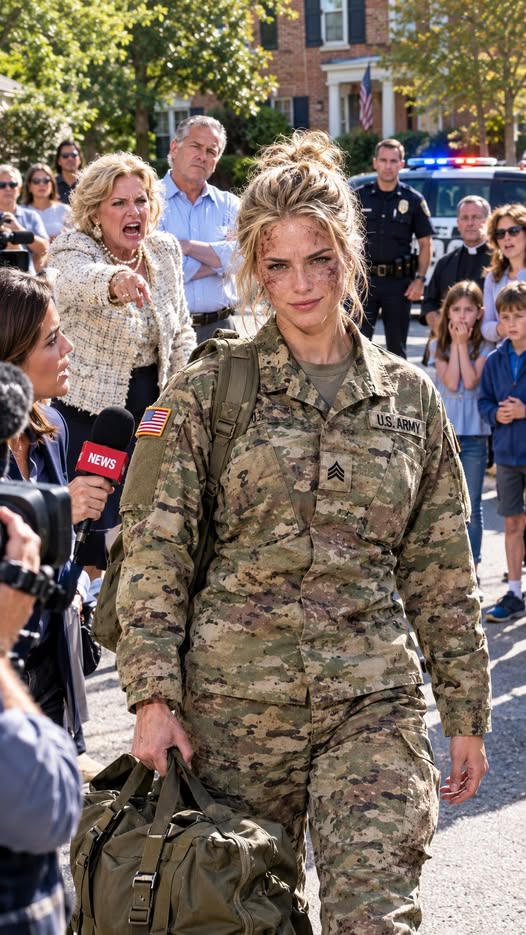
For four excruciating years, the entirety of my hometown believed I was rotting in a state penitentiary.
It wasn’t a fleeting rumor whispered over backyard fences. It wasn’t a mild suspicion. It was accepted as empirical fact, digested by the community the way a town absorbs a truth when a grieving mother delivers it in precisely the right pitch, in all the right sanctuaries, until it transcends gossip and simply becomes the architecture of reality.
My mother, Diane Parker, had weaponized her sorrow. She deployed it in the fluorescent-lit aisles of the local grocery store, in the hushed, carpeted hallways of our church, and during somber prayer circles. She was a master of the meticulously calibrated tragedy. She would press a lace-edged tissue beneath one eye, letting a fragile silence stretch—a pause designed to harvest sympathy while expertly suffocating any follow-up questions.
“Emily made terrible choices,” Diane would whisper, her voice trembling like a plucked wire.
People rarely pushed for details. I learned the hard way that grief, when performed with enough polite devastation, turns decent people into absolute cowards. They would nod solemnly, pivot the conversation, and walk away feeling profoundly virtuous for not prying. In their desperate need to be polite, they handed my mother the exact, unquestioning silence she required to bury me alive.
But I was not in prison.
I was in uniform.
I had enlisted in the United States Army, processed through the grueling machinery of Fort Carson, and spent the vast majority of the next four years deployed overseas. I was breathing in the scorched, copper-tasting dust of Kuwait and Afghanistan, pulling shifts so exhausting that my bones felt hollowed out. And yet, whenever the mail tent unzipped its canvas flaps, I sat on a rigid military cot and wrote letters home. I wrote while the desert heat felt as if it were actively peeling the skin from my knuckles.
I wrote to my mother first. When the silence stretched, I wrote to my father, Robert. When the void swallowed those too, I wrote to both of them simultaneously, propelled by the naive, desperate delusion that families could always be salvaged if you just found the right combination of ink and vulnerability.
The first letter came back two months later.
Slashed across the front, bleeding through the manila paper in violent crimson ink, was a single stamped word: REFUSED.
The second envelope returned in identical condition. Then the third. Then the sixth.
It was after that sixth letter that Mr. Arthur Greer stopped pretending my absence was a standard domestic dispute. Mr. Greer had sorted the mail in our town for thirty-one years. He had watched me evolve from a solemn, quiet kid dragging scuffed sneakers across the pavement into a woman with a regulation haircut and the rigid posture of a soldier. He possessed an innate understanding of the toxic undercurrents of local families—knowledge he kept locked behind his teeth because he was a professional.
But six violently refused letters from an active-duty combat zone was a threshold he refused to cross.
He didn’t throw them in the dead-letter bin. He hoarded them. He meticulously logged the APO postmarks. He forwarded whatever he could legally reroute through my unit’s chaplain office. He wasn’t a flamboyant hero; he was just a man who waved at stray dogs and remembered to tuck packages under the porch awning when it rained. But Mr. Greer understood a fundamental truth about human deception: every lie leaves a paper trail, provided someone is patient enough to follow it.
He became the sole keeper of my ghost. He was the only civilian in my hometown who knew I hadn’t vanished into the penal system. I had vanished into service.
When my deployment finally ended and I secured my discharge papers, I boarded a Greyhound bus bound for home. I wasn’t expecting a parade. I had been trained by a lifetime of moved goalposts and conditional affection to anticipate, at best, a quiet, tense disappointment.
Yet, I was still human. I allowed myself the dangerous luxury of imagining tiny, fractured miracles. Maybe a porch light left on. Maybe a stiff, awkward embrace. Maybe my mother weeping, finally offering an explanation that made this nightmare make sense.
Because my parents had entirely ignored my digital messages regarding my arrival, Mr. Greer had volunteered to pick me up from the depot.
I climbed into the passenger seat of his rusted Ford pickup, my combat boots heavy against the floorboards. The closer we navigated toward my childhood neighborhood, the more the atmospheric pressure in the cab seemed to violently drop. Mr. Greer’s knuckles were bleeding white against the cracked leather steering wheel.
“Don’t step out of the truck,” he rasped as we turned onto my street.
His voice sounded entirely wrong. It was thin, reedy, and laced with a primal terror that instantly made my throat close.
He slammed his hand onto the master lock switch. The doors clicked shut with a deafening finality. He stared through the windshield toward the pristine white house with the navy-blue shutters.
Your mother just dialed 911, he whispered, his eyes wide. She told dispatch there is an escaped convict trespassing on her lawn.