The Architecture of Boundaries: A Blueprint for Justice
Chapter 1: The Ledger of Blood and Steel
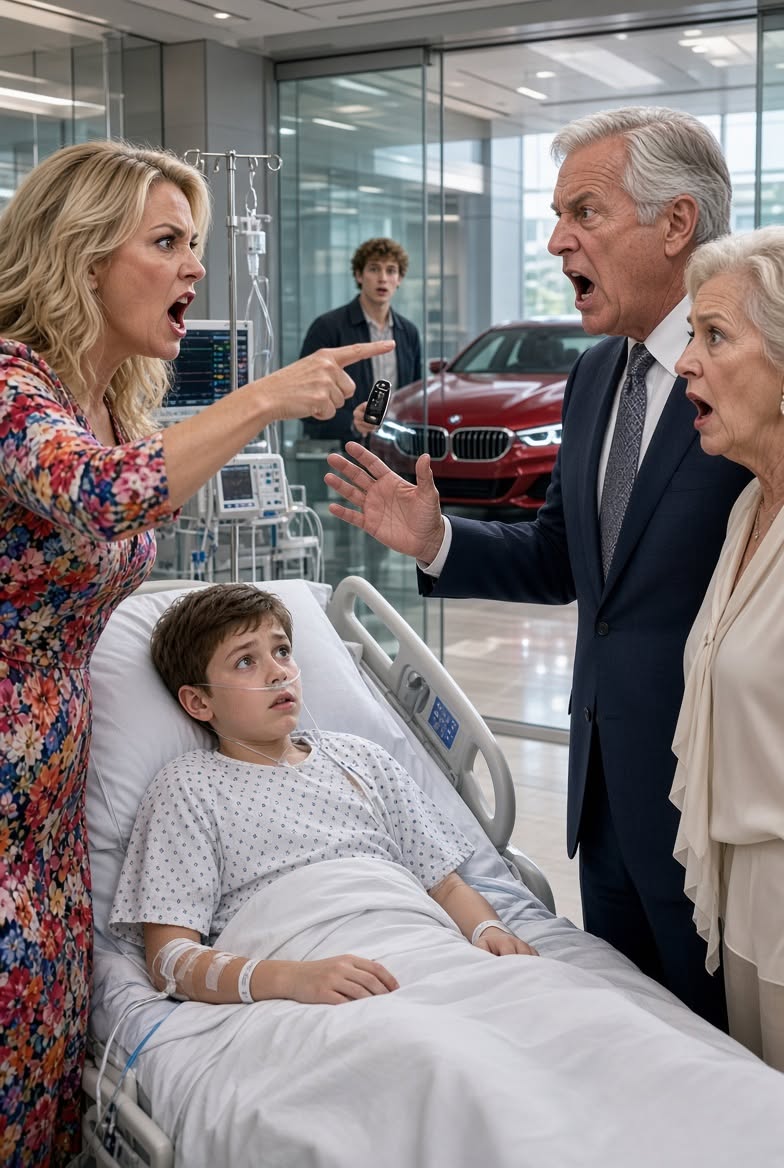
“We cannot afford your son’s medical treatment, Prudence. But we can afford your nephew’s new car.”
My father, Arthur, delivered this sentence with the measured, agonizing patience of a bank manager explaining the concept of compound interest to a particularly slow Golden Retriever. He didn’t shout. He didn’t sneer. He simply stated it as if it were an immutable law of physics, right up there with gravity and the tides.
My son, Oliver, who was nine years old and rapidly losing his childhood to sterile waiting rooms, needed exactly $32,000 for a specialized treatment program. My nephew, Mason, who was twenty-two and possessed the life survival skills of a decorative houseplant, was receiving a $45,000 BMW.
I sat across from my father at my parents’ immaculate, granite-topped kitchen table. I was still encased in my heavy, reflective yellow school bus driver’s uniform, having rushed straight over after completing my chaotic afternoon route. My thermos, scarred from years of rolling around the bus floor, sat near my elbow. Between us lay the epicenter of my anxiety: a thick, expanding file folder gorged with Oliver’s medical estimates, specialist referrals, insurance denial letters, and every scrap of documentation I had spent three weeks aggressively hunting down while surviving on perhaps fourteen minutes of sleep a night.
My father tapped the manila folder with a single, perfectly manicured index finger. “$32,000 is an astronomical sum of money, Prudence. You know that. You cannot possibly expect us to just materialize that kind of cash.”
“I am not expecting you to magically produce it,” I replied, my voice dangerously tight. “I am asking for help. A contribution. A loan. Anything.”
He frowned, his brow furrowing in genuine bewilderment. The concept of altering his financial landscape for my child seemed to short-circuit his brain.
Near the gleaming stainless-steel sink, my mother, Eleanor, was deeply engrossed in a sudden, frantic reorganization of her herbal tea collection. She operated under the lifelong theological assumption that if she meticulously avoided making eye contact during moments of profound family cruelty, the Almighty could not legally hold her accountable as an accessory.
“We have our own expenses,” Arthur continued, shifting his weight. “And, as you know, your brother has expenses.”
Ah, there it was. The foundational text of our family’s holy scripture. My older brother, Calvin, and by divine extension, Calvin’s son, Mason.
Mason had been born twenty-two years prior and was immediately promoted to the family’s Regional Director of Receiving Things. My parents had gleefully funded Mason’s elite private schooling, his orthodontia, his first MacBook, his second MacBook (after a tragic, beer-related incident involving the first), his out-of-state college tuition, his luxury apartment security deposit, and his brief, intensely annoying entrepreneurial photography phase—which abruptly ended the moment he realized professional photography required waking up before noon and carrying heavy equipment.
And now, they were purchasing him a German luxury sedan because, apparently, his four-year-old Honda Accord had devolved into a gross violation of his human rights.
I let my gaze drift toward the humming double-door refrigerator. Pinned beneath a magnetic clip shaped like a sailboat was a glossy printout of the vehicle Mason coveted: a midnight-black BMW 330i. Total cost, factoring in dealer fees and exorbitant taxes: $45,000. Beneath the high-resolution image, Mason had scrawled the word Manifesting in thick blue marker.
It was utterly fascinating how seamlessly the universe’s energy aligned with your desires when your grandfather possessed a high-yield checking account.
My father tracked my line of sight. “It is partially a graduation gift.”
“He hasn’t graduated, Dad.”
“He is on the precipice. He is finding his true direction.”
“He has changed his major four times. He currently has eleven useable credits.”
My father’s jaw tightened, the skin around his mouth growing pale. “He is young, Prudence. He is twenty-two.”
“Twenty-two is an adult,” I countered, feeling a cold knot of disbelief tightening in my stomach. “He called me in a panic last Thursday because he couldn’t figure out how to put air in his tires.”
My mother finally abandoned the chamomile and spun around. “He was simply terrified of overinflating them, Prudence! He is cautious.”
“Mom, he attached the high-pressure air hose to the windshield washer fluid nozzle.”
Eleanor swiftly turned back to her teas, her shoulders rigid.
Arthur exhaled a heavy, beleaguered sigh. “This discussion is not about Mason.”
“The $45,000 vehicle pinned to your refrigerator strongly indicates otherwise,” I said, my voice dropping to a whisper.
“We made a binding commitment,” my father said, squaring his shoulders.
I stared into his eyes, searching for a flicker of paternal warmth, a sliver of protective instinct for his grandson. “My son has a severe medical condition, Dad. His body is attacking itself.”
“And I am deeply sorry about that.”
I will carry the precise cadence of that sentence to my grave. He didn’t scream it. He didn’t sound defensive or enraged. He sounded mildly inconvenienced. He sounded exactly the way one might react upon discovering that a minor plumbing leak had occurred on the same weekend they had planned to go golfing. Oliver’s failing health was an administrative error in the ledger of his perfect life.
I slowly reached across the table and closed the heavy folder. The sound of the cardboard snapping shut echoed like a gunshot in the pristine kitchen.
“Okay,” I breathed.
My father blinked, caught off guard by the sudden cessation of hostilities. “Okay? Just… okay?”
“Yes.”
“I don’t want you leaving this house harboring anger,” he said, attempting to sound magnanimous.
“I am not angry,” I said. And in that fragmented second, it was the absolute truth. The volcanic, blinding rage would detonate later. Right then, I was simply hollowed out. I was experiencing a very specific, terminal brand of exhaustion—the kind that washes over you when you realize you have spent four decades attempting to audition for a role in a family that had cast you as the ‘Useful Background Character’ at birth.
I was forty years old. I piloted a forty-foot metal tube filled with screaming adolescents for a living. I was a single mother. I rose at 4:45 every single morning, assessed the meteorological dread outside my window before my feet hit the freezing linoleum, and drank coffee so acidic it could strip paint. I spent my days transporting fifty-eight feral children whose collective, unified objective seemed to be discovering exactly how many times a human adult could endure the phrase skibidi toilet before their soul physically detached from their body.
I intimately understood responsibility. I knew how to stretch a dollar until it screamed. I knew how to execute impossible, grueling tasks simply because they were mandatory for survival.
And sitting there, looking at the man who helped create me, I knew something else with terrifying clarity: the cavalry was never coming. If my son was going to survive, I had to become the army.
I stood up, grabbing my reflective vest.
“Prudence, honey, it really is going to be fine,” my mother cooed, turning around with a strained, synthetic smile.
Arthur leaned back in his oak chair, looking relieved. “You understand our position, right?”
“Oh, completely,” I murmured, slinging my heavy bag over my shoulder. “For the very first time in my life, I understand perfectly.”
But as I walked out the front door into the crisp evening air, I knew the battle had just begun. And the first casualty was going to be everything I owned.
Would I be able to gather the money before Oliver’s condition worsened beyond the point of no return?