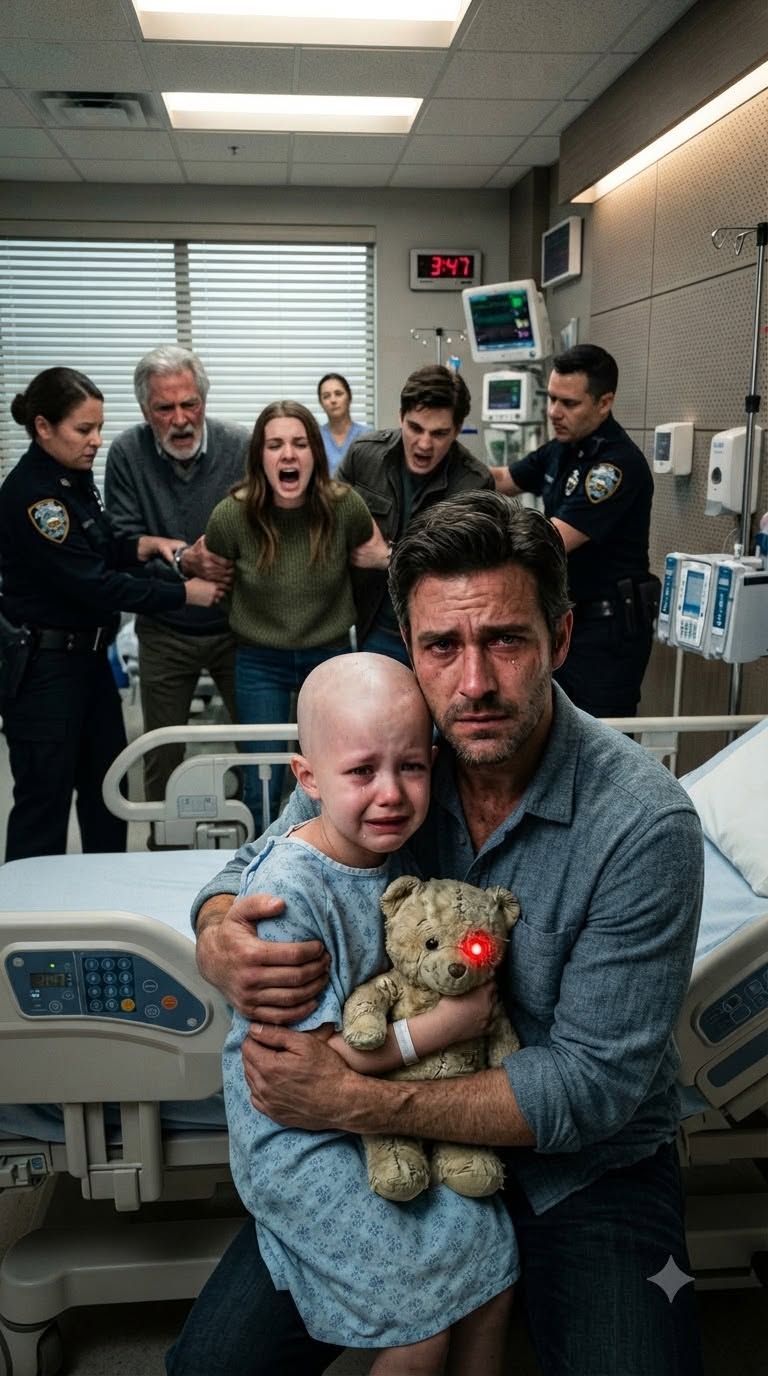
I sat in my daughter’s bedroom with her teddy bear in my hands and a voice recorder resting on my palm like a live grenade.
For several seconds, I could not breathe. The room still smelled like baby shampoo, sterile hospital sanitizer, and the strawberry lotion Chloe used to beg me to rub on her hands before bed. Her little sneakers were still lined up under the window—one pair with purple glitter, one pair with Velcro straps she had outgrown but refused to throw away because she swore they made her run faster.
My daughter was gone.
And inside her old stuffed bear, Barnaby, she had left me a map to the monsters who had been smiling beside her hospital bed.
I pressed pause on the small digital device with a shaking thumb. I wanted to hurl the recorder against the wall. I wanted to scream so loudly the whole apartment building would wake up and understand that my grief had just mutated into something infinitely worse. But Chloe’s last request echoed in my mind, delivered in her weak, breathless little voice.
“Listen to Barnaby, Daddy. But only you.”
So, I listened. Again. This time, I forced myself to hear every single word.
Chloe’s voice came first, small and fragile.
“Today Daddy went to work. Aunt Sarah said I have to be a good girl. Uncle Richard came again. They were talking in the kitchen, but they thought I was sleeping. Barnaby heard them too.”
There was a rustling sound, then a soft cough. I pressed the teddy bear to my chest as if I could somehow protect her retroactively, as if I could reach through the static and carry her out of that suffocating room.
Then Richard’s voice entered, smooth, corporate, and sickeningly impatient.
“As long as the donations keep coming, we stay on schedule. The story works because people love a dying kid. They open their wallets faster when there’s a tragic deadline.”
I closed my eyes. A fault line cracked open right through my chest.
A dying kid.
Not Chloe. Not my baby. Not the little girl who drew lopsided hearts on my lunch napkins and named every stuffed animal like it had a birth certificate.
Sarah, my older sister, answered in a nervous whisper.
“Arthur can’t know about the second account, Richard. He’s going to start asking questions about the medical bills.”
“He won’t,” Richard replied, his tone dripping with condescension. “He’s too busy being devastated. Grief makes people easy to steer. We just keep playing the supportive family.”
My hand tightened around the recorder until my knuckles turned stark white.
Sarah sounded frantic now. “What about the medical papers from Boston? If he sees—”
“They’re hidden,” Richard interrupted. “Everything is handled. He thinks the experimental treatment was a dead end. By the time Arthur figures out anything, the girl will be gone.”
I stopped the recording.
I bent forward over Chloe’s bed and pressed both hands over my mouth. No sound came out at first. Then a broken noise escaped me, not quite a sob and not quite a scream—something animal and helpless that seemed to come from a place in my body I had never known existed.
Chloe had not just died. She had died surrounded by people who had turned her failing heart into a revenue stream.
I was thirty-nine years old, a commercial HVAC technician. I knew how machines worked. I knew warning lights, electrical overloads, wiring diagrams, and the distinct smell of insulation before it caught fire. But I had not known how to read betrayal when it came wearing my own sister’s face, carrying homemade casseroles into a pediatric oncology ward.
Sarah had always been the responsible one. After our parents passed, she was my anchor. When Chloe got sick, Sarah was there with fundraisers, clean laundry, and arms that looked safe when I was too exhausted to stand. I had trusted her with my spare key. My bank statements. My daughter.
That was the part that was currently suffocating me.
I wrapped the recorder in one of Chloe’s old T-shirts and locked it in a metal toolbox under my sink. I sat at the kitchen table until the sun crept over the horizon, staring at the empty chair where my little girl used to eat cereal.
By morning, the paralyzing weight of grief had not left. But a cold, terrifying purpose had arrived to sit beside it. I needed to know exactly what they had done. I picked up my phone to call the one person at the hospital who had always looked at Sarah with quiet suspicion.
But before I could dial, my phone vibrated in my hand. It was an unknown number.
I answered cautiously. “Hello?”
“Arthur,” a hushed, frantic voice said. It was Margaret, Chloe’s hospital social worker. “Listen to me very carefully. Do not talk to your sister. Do not go to the police yet. You need to come to the hospital’s side entrance immediately. There are things about Richard you don’t know.”