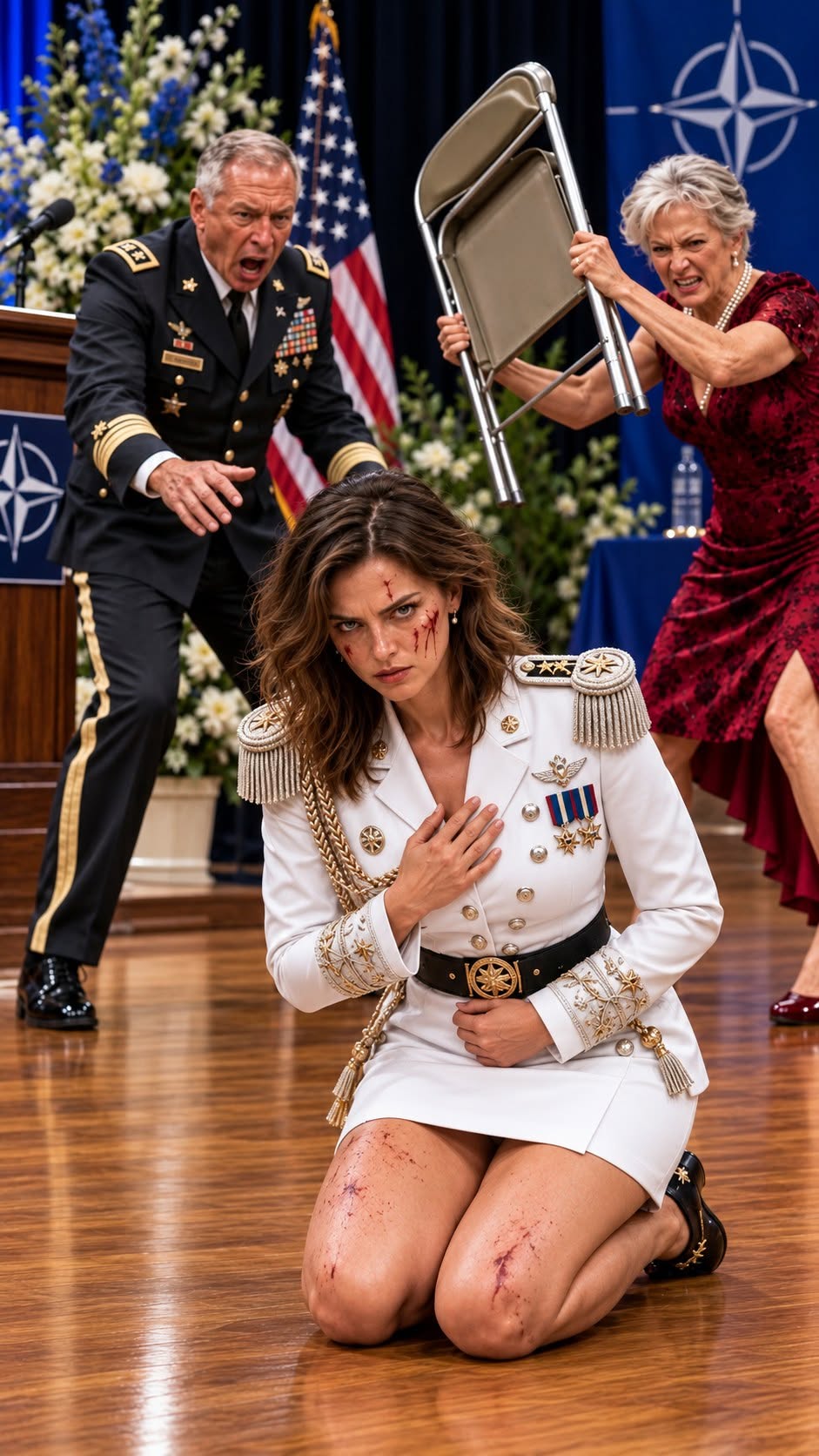
Title: The Silence of the Purple Heart
Chapter 1: The Weight of the Metal
The sound of my arm breaking was louder than the applause.
One second, I was standing beside the stage at my Purple Heart ceremony, the heavy velvet curtains a stark contrast to the sterile, bright lights of the auditorium. I was helping a decorated veteran, a man whose hands shook with the ghosts of a forgotten war, steady himself as he descended the stairs.
The next second, the air left my lungs.
My stepmother, Linda, didn’t just swing a chair. That would have been too simple, too raw for the audience she had carefully cultivated over the years. No, she had walked onto the stage under the guise of the overflowing, proud mother. She had thrown her arms around my stiff, uniformed shoulders, smiling for the military photographers.
But as she pulled me close, her fingernails dug into my collarbone. Her breath was hot and sour against my ear.
“You don’t deserve this,” she hissed, her voice a razor blade wrapped in a whisper. “You’re still a parasite in a uniform.”
Before I could react, her hand darted down. She clamped her fingers over the Purple Heart that had been pinned to my chest just ten minutes earlier and yanked. The heavy pin tore through the fabric of my dress uniform, ripping the ribbon away.
No.
Instinct took over. The same instinct that had kept me alive in the dust and blood of the desert. I reached out to grab her wrist, to stop my medal from falling to the floor.
That was when she grabbed the metal folding chair from the front row of the VIP section. She swung it with a practiced, vicious arc, bringing it crashing down across my extended left arm.
CRACK.
Pain exploded from my wrist all the way to my shoulder, a blinding, white-hot flash that short-circuited my brain. My knees folded beneath me. The medal struck the polished floor, the metallic ping lost in the collective gasp of three hundred people.
I hit the ground hard, pulling my shattered arm against my chest. My vision blurred, tunneling until all I could see were Linda’s sensible, low-heeled shoes stepping back.
Hundreds of people had been applauding only seconds earlier. Officers. Veterans. Local officials. The soldiers of my unit, men and women wearing ribbons that represented nightmares most civilians would never comprehend. Every single one of them was staring.
But I wasn’t watching the crowd. I was watching my father, Richard Bennett.
He was sitting in the front row, mere feet away. He had seen everything. He had watched his wife rip a military honor from his daughter’s chest. He had watched her swing steel against bone.
I waited for the illusion to break. I waited for the man who was supposed to protect me to finally stand up, to shove her aside, to kneel beside me and say, That’s my daughter.
Instead, he bolted from his seat, his face flushed with a dark, furious red. But his anger wasn’t directed at Linda. He stepped over my legs, pointing a trembling finger down at my face.
“Becca, have you lost your mind?!” he roared, his voice echoing off the high ceilings. “Are you trying to humiliate us? Stop making a scene and apologize to your mother right now!”
The pain in my arm surged, deep and sickening, but it was nothing compared to the cold void that opened in my chest. Apologize. I was on the floor with a fractured limb, and he was demanding I apologize for bleeding on his public image.
Beside him, my stepbrother, Aaron, let out a low, mocking chuckle.
In that agonizing moment, I understood a truth I had spent twenty-eight years running from: Linda had never been the only monster in my house. My father hadn’t just tolerated her cruelty; he had weaponized it.
My fingers wouldn’t move. A wave of nausea rolled over me.
Then, the temperature in the room seemed to drop. A shadow fell over me, blocking out the glare of the stage lights. I felt a firm, heavy hand settle on my uninjured right shoulder.
General Robert Hayes.
Three silver stars gleamed on his crisp uniform. A few minutes earlier, he had been smiling warmly as he pinned the medal on me. Now, his face looked like it was carved from granite.
He didn’t look at me. He looked at Linda, who was suddenly trying to hide the chair behind her leg, and then at my father, whose furious shouting died instantly in his throat.
When the General spoke, his voice was quiet, yet it carried the lethal authority of a drone strike.
“Step away from the Captain,” Hayes commanded.
Linda’s mouth opened and closed. “She—she provoked me! She’s always been a liar, General, she—”
“You just assaulted a uniformed service member, and a decorated war hero, at her own commendation ceremony,” Hayes said, his voice dropping an octave. He lifted his chin toward the rear doors. “MPs.”
Two massive Military Police officers stepped into the aisle, their hands resting instinctively on their utility belts, closing the distance in seconds.
My father panicked. He stepped between the MPs and his wife. “General, please, this is a family matter. My daughter and my wife have a very difficult relationship. Becca is… emotionally unstable.”
General Hayes finally turned his full attention to my father. He stared at Richard Bennett with an expression of such profound disgust that my father physically recoiled.
But it wasn’t just disgust in the General’s eyes. It was recognition.
“This stopped being a family matter the second she struck an officer,” Hayes said, his eyes narrowing into predatory slits as he studied my father’s pale face. “And you… I know you.”
My father froze. The color drained from his face completely.
“Richard Bennett,” General Hayes said, the name sounding like a curse in his mouth. “You worked as a civilian communications contractor. Fort Bragg. 1997.”
My father took a step backward, his hands beginning to shake. “I—I don’t know what you’re talking about.”
“Yes, you do,” Hayes whispered, leaning in. “Because I have spent the last eleven years looking for the man who murdered my best intelligence officer.”