The tenor of my granddaughter’s wail mutated the instant my fingers brushed the edge of her diaper. It wasn’t merely louder, nor was it the typical, rhythmic fussing of a tired infant. It was a sharp, jagged shriek that seemed to tear through the quiet of my living room, a sound so laced with sudden agony that the breath caught and died in my own throat.
Less than ten minutes prior, my son, Caleb, and his wife, Megan, had backed their SUV down my driveway, leaving seven-month-old Mia in my care. Now, staring down at her on the changing pad, I realized how disastrously wrong the morning had already gone. She was radiating heat, her skin flushed and tight. She had outright rejected the bottle I offered, and every microscopic adjustment of her posture triggered a fresh, breathless scream.
My hands, usually steady, betrayed a slight tremor. I didn’t waste time looking for a thermometer. I bundled her frail, shuddering form into an old, faded quilt that had once belonged to my late wife, Susan, scooped up her heavy diaper bag, and hurried to my car.
The drive to the emergency room was a blur of frantic prayers and running amber lights. Upon our arrival, the triage nurses moved with frightening efficiency. The attending physician, a stern-faced woman with tired eyes, took one look beneath Mia’s diaper, paused, and looked up at me. Her expression was completely unreadable.
“Mr. Avery,” the doctor murmured, her voice stripped of bedside pleasantries. “This degree of inflammation did not manifest today. Not even close.”
It was a sentence that would ultimately fracture my family.
I am Thomas Avery. Approaching my late sixties, I had spent nearly four decades untangling the labyrinthine webs of bank fraud and regulatory compliance. I lived a quiet, solitary existence on the wooded outskirts of Raleigh. My wife, Susan, had passed away twenty months prior, yet the very architecture of my home still felt meticulously arranged around the gaping void of her absence. Her books remained on the nightstand; her gardening gloves still rested on the porch railing.
That fateful Saturday morning had begun ordinarily enough. Caleb and Megan had arrived exactly at 9:40 AM. I was already standing on the porch, a cup of black coffee in hand, watching Caleb unbuckle Mia from her car seat.
“There’s my little girl,” I had called out, expecting the usual frantic bicycling of her legs and the toothless, gummy smile she reserved just for me.
But that morning, she offered nothing. Her small head lolled against Caleb’s shoulder, her eyes heavy, glassy, and fixed on some distant point. When Megan handed over the floral-print diaper bag, I noticed she wouldn’t meet my gaze.
“She’s been a little fussy today, Tom,” Megan said, her tone casually dismissive as she adjusted her designer sunglasses.
“How little?” I asked, frowning.
“Oh, you know. Standard baby fussy. Nothing major.”
Caleb was already pacing near the rear bumper of their car, checking his watch. “We’re just heading out to do some shopping, Dad. We’ll be back mid-afternoon.”
As Caleb transferred Mia into my waiting arms, the baby let out a low, ragged whimper that vibrated against my collarbone. It didn’t sound right.
“Did she sleep at all last night?” I pressed.
“Not much,” Caleb replied without turning around. “We think she’s teething.”
With that, they were gone, the crunch of tires on gravel the only sound left in their wake. I carried Mia inside, settling into Susan’s old wooden rocking chair by the front window—the same chair Susan had used to rock Caleb thirty years ago. For a fleeting, quiet moment, as Mia’s feverish cheek rested against my chest, the house felt vibrant and occupied once more.
But the peace was shattered within minutes. The whimpering escalated into a relentless, desperate cry. I walked her back and forth across the hardwood floors. I hummed. I offered her a warm bottle, which she weakly swatted away after consuming less than a single ounce. By 10:30 AM, the heat radiating through her onesie was alarming. When I laid her down to check her diaper, that horrific, breathless scream erupted.
The skin beneath her diaper wasn’t just irritated; it was violently inflamed, an angry, blistering crimson that looked raw and agonizing. I secured a clean diaper as loosely as humanly possible, grabbed her things, and fled to the hospital. I made a conscious, deliberate choice in my driveway: I did not call Caleb for permission to save his daughter.
Now, standing under the harsh fluorescent lights of the ER, a pediatric nurse gently tapped my arm. “Sir? Do you happen to have the baby’s insurance card in her bag?”
“Let me check,” I muttered, my mind racing. I unzipped the front pocket of the floral bag. I bypassed the spare wipes, a rolled-up onesie, and a stray pacifier. My fingers grazed the silky inner lining, seeking a plastic card, but instead, they brushed against a crumpled paper sack.
I pulled it out. It was a small, white pharmacy bag.
Printed clearly on the front label was Mia’s full name. Beneath it was a date from exactly eight days prior.
I stared at the top of the bag. The thick, industrial staples securing it were completely intact. Unbroken. Unopened.
The nurse leaned in, her brow furrowed. “Mr. Avery? Are you alright?”
A cold dread coiled in my gut, a sensation I hadn’t felt since my days of uncovering multimillion-dollar corporate embezzlements.
“I’m fine,” I lied smoothly, sliding the unopened medication back into the hidden depths of the bag. I knew, with sickening certainty, that a storm was coming.Bone is a peculiar architecture. For decades, it feels permanent, an unbreakable scaffolding holding up your life. Then, a single, violent fraction of a second rewrites its structural integrity forever.
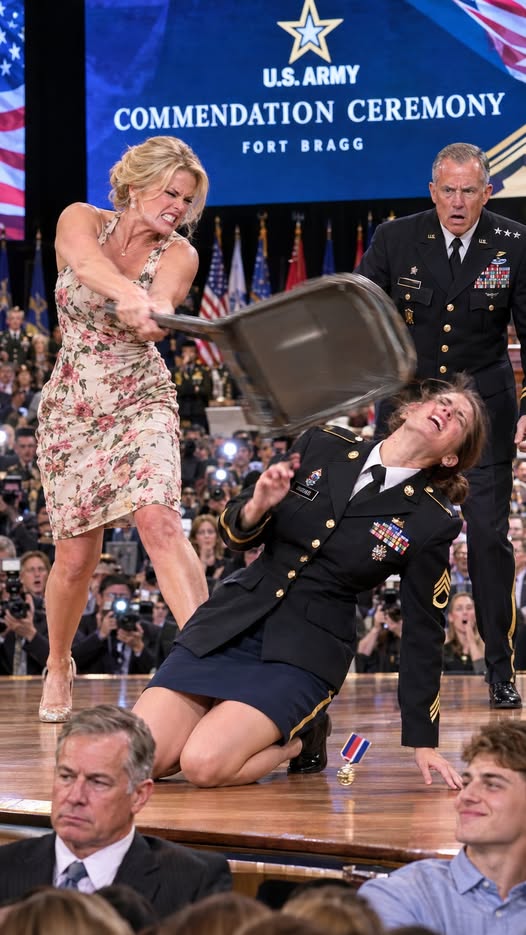
The sickening CRACK of my own radius giving way was infinitely louder than the polite applause filling the Fort Bragg auditorium.
One second, I was standing off to the side of the stage at my own Purple Heart ceremony, subtly offering my right arm to help an elderly, decorated Vietnam veteran steady his balance. The heavy wool of my dress blues felt suffocating under the harsh theatrical lighting, but I was proud. I had survived.
The next second, a cold, heavy metal folding chair came crashing down across my left forearm like an executioner’s blade.
Agony, bright and blindingly white, detonated from my wrist and shot straight into my shoulder socket. The sheer kinetic force of the blow buckled my knees. The gleaming brass-and-purple medal that had been meticulously pinned to my lapel less than ten minutes earlier tore loose, striking the polished oak floorboards with a dull ping as I collapsed.
Looming over me, still gripping the bent steel frame of the chair, was my stepmother, Linda.
Her features were contorted into a terrifying mask of pure, unadulterated vitriol. Her knuckles were white from the strain.
“You’re still nothing but trash in a costume!” she shrieked, her voice scraping against the acoustics of the grand hall.
The entire auditorium, filled with three hundred people, plunged into a suffocating, absolute silence. The applause died in the span of a single heartbeat.
Then, she spat the specific, venomous word she had been throwing at me behind closed doors since my seventeenth birthday.
“You whore.”
Nobody breathed. Only moments prior, this room had been a sea of standing ovations. Mayors, local officials, families, and soldiers I had bled beside were gathered to honor actions most civilians couldn’t begin to fathom. Men and women wearing ribbons that represented unimaginable nightmares were now frozen in shock, their eyes glued to the woman in the floral dress holding a weapon.
But I wasn’t looking at the horrified crowd. I wasn’t even looking at Linda. I was staring desperately at the third row. I was watching my father.
He had seen every frame of it. He had watched his wife stalk down the aisle, lift that steel chair, and swing it hard enough to shatter my skeletal frame. Through the blurring tears of my pain, I waited for him to shoot out of his seat. I waited for him to scream her name, to rush to my side, to finally utter one protective sentence: That is my daughter.
Instead, his shoulders slumped. He slowly lowered his gaze, finding immense fascination in the toe of his polished dress shoes. Beside him, my twenty-two-year-old stepbrother leaned back in his seat and actually let out a low, amused chuckle.
That subtle, mocking sound hurt infinitely worse than the splintered bone tearing through my muscle tissue.
Because in that excruciating moment on the floor, the defining illusion of my entire life evaporated. Linda had never been the sole architect of my misery. My father had simply spent twenty years handing her the blueprints and looking the other way.
The pain in my arm surged again, a deep, nauseating throb that made the room spin. I instinctively pulled the ruined limb tight against my chest, realizing with a cold panic that my fingers would no longer obey my brain. The edges of my vision darkened, threatening a faint.
Then, a massive, unyielding hand settled onto my uninjured right shoulder.
I looked up. Standing above me was General Robert Hayes. Three silver stars gleamed fiercely on his lapels. Just minutes ago, he had been offering me a warm, paternal smile as he fastened the Purple Heart to my chest. Now, all warmth had been vacuumed from his expression, replaced by a terrifying, glacial fury.
He looked at Linda. He looked at the discarded chair. Then, his steel-gray eyes locked directly onto my cowering father in the third row.
“She is not trash,” the General whispered. But in the dead quiet of the room, the words carried the concussive force of an artillery shell.