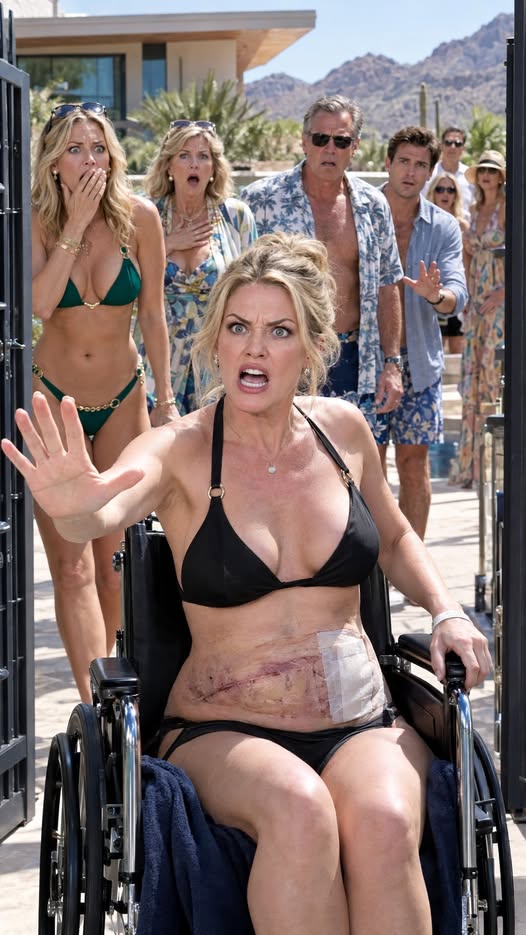
Chapter 1: The Scent of Bleach and Stolen Credit
My name is Karen Holstead. I am thirty-four years old, and exactly eleven days after I nearly slipped into the absolute dark and didn’t wake up, I learned the true currency of my bloodline.
The intensive care unit was a symphony of clinical misery. It smelled of sharp bleach, iodine, and the metallic tang of fear. The rhythmic beep-hiss of the ventilator in the next room had been my only companion for a week. I was fragile, hollowed out by an infection that had ravaged my system, leaving me tethered to monitors and IV poles. My skin was paper-thin, my breathing shallow, and the simple act of lifting my head felt like moving a mountain.
It was in this state of profound vulnerability that my parents marched into my hospital room. They didn’t knock. They rarely did.
My father, Earl Holstead, entered first. He didn’t carry flowers or a card; he carried the heavy, suffocating aura of a man who owned whatever room he stepped into. My mother, Nadine, trailed behind him, her eyes scanning the sterile environment with mild distaste, as if my brush with death was an inconvenient detour on her social calendar.
“We’re coming out on Friday,” Earl announced.
He didn’t ask how I was feeling. He didn’t ask if I was capable of standing, let alone entertaining. He delivered the information with the blunt force of a foreman barking instructions at a dusty job site.
“The whole family,” Nadine chimed in, casually inspecting her manicure. “Twelve people. Nine days at the desert house. I already told everyone we built the place ourselves, so they’re absolutely dying to see it.”
I stared at them, the pulse monitor strapped to my index finger suddenly fluttering, betraying the spike in my heart rate. “I just survived something that nearly took my life,” I rasped, my throat still raw from the intubation tubes they had pulled out just days prior. “I can’t host. You need to postpone this visit.”
Nadine sighed, a sharp, exasperated sound that cut through the hum of the medical machinery. A nurse was actively standing beside my bed, checking the fluid levels in my bags, her eyes widening in disbelief.
“What does your illness have to do with us?” Nadine asked, genuinely perplexed.
From the doorway, a sudden bark of amusement echoed. It was my older sister, Gretchen. She laughed. A second later, Earl chuckled too, a deep, rumbling sound of shared familial delusion.
Before I could process the sheer audacity of the moment, Earl took a step back, raised his smartphone, and snapped a photo. The flash blinded me for a fraction of a second. I didn’t need to see the screen to know what he had captured: his smiling face in the foreground, my exhausted, gray complexion in the background, and the glaring plastic of my hospital admission bracelet perfectly framed in the shot. It was a prop. I was a prop.
I went utterly quiet. My jaw locked. This was not an isolated incident; it was the crescendo of a lifetime of conditioning. My family had always treated my home, my resources, and my energy as if they were communal property held in a trust they controlled. For years, they had shown up hours early to gatherings, stayed days late, invited unvetted extra guests, and left me to scrub the floors and pay the catering bills afterward. Every objection I had ever dared to voice was swiftly crushed beneath the unbearable weight of a single word: Family.
They weren’t confused about my boundaries. They were acutely aware of exactly where I stood. They simply expected those boundaries to evaporate like desert mist the moment they became inconvenient for their narrative.
I looked at the three of them—my father admiring his photo, my mother adjusting her designer scarf, my sister smirking from the threshold. The anger that ignited in my chest wasn’t a sudden explosion; it was a slow, steady pour of liquid iron.
“Then come,” I whispered.
My voice was weak, but the vow beneath it was indestructible. By Friday, twelve people would arrive at my heavy iron gates expecting nine free days of luxury in the Arizona sun. My mother would be the first one to step onto the gravel. She would look at what was waiting in that driveway, and she would scream. And for the very first time in my thirty-four years of life, I was not going to be the one on my hands and knees cleaning up a catastrophe my family had engineered.
Because if someone treated your home like a free, all-inclusive resort while aggressively ignoring the fact that you had just been fighting for your last breath, would you still open the gates? Or would you finally let them discover that blood does not guarantee unlimited access?
My family was packing their resort wear, completely blind to the fortress I was about to build.
I just needed to get out of this bed.