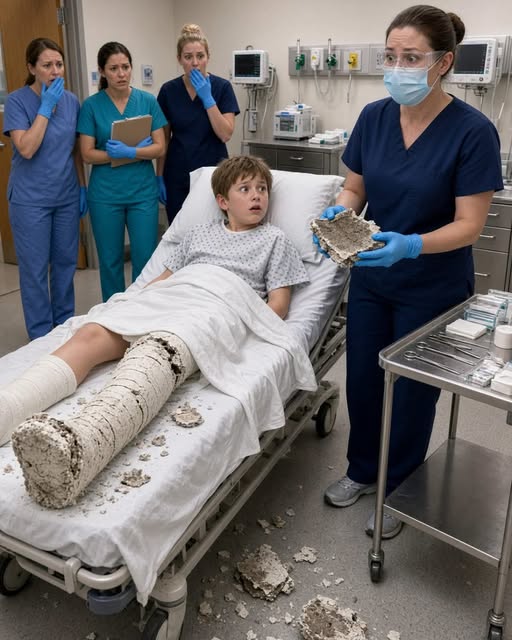
The boy’s whisper changed the room more completely than any alarm could have.
Martha had been shouting over everyone only seconds earlier. Now she went silent.
I moved closer to the bed and kept my voice low.
“What weren’t you supposed to tell me?”
His eyes shifted toward his mother.
That was enough.
I looked at security. “Take Mrs. Harris outside. She can stay in the department, but she cannot remain in this room.”
Martha found her voice again.
“Absolutely not. He’s eight years old. I’m his mother.”
“And right now he’s my patient.”
The guards escorted her into the hallway while she demanded an attorney, the hospital administrator, and my full name.
The door closed.
For the first time since the stretcher arrived, the boy’s shoulders loosened slightly.
“What’s your name?” I asked.
“Evan.”
“Evan, you’re not in trouble. I need to know what happened to your arm so we can help you.”
His lower lip trembled.
“Mom did the cast.”
Clara stopped beside the medication cart.
Marcus looked at me as if he thought he had misheard.
“At home?” I asked.
Evan nodded.
“In the kitchen.”
The answer explained the missing orthopedic record, but it created a worse question.
Why would a mother put a fiberglass cast on her own child’s broken arm instead of taking him to a hospital?
Clara glanced toward the exposed arm and said quietly, “Maybe it was never fractured. Maybe she was trying to make it look like one.”
She was wrong about that one thing.
The portable X-ray showed a real fracture of both forearm bones, already beginning to heal in poor alignment. Whatever had happened to Evan, he had genuinely broken his arm.
The cast had simply never been medical.
Underneath it, the damage was worse than anything visible from the outside.
The skin around his wrist and forearm had broken down beneath soaked padding. Several areas had turned gray-black. Infection had tracked through the tissue, and the swelling had compressed circulation into his hand for far too long.
The maggots were horrifying, but they were not the thing trying to kill him.
The infection was.
His blood pressure fell again.
“Sarah,” Marcus said, watching the monitor.
“I see it.”
We pushed more fluids and started medication to support his blood pressure while surgery, infectious disease, pediatrics, and the intensive care team converged on Trauma Room 2.
For a few minutes, Evan seemed to fade beneath all the activity.
I leaned over him.
“Stay with me, buddy.”
His eyes opened.
“Am I going to get in trouble for telling?”
That question hurt more than the sight of his arm.
“No,” I said. “You did exactly what you were supposed to do.”
He swallowed.
“Mom said if I told, Dad would take me away.”
There it was.
Not confusion.
Not a misunderstanding about a doctor’s instructions.
A secret.
I asked one question at a time.
Evan said he had fallen from the railing of their back porch about five weeks earlier. His mother knew immediately that something was wrong because his arm bent strangely and he could barely move his fingers.
He begged to go to the hospital.
She told him they couldn’t.
That night, a box arrived from something she called a medical supply company. The next evening she wrapped his arm herself while watching instructions on her tablet.
“Did anybody else see it?”
He shook his head.
“She said Daddy was trying to say she didn’t take care of me.”
I felt my stomach tighten.
“Did the cast start hurting right away?”
“It was tight.”
“Did you tell her?”
“Every day.”
He said it simply.
Every day.
Marcus turned away for a moment and rubbed both hands over his face. On the way back to the monitor, he knocked an unopened roll of tape from the counter, picked it up, and set it beside the sink.
I kept my attention on Evan.
“When did it start smelling bad?”
“A long time ago.”
“Did your mom notice?”
He nodded.
“She sprayed stuff on my sleeve.”
The operating-room team arrived before I could ask more.
We had enough.
The rest could wait until Evan was alive to tell it.
As they prepared to take him upstairs, Martha saw the movement through the doorway and pushed away from the security officer.
“Where are you taking him?”
I stepped into the hall.
“Emergency surgery.”
Her face changed.
“Surgery? No. I don’t consent to that.”
“His condition is life-threatening. We’re treating the emergency.”
“You don’t understand what this will do to my family.”
I looked at her for a second.
“I’m concerned with what has already been done to your son.”
She stared at me.
Then she said something I have never forgotten.
“His father will use this against me.”
Not: Will he survive?
Not: Can you save his hand?
His father will use this against me.
A hospital social worker named Denise arrived just as Evan disappeared through the double doors toward surgery.
Child protection had already been notified. Hospital security preserved the removed cast, its padding, and photographs of the arm according to our procedures.
Martha refused to answer Denise’s questions.
She did, however, insist that Evan’s father was dangerous, manipulative, and obsessed with taking custody from her.
We had no way to know whether any of that was true.
So Denise made calls.
Less than an hour later, she came back carrying a thin folder.
“You need to see this.”
Evan’s school nurse had documented three contacts with Martha during the previous month.
First, Evan had complained that the cast felt too tight.
Then classmates noticed an odor.
Finally, the nurse saw discoloration around his fingertips and told Martha that Evan needed immediate medical evaluation before returning to school.
The following morning, Martha withdrew him.
She told the school she would be homeschooling him until his arm healed.
That was the second moment the story changed.
Martha had not merely failed to recognize the danger.
According to the school’s records, someone had pointed directly at the danger and told her to seek medical care.
She removed the person who could see it instead.
When Denise confronted her with the nurse’s notes, Martha said the school had exaggerated everything.
Then she demanded to know who had authorized the release of the records.
Upstairs, Evan was still in surgery.
The orthopedic surgeon called me after the first debridement.
His voice was careful, which usually meant the news was bad.
They had removed infected and dead tissue and relieved the pressure around the arm, but the infection was extensive. The fracture itself was unstable and contaminated. Vascular specialists had restored better flow into the hand, but nobody could promise how much function would remain.
“We’re trying to save the limb,” he said. “Right now, saving the child comes first.”
That sentence stayed with me.
Around midnight, Evan’s father arrived.
Daniel Harris looked nothing like the monster Martha had described.
That did not prove anything. Emergency departments teach you quickly that appearances are useless evidence.
He came in wearing work pants and a wrinkled button-down shirt, breathing hard as if he had run from the parking garage.
“Where is my son?”
Denise brought him into a consultation room before anyone allowed him near the ICU.
I joined them because I wanted to hear his account myself.
Daniel took out his phone.
For five weeks, he said, Martha had canceled every scheduled visit.
At first she claimed Evan had a contagious respiratory infection.
Then she said the orthopedic surgeon wanted him resting.
Daniel had asked for the doctor’s name.
She refused to give it.
He had requested a welfare check twice and had filed an emergency motion through his attorney three days earlier.
Then he showed us a photograph Martha had sent him.
Evan sat on a couch smiling weakly, his cast hidden beneath a long sweatshirt sleeve.
The message underneath said he was recovering normally.
Daniel’s hands began shaking.
“I believed the picture,” he said. “I knew something was wrong, but I believed the picture.”
That was the one step away from the medical crisis I allowed myself that night, because it answered the question Evan had been carrying alone.
He had not been forgotten.
Someone had been trying to reach him.
Someone had simply been kept outside the door.
Then the ICU called.
Evan was crashing.
His blood pressure had dropped despite medication, his oxygen level was falling, and laboratory results showed the infection was driving severe organ dysfunction.
By the time I reached his room, the pediatric intensive care team surrounded the bed.
For one terrible stretch of minutes, every earlier question about custody, school records, homemade casts, and parental explanations became irrelevant.
Evan stopped breathing adequately on his own.
They placed him on a ventilator.
His blood pressure dropped again.
Daniel stood behind the glass with Denise beside him, both hands pressed against his mouth.
Martha was farther down the hallway with security.
She had stopped demanding to leave.
The next twenty-four hours were the lowest point.
Evan returned to surgery twice. Doctors removed more infected tissue and washed the wound repeatedly. Cultures guided the antibiotics. His kidneys showed signs of stress. Surgeons warned Daniel that if circulation failed again or the infection could not be controlled, amputation might still be necessary.
Nobody promised him a miracle.
On the second afternoon, the numbers finally began moving in the right direction.
The medication supporting Evan’s blood pressure came down.
Then one of the surgeons found a pulse in the wrist without needing a Doppler machine.
The hand remained badly injured, but warm color had returned to fingers that had been blue when he arrived.
I did not celebrate yet.
I had learned that lesson years earlier.
But I allowed myself to breathe.
The investigation continued while Evan slept.
The police obtained evidence through the proper process, and what emerged removed the last plausible claim that Martha had simply panicked once and made a terrible mistake.
Purchase records showed that a home fiberglass casting kit had been ordered the night Evan broke his arm.
Messages recovered during the investigation documented complaints from Evan about worsening pain and numbness.
The school nurse’s warning was there too.
Most damaging was a message Martha herself had sent to a relative after withdrawing Evan from school.
She wrote that she could not take him to an emergency room because his father already had a custody case pending and “one more report” would destroy her position.
That was her explanation in her own words.
She knew medical attention could create a record.
She chose avoiding that record over getting treatment for her son.
When detectives interviewed her formally, she continued to say she had only been protecting Evan from a bitter custody fight. She said she believed the fracture would heal and that she had planned to seek care if his fever became serious.
The fever was 103.8 when she finally brought him in.
By then he was in septic shock.
Martha was arrested before Evan left intensive care and later faced criminal charges related to the treatment and neglect of her son. The custody court placed Evan with his father while the criminal and child-protection cases moved forward.
I never followed every hearing.
Doctors are witnesses to beginnings more often than endings.
But I followed Evan.
After several surgeries, skin grafting, weeks of antibiotics, and months of therapy, his surgeons saved his arm and hand.
They could not erase what had happened.
He lost some movement in two fingers, and his forearm carried scars that would grow with him. His fracture needed additional correction because it had begun healing in the wrong position.
But he could hold a pencil.
He could pick up a cup.
Eventually, he could squeeze his father’s hand.
The first time I saw him awake after the ventilator was removed, he remembered me before I expected him to.
“You’re the saw doctor,” he whispered.
I laughed so suddenly that Clara had to turn away because she was crying.
“That’s me.”
Evan looked around the room.
“Is Mom here?”
I did not lie to him.
“No.”
He stared at the blanket for a few seconds.
Then he asked, “Is Dad?”
Daniel had been sitting ten feet away in the family room.
When we brought him in, he stopped at the doorway instead of rushing toward the bed.
“Hey, buddy.”
Evan watched him cautiously.
Daniel waited.
Finally Evan lifted his uninjured hand.
His father crossed the room and took it.
That was all.
No speech.
No promise that everything was suddenly fixed.
Just a father holding the hand his son offered him.
Months later, I was finishing a night shift when Clara appeared outside my office smiling.
“You have a visitor.”
Evan walked in beside Daniel.
He looked taller.
Healthier.
Louder, too.
His arm was protected by a clean blue removable brace while the bone completed its long recovery.
Almost every visible inch had been covered with signatures and crooked drawings from children at his new school.
For a moment I could not speak.
The first cast I had seen on that child had been black with dirt, soaked through, hiding an injury nobody was supposed to see.
This one was bright blue.
It had been fitted by people whose names were in his medical chart.
His father knew when his next appointment was.
His teachers knew what had happened.
His therapists knew what movements hurt.
Nothing about his care depended on secrecy anymore.
Evan caught me staring at the brace.
“Want to sign it?”
He held out a marker.
I took it.
There were dozens of messages already squeezed together, so I found a small empty space near his wrist.
I did not write anything profound.
I wrote my name.
Then I handed the marker back.
Evan examined the signature and smiled.
For eight years I had thought the hardest part of emergency medicine was knowing what to do when the human body began failing in front of you.
Trauma Room 2 taught me something harder.
Sometimes the emergency has been happening quietly for weeks, hidden beneath a sleeve, a polished explanation, and an adult who keeps insisting there is nothing to see.
The smell exposed what Martha had tried to keep covered.
But the moment I remember most is not what fell from that filthy cast.
It is the second cast months later—the clean blue one covered in names—because every signature meant somebody could see Evan now.
And nobody was asking him to keep quiet.