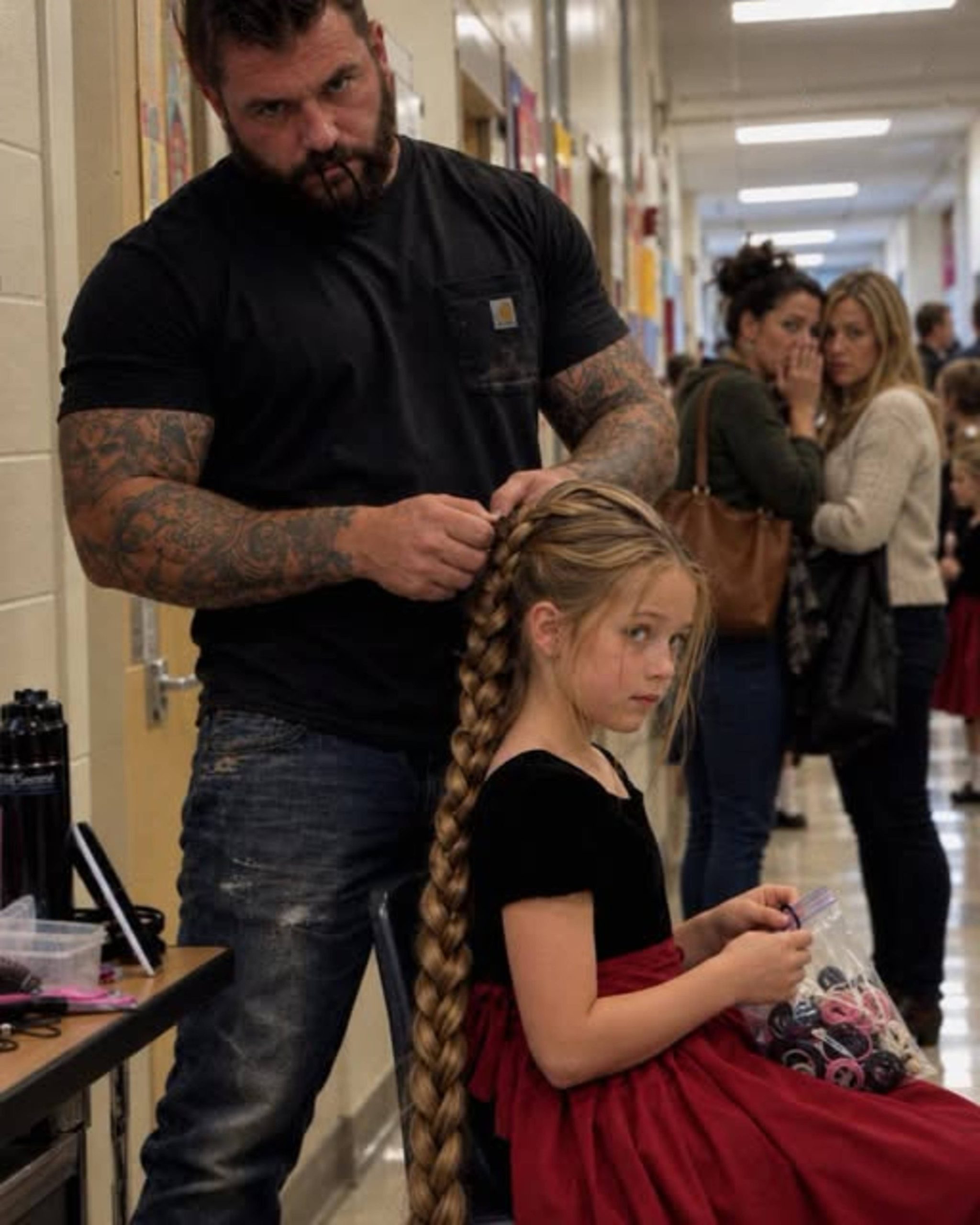
Goldie’s hair reached past her knees, and everyone could see how much work it was for her to carry.
We thought her father was refusing to cut it for his own reasons.
Some people assumed he was overly strict. Others thought he was simply attached to the hair. A few parents quietly wondered whether he was trying to make Goldie stand out.
But the truth was heavier than any of us expected.
The first time I saw Goldie’s braid catch on the back of her chair, I thought she was going to fall.
She stood too quickly after an event, her braid pulled tight, and her head jerked backward.
She grabbed the front seat with one hand and the thick rope of hair with the other.
A few kids laughed before they realized she was embarrassed.
Then the room went quiet.
Goldie carefully freed the braid and lowered herself back into the chair.
She didn’t cry.
She didn’t complain.
She just looked down.
My daughter was in the same class as Goldie, so I’d seen her hair plenty of times.
It went past her knees when it was loose.
Even braided, it hung so low that she had to think about it every time she sat down.
Everybody talked about how beautiful it was.
And everybody talked about her father.
He showed up early to school events.
He would bring a small folding mirror from his car, sit Goldie on a bench in the hallway, and do her hair himself.
Not badly, either.
French braids with ribbons.
Pins arranged so neatly that they looked professionally done.
He could separate sections with his fingers without even looking in the mirror.
The other mothers loved watching him.
“Look at that dad,” someone would say.
“My husband can’t even make a ponytail.”
“That girl is lucky.”
And maybe she was.
But every time I watched him braid that enormous length of hair, I found myself looking at Goldie instead.
I saw her holding the braid in one hand while running so she wouldn’t step on it.
I saw her gather it into her fist while eating so she could lean toward her lunch tray.
I saw her turn sideways before sitting down.
I saw her check the floor before standing up.
She had learned to live around her hair.
Once, when she got up from a table, another child had accidentally trapped the end beneath a backpack.
Goldie didn’t complain.
She simply stopped.
The child didn’t notice.
Goldie stood there silently until I saw what had happened.
“Hold on, sweetheart.”
I moved the backpack.
Her braid slid free.
“Thank you,” she whispered.
Then she walked away.
I watched her for a moment.
There was something about the way she said it that stayed with me.
Not annoyance.
Not embarrassment.
Resignation.
Like this was simply another thing she had learned to endure.
A few weeks later, I heard two mothers talking near the school entrance.
“Her father won’t let her cut it.”
“Seriously?”
“Apparently.”
“Why?”
“No idea.”
They lowered their voices when they saw me.
I didn’t ask.
But the rumor spread.
Goldie’s father wouldn’t allow her to cut her hair.
Some people thought it was cultural.
Others thought it was religious.
Some assumed he had made some strange promise.
And, inevitably, there were people who judged him.
“She’s old enough to decide for herself,” one mother said.
“That poor child,” another whispered.
I wasn’t comfortable with the gossip.
We didn’t know the family.
We didn’t know what happened at home.
We certainly didn’t know why Goldie’s hair was so important.
So I tried not to make assumptions.
But I couldn’t stop noticing things.
At pickup, Goldie’s father always checked the braid before she got into the car.
He would gently run his fingers down it, making sure no strands had come loose.
Sometimes he would redo part of it.
And Goldie never seemed angry with him.
She simply stood still.
One afternoon, I saw something different.
Goldie’s father was brushing her hair beside the school.
He stopped halfway through.
His hand froze.
Goldie turned around.
“What?”
He didn’t answer.
He simply looked at her hair.
Then he looked at her face.
For a second, his expression changed.
It wasn’t pride.
It wasn’t stubbornness.
It was sadness.
Deep sadness.
Goldie reached for his hand.
“Dad?”
“I’m okay.”
He wasn’t.
I knew it immediately.
But I also knew it wasn’t my place to ask.
A few days later, Goldie’s father came to the school office.
He spoke quietly with the principal.
I happened to be there because I was dropping off paperwork.
I wasn’t trying to listen.
But I heard one sentence.
“Please don’t ask her about cutting it.”
The principal nodded.
“Of course.”
I looked at Goldie’s father.
He noticed me.
For a second, neither of us spoke.
Then he gave me a polite smile and left.
That was when I realized there was something behind the hair.
Something bigger than vanity.
Something bigger than control.
Months passed.
Goldie continued coming to school with her braid.
Winter came.
Then spring.
Her hair seemed even longer.
One morning, I found her sitting alone on a bench.
Her braid was spread across the seat beside her.
She was holding a pair of scissors.
My heart stopped.
“Goldie?”
She looked up.
She wasn’t cutting it.
She was just holding the scissors.
“I’m not going to do it,” she said quickly.
“Do what?”
“Cut it.”
I sat beside her.
“Why would you?”
She looked down.
“My dad says I have to wait.”
“Wait for what?”
She didn’t answer.
I didn’t push.
Then she quietly said, “Until he says it’s okay.”
Something about the way she said it made me ask the question I had been avoiding.
“Goldie, does your dad make you keep your hair long?”
She looked at me.
“No.”
The answer came immediately.
Then she added, “He asks me to.”
That distinction stayed with me.
“Why?”
She looked toward the school doors.
“Because my mom wanted it.”
I felt my chest tighten.
Her mother.
I had met her once, years earlier, but I didn’t know her well.
I had heard that she had been sick.
I hadn’t known much more.
Goldie touched the end of her braid.
“Mom grew her hair really long.”
She swallowed.
“She used to say she wanted to donate it someday.”
I waited.
“But she got sick before she could.”
Goldie’s eyes filled with tears.
“My dad promised her he wouldn’t cut mine until I was ready.”
I suddenly understood why her father treated that braid like something fragile.
It wasn’t about control.
It wasn’t about making his daughter different.
It wasn’t even really about the hair.
It was about a promise.
A promise made to a woman who wasn’t there anymore.
Goldie continued.
“Mom said when I was older, I could cut it and give it to another kid.”
“Another kid?”
She nodded.
“She said someone who lost their hair because they were sick might need it more than I did.”
I looked at that enormous braid.
Suddenly, it didn’t look excessive anymore.
It looked like time.
Every inch represented another month her father had kept his promise.
Another morning Goldie had gotten ready for school.
Another birthday.
Another Christmas.
Another year without her mother.
I understood why everyone had misunderstood.
From the outside, all we had seen was a father insisting his daughter keep extraordinarily long hair.
We had judged what we could see because we didn’t know what was underneath it.
And perhaps the hardest part was realizing that Goldie hadn’t been carrying the hair alone.
Her father had been carrying the reason for it.
A few weeks later, Goldie came to school with her hair loose.
She walked into the classroom slowly.
Her hair flowed almost to her ankles.
The room became quiet.
She stood at the front and smiled nervously.
Then she told us what she was going to do.
She was finally ready.
Her father had kept his promise.
She was going to cut her hair.
Not because she hated it.
Not because someone had forced her.
But because she had decided that the promise could finally change hands.
The hair that had once belonged to a memory was going to become something useful to someone still fighting for a future.
When the day came, her father stood beside her.
He held her hand while the first section was cut.
For the first time, I saw him cry.
Goldie cried too.
But she was smiling.
And when the braid finally came away, she looked almost startled by how light her head felt.
She touched the back of her neck.
Then she laughed.
Her father laughed through his tears.
Everyone around them applauded.
Later, I watched Goldie walk across the schoolyard.
Her hair was short now.
She didn’t have to hold it while she ran.
She didn’t have to check the chair before sitting down.
She didn’t have to gather it around her plate at lunchtime.
She could simply move.
And as she ran toward my daughter, I realized how easily we had misunderstood the story.
We had seen a girl carrying hair.
We hadn’t seen a daughter carrying her mother’s last wish.
We had seen a father refusing to let go.
We hadn’t seen a man trying to keep a promise.
And sometimes, the things that look strange from the outside make perfect sense when you finally learn the story underneath them.