I looked at the handwritten note again.
Three lines.
That was all.
But the third line made my stomach tighten.
Claire — 8:00 a.m.
Blue tablet after breakfast.
Do NOT let Ethan handle the medication.
I stared at the words until they blurred.
Claire was my wife.
Marlene was her mother.
And I had never seen that instruction before.
“What does this mean?”
Marlene folded her arms.
“It means exactly what it says.”
“Why would you write that?”
“Because Claire has been confused lately.”
“That isn’t what I asked.”
Behind me, Lily made a small sound.
Marlene glanced toward her.
It happened fast, but I saw it.
Not anger.
Warning.
Lily immediately lowered her eyes.
I stepped sideways, blocking Marlene’s view of her.
“Look at me,” I said.
Marlene did.
“Why did you write that I shouldn’t handle my wife’s medication?”
Her expression hardened.
“Because you don’t know everything about your wife.”
“Then tell me.”
“This is not a conversation we should have in front of a child.”
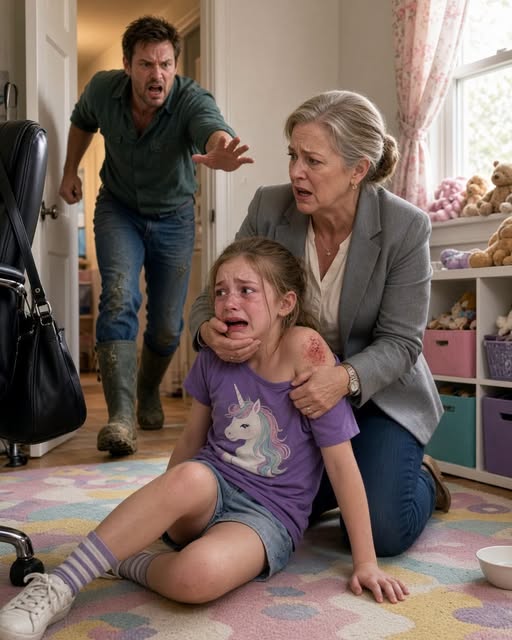
“You seemed comfortable having conversations with her when your hand was over her mouth.”
Marlene’s lips tightened.
I pulled out my phone.
That changed her.
“What are you doing?”
“Calling Claire.”
“She’s sleeping.”
I froze.
“How do you know that?”
Marlene blinked.
Only once.
But it was enough.
Claire had left the house that morning saying she was going to an urgent care clinic because she had been dizzy and nauseated for several days. She had texted me around ten thirty saying the doctor wanted to observe her for a little while.
At eleven forty-eight, she sent another message.
Mom is driving me home. I’m exhausted. Going to sleep when I get there.
I had assumed she meant our house.
But Claire wasn’t home.
I had checked upstairs twenty minutes before I started mowing.
Her car wasn’t in the driveway either.
“Where is my wife?”
Marlene exhaled sharply.
“At my house.”
“Why?”
“Because she needed rest.”
“Why didn’t she come home?”
“She didn’t want Lily bothering her.”
Behind me, my daughter whispered, “That’s not true.”
Marlene’s head snapped toward her.
I raised my hand.
“Don’t look at her.”
“Ethan, this is ridiculous.”
“Lily,” I said without turning around, “what isn’t true?”
Silence.
I could hear the mower still running outside.
The engine coughed unevenly where I had abandoned it in the grass.
Then Lily spoke.
“Mom wanted to come home.”
Marlene stepped forward.
“That is enough.”
I moved between them.
“No. It isn’t.”
Lily wiped her face.
“Grandma told her she couldn’t.”
“When?”
“At the hospital.”
Marlene laughed.
Actually laughed.
“She wasn’t even there.”
Lily’s eyes widened.
I turned toward Marlene.
“You just said she misunderstood a private conversation.”
Marlene’s face changed.
She realized it too late.
I looked back at Lily.
“Were you at the hospital?”
She nodded.
“Grandma picked me up from Aunt Rachel’s house.”
I hadn’t known that either.
Claire and I had arranged for Lily to spend the morning with my sister Rachel because I had yard work to finish and Claire had her appointment.
Rachel had texted me shortly before noon.
Marlene grabbed Lily. Said Claire asked for her.
At the time, it had seemed normal.
Now nothing did.
“What happened at the hospital?”
Lily squeezed her knees tighter.
“Grandma told me not to tell.”
“She can’t stop you now.”
Lily looked toward the purse.
“She gave Mom something.”
The room seemed to shrink around me.
“What?”
“I don’t know.”
“A pill?”
She nodded.
Marlene stepped forward again.
“That was prescribed medication.”
I held up the paper.
“Then why hide this?”
“I didn’t hide anything.”
“It was folded inside your purse.”
“That’s where I keep paperwork.”
“Then why were you pinning Lily to the floor?”
“I already told you—”
“No.”
My voice came out louder than I intended.
Lily flinched.
I immediately lowered it.
“No more explanations from you.”
I dialed Claire.
It rang.
Once.
Twice.
Three times.
No answer.
I called again.
Nothing.
Then I called my mother-in-law’s house phone.
We heard a ringtone.
Not through the phone.
Inside the room.
All three of us looked toward the purse.
Marlene’s face went white.
I reached inside.
Under a zippered compartment, I found another phone.
Claire’s phone.
My wife’s phone was inside her mother’s purse.
For several seconds, nobody spoke.
I held it up.
“Explain this.”
Marlene stared at me.
“She asked me to hold it.”
“Why?”
“She was tired.”
“You brought her phone here?”
“She didn’t need it.”
“You left my wife asleep at your house without her phone?”
“She needed peace.”
I walked toward Lily.
“Put your shoes on.”
Marlene blocked the doorway.
“Where are you going?”
“To get Claire.”
“You’re making a mistake.”
“Move.”
“Ethan, listen to me.”
“Move.”
“She is finally resting.”
“And you are going to move away from that door.”
For the first time since I had entered the bedroom, Marlene looked uncertain.
Then she stepped aside.
I took Lily’s hand.
We made it halfway down the hallway before Marlene spoke.
“If you wake her up too quickly, don’t blame me for what happens.”
I stopped.
Every instinct in my body told me to turn around.
Instead, I looked down at Lily.
She was staring at me.
Terrified.
And suddenly I understood something important.
This was bigger than a family argument.
I wasn’t going to drive to Marlene’s house and walk blindly into whatever was waiting there.
I called 911.
Marlene heard the dispatcher answer.
Her calm disappeared.
“Ethan, hang up.”
I walked toward the front door.
“I need a welfare check on my wife.”
Marlene followed me.
“You are humiliating this family.”
“My wife may be medically vulnerable, her phone was taken from her, and the person who brought her home was just physically restraining my nine-year-old daughter while threatening her.”
The dispatcher’s voice sharpened.
“Sir, is the child safe with you now?”
“Yes.”
“Is the person who restrained her still present?”
“Yes.”
“Do not confront her further. Take your daughter somewhere secure if you can.”
I opened the front door.
My neighbor, Tom Alvarez, was standing beside his mailbox looking toward the house.
He had probably heard the shouting.
I waved him over.
“Tom, can Lily stay with you for a few minutes?”
Marlene stared at me.
“You are not taking my granddaughter anywhere.”
Tom stopped.
He looked at Lily’s face.
Then at Marlene.
Then at me.
“What happened?”
“Police are coming.”
That was enough.
Tom opened his gate.
Lily grabbed my wrist before leaving.
“Dad.”
I crouched.
“What?”
Her voice dropped to a whisper.
“There’s more.”
I felt cold despite the afternoon heat.
“What do you mean?”
“She put something in Mom’s orange juice.”
Marlene shouted from behind me.
“She is lying!”
Lily jumped.
Tom immediately stepped between the porch and my daughter.
I stood.
Marlene was breathing hard now.
“You see?” she said. “This is exactly what I mean. She makes things up when she’s upset.”
But Lily wasn’t looking at her.
She was looking at me.
“I saw her,” she whispered.
“When?”
“This morning.”
“Where?”
“At Grandma’s house.”
I forced myself to keep my voice steady.
“Tell me exactly what you saw.”
“Mom was lying on Grandma’s couch. Grandma went into the kitchen. I followed because I wanted water.”
Marlene shook her head.
“No.”
Lily continued.
“She opened a bottle from her purse.”
“What bottle?”
“Brown. Little.”
Marlene lunged for the purse.
I grabbed it first.
She stopped.
The front zipper.
I hadn’t checked it.
My hands shook as I opened it.
Inside was a small amber prescription bottle.
The label had been partially peeled away.
There were tablets inside.
I did not open it.
I did not touch anything else.
I set the purse carefully on the porch table.
Marlene stared at it.
Then she sat down.
Not dramatically.
Not crying.
She simply lowered herself into the chair as if her knees had stopped working.
Sirens sounded in the distance.
Lily went with Tom.
I stayed on the porch.
Marlene stared across the lawn.
“You have no idea what your wife has put me through.”
I looked at her.
“What?”
“She was going to destroy everything.”
I said nothing.
Sometimes silence makes people fill it.
Marlene did.
“She was going to tell you.”
“Tell me what?”
She looked at me.
Then toward the approaching police cruiser.
And smiled bitterly.
“Ask Claire.”
Two officers arrived first.
Officer Daniel Reeves separated us while his partner spoke with Lily at Tom’s house.
I gave Reeves the purse, Claire’s phone, and the folded hospital paper.
I told him exactly what I had seen.
I repeated Marlene’s threat word for word.
Your mother won’t wake up next time.
The officer’s expression changed when he heard it.
“Where is your wife now?”
“At her mother’s house.”
“Address?”
I gave it to him.
He spoke into his radio.
Within minutes, another unit was sent there along with paramedics.
I wanted to go.
They told me to wait.
Those twelve minutes felt longer than the previous twelve years of my marriage.
Then Reeves’s radio crackled.
A voice came through.
Female located.
Unresponsive but breathing.
EMS requesting immediate transport.
My legs nearly gave out.
“Is she alive?”
Reeves held up one hand while listening.
Then he nodded.
“She’s alive.”
That was all I heard.
Everything after that blurred.
Marlene was placed in the back of a patrol car.
She did not fight.
She did not scream.
She watched me through the window.
I went across the street and found Lily sitting beside Tom’s wife on their porch.
The second she saw me, she ran.
I caught her.
“Is Mom dead?”
“No.”
The question broke something inside me.
“No, sweetheart. She’s alive. The ambulance found her.”
Lily buried her face against my chest.
“I should’ve told you sooner.”
“You told me when you could.”
“I was scared.”
“I know.”
“Grandma said nobody would believe me.”
I pulled back enough to look at her.
“I believe you.”
She started crying again.
I held her until another officer approached.
“Mr. Whitaker?”
“Yes.”
“Your wife is being transported to St. Anne’s.”
“I’m going.”
He nodded.
“We’ll need to speak with you there.”
At the hospital, Lily stayed with Rachel while I followed a nurse through two sets of doors.
Claire was in a treatment room surrounded by equipment.
She looked impossibly small beneath the white blanket.
A physician named Dr. Patel met me outside.
“Your wife is stable.”
I grabbed the wall.
Stable.
The most beautiful word I had ever heard.
“What happened?”
“We’re still determining that.”
“Was she drugged?”
“We’ve drawn blood and urine. I can’t speculate until we have results. What I can tell you is that her level of sedation was concerning enough that the paramedics administered supportive treatment and transported her immediately.”
“Will she wake up?”
“We expect her to.”
“Expect?”
“Her vital signs are improving.”
I sat beside Claire for almost two hours.
At 5:43 p.m., her fingers moved.
Then her eyes opened.
She looked around slowly.
“Ethan?”
I stood so quickly the chair hit the wall.
“I’m here.”
She tried to sit up.
“Lily.”
“She’s safe.”
“Where?”
“With Rachel.”
Claire closed her eyes.
Tears slipped toward her ears.
“She saw.”
I stopped.
“Saw what?”
Claire looked at me.
“My mother.”
That was when I knew Lily had not misunderstood anything.
Claire told me the story in pieces.
Marlene had been controlling parts of Claire’s life for years.
Not in obvious ways.
Not in ways that looked frightening from the outside.
She inserted herself into appointments.
She demanded access to medical information.
She kept copies of insurance paperwork.
She called doctors “for Claire.”
She offered to organize medications.
She presented every intrusion as help.
And because Marlene had worked as a medical receptionist for nearly twenty years, she knew enough terminology to sound authoritative.
I had noticed some of it.
I just hadn’t understood the pattern.
Then, three months earlier, Claire discovered something else.
Her mother had been using Claire’s identity.
It began with a credit monitoring alert.
Then another.
A store card Claire had never opened.
A personal loan application she had never submitted.
An old checking account Marlene had convinced her to open jointly when she was nineteen.
Claire began digging.
She found years of transactions.
Small amounts at first.
Then larger ones.
Transfers.
Credit lines.
Bills opened under variations of Claire’s name.
When Claire confronted her mother, Marlene cried.
Then she blamed debt.
Then loneliness.
Then Claire’s father.
Then me.
Finally, she promised to repay everything if Claire kept it private.
Claire didn’t.
That morning, she had planned to meet with a bank investigator after her urgent care appointment.
“That’s why she came to the hospital,” Claire whispered.
“She knew?”
“I made the mistake of telling her yesterday.”
“What happened?”
“She acted calm. She said she understood. She said she wanted to drive me because I wasn’t feeling well.”
Claire swallowed.
“At the hospital, she kept trying to speak for me. The nurse finally asked her to wait outside.”
I thought about the paper in Marlene’s purse.
“Did they change your medication?”
Claire nodded.
“They told me not to take anything until they finished evaluating the dizziness. They gave me instructions.”
“Did your mother know that?”
“She was standing there when the nurse explained it.”
My stomach turned.
“Then what?”
“She said she’d drive me home.”
“But she didn’t.”
Claire shook her head.
“She said she needed to stop at her house for five minutes.”
Lily had been there.
Rachel later confirmed Marlene had picked her up without Claire requesting it.
At Marlene’s house, Claire had become increasingly tired.
“I thought it was because I hadn’t slept,” she said.
“Did she give you orange juice?”
Claire stared at me.
“Yes.”
Neither of us spoke.
“Lily saw her put something in it.”
Claire covered her mouth.
“She tried to tell me.”
“When?”
“Before I fell asleep. She said, ‘Mom, Grandma put medicine in your drink.’ I thought she meant the vitamin powder my mother uses.”
Claire started crying.
“I told her it was okay.”
I took her hand.
“What happened after that?”
“I remember Mom taking my phone.”
“Why?”
“She said it kept buzzing and I needed rest.”
“And then?”
“I remember Lily arguing with her.”
“About what?”
Claire squeezed her eyes shut.
“She wanted to call you.”
That was the reason.
Lily had seen something.
Marlene knew she had seen it.
And when Marlene later brought Lily back to our house, she tried to make sure a frightened nine-year-old would never repeat it.
The police returned that evening.
They interviewed Claire.
Then Lily.
Then me.
The bottle from Marlene’s purse was taken as evidence.
So was the hospital paperwork.
So was Claire’s phone.
Investigators later obtained surveillance footage from the urgent care center, records from the pharmacy connected to the prescription bottle, financial documents Claire had already gathered, and footage from a camera mounted over Marlene’s kitchen.
That last piece surprised everyone.
Marlene had installed the camera herself two years earlier after a package theft.
Apparently, she had forgotten it was still recording.
It showed Claire sitting weakly at the kitchen table.
It showed Lily walking toward the hallway.
It showed Marlene standing at the counter.
And it showed her handling the small bottle shortly before carrying Claire a glass of orange juice.
The toxicology results did not arrive immediately.
When they did, investigators told us Claire had a sedating medication in her system that had not been part of the treatment plan documented at the clinic that morning.
That changed the case completely.
Marlene’s first explanation was that Claire had taken it herself.
Then investigators showed her the kitchen footage.
Her explanation changed.
She said Claire had asked for it.
Claire denied that.
Then Marlene claimed she had misunderstood what Claire wanted.
Then detectives showed her the clinic instructions.
She changed her story again.
By the time the prosecutor reviewed everything, there were several different versions of the same morning.
Only one person’s story had remained consistent from the beginning.
Lily’s.
The nine-year-old everyone was supposedly going to dismiss.
The child Marlene had called dramatic.
The child she said “always lies.”
I will never forget the detective explaining that to me.
“Kids don’t always remember details in perfect order,” Detective Ruiz said. “Adults don’t either. But your daughter told us what she saw without trying to fill the gaps. When she didn’t know something, she said she didn’t know.”
That mattered.
Lily never claimed she knew what the tablets were.
She never claimed she knew why Marlene used them.
She simply said:
Grandma opened the bottle.
Grandma put something in Mom’s drink.
Mom got very sleepy.
Grandma took Mom’s phone.
And Grandma told me not to tell Dad.
Those facts could be checked.
And they were.
Claire came home two days later.
Marlene did not.
A temporary protective order was issued.
Then another order followed.
There were hearings.
Interviews.
Financial investigators.
Lawyers.
Forms.
So many forms.
Claire’s identity theft case expanded as records were collected.
Some of the accounts were older than our marriage.
The total amount was larger than either of us expected.
But the money became almost secondary.
What haunted Claire was the realization that her mother’s control had been present for so long that she had stopped recognizing it as control.
“I thought difficult mothers were just like that,” she told me one night.
We were sitting at the kitchen table after Lily had gone to bed.
The same kitchen where I had found the hospital paper.
“I thought if I kept enough boundaries, eventually she’d respect them.”
“Why didn’t you tell me about the financial investigation?”
Claire looked down.
“Because I was embarrassed.”
“You didn’t do it.”
“I know.”
“Then why were you embarrassed?”
She thought for a long time.
“Because every time I confronted her, she somehow made me feel cruel for noticing.”
That sentence stayed with me.
Because that was exactly what I had watched Marlene do in Lily’s bedroom.
She had been caught physically restraining a frightened child.
And within seconds, she had tried to turn the conversation into whether Lily was dramatic.
Not what she had done.
How Lily reacted to it.
The criminal case took months.
We were advised not to discuss details publicly while it was pending.
We didn’t.
Lily started seeing a child therapist.
For the first few weeks, she checked the front window every time a car slowed near the house.
She asked whether Grandma knew where she slept.
She asked whether police could “change their minds.”
She asked whether adults could get in trouble for telling the truth.
Then, gradually, the questions changed.
Could she paint her bedroom yellow?
Could we get pancakes Saturday morning?
Could she invite Sophie over?
Could she quit soccer and try theater instead?
Those ordinary questions felt like miracles.
Claire recovered physically faster than emotionally.
There were days she blamed herself.
Days she replayed every moment.
Days she remembered childhood incidents differently because of what she knew now.
Her relationship with her mother had always been built around one rule:
Marlene was the person who decided what reality meant.
If Claire was angry, she was ungrateful.
If Claire wanted privacy, she was secretive.
If Claire disagreed, she was confused.
If Lily objected, she was dramatic.
Marlene never needed to win an argument if she could redefine the person arguing with her.
That pattern finally stopped working.
Because this time there were records.
There was video.
There were messages.
There were medical instructions.
There was a prescription bottle.
And there was Lily.
The prosecutor eventually offered Marlene a plea agreement.
I won’t pretend the legal outcome made everything feel finished.
It didn’t.
There was no dramatic moment where a judge said something profound and suddenly repaired our family.
There was only accountability.
Marlene accepted responsibility for multiple offenses connected to what happened that day and for parts of the financial conduct uncovered during the investigation. The exact consequences came from the court, not from us.
Claire did not attend every hearing.
Neither did Lily.
I attended the final one.
Marlene looked smaller than I remembered.
When she entered the courtroom, she searched the benches.
She found me.
For one second, I saw the old expression.
The one that expected me to question myself.
Then she looked away.
Outside the courthouse, I sat alone on a bench for nearly twenty minutes.
I thought I would feel triumphant.
I didn’t.
I felt tired.
Mostly, I wanted to go home.
So I did.
When I pulled into the driveway, Lily was outside.
The lawn had grown embarrassingly high.
I had not touched the mower since that day.
It was ridiculous, but every time I looked at it, I heard her scream again.
Lily stood beside it.
“Dad?”
“Yeah?”
“The grass looks terrible.”
I laughed.
For the first time in weeks, I actually laughed.
“It does.”
“Mom said the neighbors are probably judging us.”
“Your mother is correct.”
Claire opened the front door.
“I said no such thing.”
Lily grinned.
“You said Tom’s yard makes ours look abandoned.”
“That is not the same thing.”
It was such a normal family argument that I almost cried.
Instead, I pulled the mower from the garage.
Lily followed me.
“You want help?”
“You’re nine.”
“I can supervise.”
“That sounds suspiciously like something your grandmother would say.”
The words escaped before I could stop them.
Lily went quiet.
So did I.
“I’m sorry.”
She looked down at the grass.
Then she shrugged.
“It’s okay.”
But I knew “okay” was complicated now.
Probably always would be.
I started the mower.
The engine roared.
For one terrible second, my body went back to that afternoon.
The scream.
The hallway.
The bedroom door.
Then Lily tapped my arm.
I released the handle.
The engine stopped.
“What?”
She pointed toward the porch.
Claire stood there holding two glasses of lemonade.
“Mom says break.”
“I literally just started.”
“She said break.”
Claire lifted one eyebrow from across the yard.
I surrendered.
We sat together on the porch.
Lily drank half her lemonade in one breath.
Then she looked at me.
“Dad?”
“Yeah?”
“Do you remember when I told you to check Grandma’s purse?”
I glanced at Claire.
She was watching Lily carefully.
“Of course.”
“I thought you wouldn’t.”
“Wouldn’t what?”
“Check.”
That hurt more than I expected.
“Why?”
“Because Grandma said adults believe other adults.”
I set down my glass.
“Sometimes they do.”
“She said kids get confused.”
“Sometimes kids do.”
Lily frowned.
“That sounds like Grandma.”
“No. Listen.”
I leaned toward her.
“Children can misunderstand things. Adults can misunderstand things too. That’s why we ask questions. That’s why we look at facts. That’s why we don’t threaten people into staying quiet.”
She thought about that.
“So you didn’t believe me just because I’m your daughter?”
“I took you seriously because you were scared and because what you told me mattered. Then other people checked what happened.”
“The police.”
“The doctors. The police. The investigators.”
“And the camera.”
“And the camera.”
She smiled slightly.
“That camera really messed Grandma up.”
Claire nearly choked on her lemonade.
“Lily.”
“What?”
I tried not to laugh.
Claire pointed at me.
“Do not encourage her.”
“I’m not doing anything.”
“You’re smiling.”
“I have no control over my face.”
Lily started laughing.
Then Claire did.
And finally I did too.
For several seconds, the three of us sat on the porch laughing about something that wasn’t really funny.
Maybe that was healing.
Not forgetting.
Not pretending.
Just reaching a point where one terrible day no longer owned every moment that came after it.
Months later, Claire received the final packet from the bank’s fraud department.
Several fraudulent accounts had been closed.
Others had been removed from her credit history.
There were still legal and financial matters to resolve, but for the first time, there was a path forward.
She put the documents into a folder.
Then she stopped.
“What?”
I asked.
She looked at the folder.
“My mother used to keep copies of everything.”
I understood.
“So what do you want to do?”
Claire thought about it.
Then she handed me the folder.
“Put it in the safe.”
I did.
No secret drawer.
No hidden purse.
No mysterious paperwork one spouse wasn’t allowed to see.
Just a folder in a safe both of us could open.
A year after that afternoon, I finally replaced the old mower.
Lily came with me to the hardware store.
She was ten now.
Taller.
Louder.
Much more opinionated.
She insisted the new mower needed cup holders.
“Mowers don’t need cup holders.”
“Everything needs cup holders.”
“That is objectively false.”
“Cars have them.”
“Cars also have airbags. Should the mower have airbags?”
She considered this seriously.
“Yes.”
We bought the mower without airbags.
That Saturday, I was halfway through the front yard when the engine cut off.
I turned.
Lily stood on the porch waving both arms.
For one second, fear flashed through me.
Then she shouted:
“Dad! Mom ordered pizza!”
I stared at her.
“That’s the emergency?”
“Yes!”
“What happened to knocking on the window?”
“You can’t hear anything with that stupid mower!”
Claire appeared behind her.
“Language!”
Lily pointed at me.
“Dad says worse things.”
“Traitor,” I said.
She laughed and disappeared inside.
I stood in the yard for a moment.
The smell of cut grass filled the air.
The sprinkler clicked across Tom’s lawn.
Cartoons played faintly through an open window.
Almost exactly the sounds of that other Saturday.
But they didn’t belong to that memory anymore.
They belonged to this one.
I turned off the mower and went inside.
There were three pizza boxes on the counter.
Lily was arguing that pineapple belonged on pizza.
Claire was arguing that this was grounds for removing her from the family.
I opened the refrigerator.
Then Lily suddenly said, “Dad?”
I looked over.
She was holding a slice with both hands.
“What?”
“Thanks for checking.”
I knew immediately what she meant.
The purse.
The paper.
The phone.
The bottle.
The truth.
I closed the refrigerator.
“You never have to thank me for listening to you.”
She nodded.
Then she took another bite of pizza as if the conversation were over.
Maybe for her, in that moment, it was.
I looked at Claire.
She reached across the counter and squeezed my hand.
For months, I had wondered what would have happened if I had kept mowing.
What if the engine had been louder?
What if Lily had screamed once instead of twice?
What if I had accepted Marlene’s first explanation?
What if I had decided opening someone else’s purse was rude?
What if I had looked at a frightened nine-year-old and told myself children exaggerate?
Those questions used to keep me awake.
Eventually, I realized they were the wrong questions.
Because I did hear her.
I did go inside.
I did open the door.
And when Lily told me where to look, I looked.
The truth wasn’t sitting neatly inside Marlene’s purse waiting to explain itself.
There was no confession.
No document saying exactly what she had done.
There were only pieces.
A hospital paper that should not have been there.
A handwritten instruction that made no sense.
Claire’s missing phone.
A prescription bottle.
A terrified child.
One piece led to another.
And eventually, the story Marlene had spent years controlling collapsed under the weight of facts she could no longer redefine.
That night, after Lily went upstairs, Claire and I sat on the back porch.
The yard was dark.
Crickets hummed beyond the fence.
Claire rested her head against my shoulder.
“She saved me, you know.”
I knew who she meant.
“Lily?”
Claire nodded.
“If she hadn’t seen it…”
I looked through the kitchen window.
Our daughter had left her backpack beside the stairs even though we had told her approximately six thousand times not to.
“She did what she was supposed to do,” I said.
“What?”
“She told someone.”
Claire was quiet.
Then she said, “And someone believed her.”
I thought about that.
“No.”
Claire lifted her head.
“No?”
“I didn’t know whether every detail was right. I just knew she deserved to be heard.”
Claire looked toward the window.
“That might be more important.”
Maybe it was.
Because that was the lesson Marlene had tried hardest to destroy.
She had tried to teach Lily that truth belonged to whoever was older.
Whoever sounded calmer.
Whoever could explain things more confidently.
Whoever could call someone else dramatic before anyone asked what actually happened.
But that wasn’t the lesson Lily kept.
The lesson she kept was simpler.
If something feels wrong, speak.
If the first words are difficult, say the words you can.
If you don’t understand everything you saw, say what you do understand.
And when someone tells you to stay quiet because nobody will believe you—
tell anyway.
I sometimes think about the moment I pulled that folded paper from Marlene’s purse.
At the time, I thought that was the reveal.
I thought whatever was written on that page would explain everything.
It didn’t.
The most important thing inside that purse wasn’t the paper.
It wasn’t Claire’s phone.
It wasn’t even the bottle.
The most important thing was what Marlene’s reaction told me.
She was afraid of being checked.
Afraid of questions.
Afraid of evidence.
Afraid of a nine-year-old girl being allowed to finish a sentence.
And that was the beginning of the end for her version of our family.
The following spring, Lily had a school presentation.
Parents were invited.
Claire and I sat in the second row.
Each student had to speak for three minutes about something they believed was important.
There were presentations about recycling.
Pets.
Sports.
Friendship.
Then Lily walked to the front.
She held a stack of index cards.
She looked nervous.
Her teacher smiled.
“You’re ready, Lily.”
Lily looked down at the first card.
Then she put all of them on the desk.
“My presentation is about speaking up.”
Claire’s hand found mine.
Lily continued.
“Sometimes people think being brave means you aren’t scared.”
She paused.
“I think being brave can mean you’re really scared, but you tell somebody anyway.”
My throat tightened.
She never mentioned Marlene.
She never mentioned the hospital.
She didn’t need to.
She talked about teachers.
Parents.
Doctors.
Counselors.
Friends.
She said if something made you feel unsafe or confused, you should tell a trusted adult.
And if the first person didn’t listen, tell another.
Then another.
Until someone did.
When she finished, the class applauded.
Lily smiled.
Not the careful smile she used during those first months after everything happened.
A real one.
Afterward, we walked toward the parking lot.
Claire hugged her.
“You were incredible.”
Lily groaned.
“Mom.”
“What?”
“You’re embarrassing me.”
“That is literally my job.”
Lily looked at me.
“Dad?”
“Yes?”
“Was it good?”
I thought about the frightened girl pressed against her bedroom wall.
The girl who had barely been able to whisper three words.
Check her purse.
Now she had stood in front of an entire classroom and spoken without anyone telling her what she was allowed to say.
“Yeah,” I said.
“It was good.”
She smiled.
Then she ran ahead toward the car.
Claire slipped her hand into mine.
We watched our daughter go.
And for the first time, when I remembered that afternoon, I didn’t hear Marlene’s voice.
I heard Lily’s.
Clear.
Steady.
Unhidden.
And nobody was covering her mouth anymore.