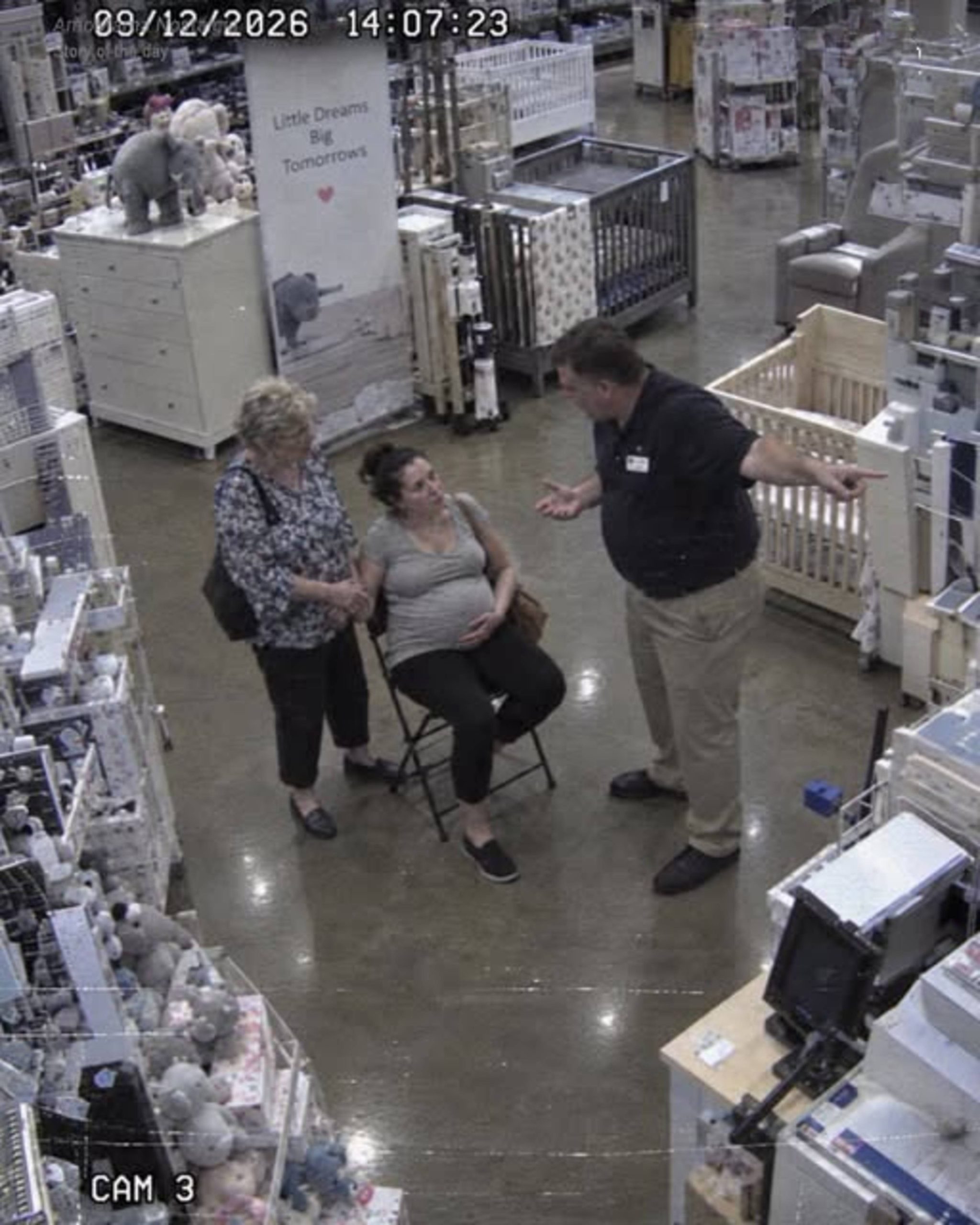
My pregnant daughter needed five minutes to sit down.
The manager decided the chair should be saved for people he thought would spend more money.
Then the owner walked in, saw who we were, and suddenly wanted to know where I got a 30-year-old receipt.
My daughter Isabella was eight months pregnant when we went shopping for a crib.
She had been excited all morning.
She’d spent weeks comparing different styles, sending me pictures of white cribs, wooden cribs, convertible cribs, and one particularly expensive crib that looked like it belonged in a royal nursery.
“I just want something safe,” she’d said.
“You’ve sent me seventeen pictures.”
“Eighteen.”
“I stand corrected.”
She laughed.
That was my daughter.
Even when pregnancy made her tired, uncomfortable, and emotional, she still found reasons to laugh.
We had been inside the furniture store for nearly an hour when she suddenly grabbed my arm.
“Mom, I need to sit down.”
Her voice was quiet, but I heard the strain in it immediately.
“Of course.”
I looked around.
There was a beautiful upholstered chair only a few feet away.
There was a small card on the armrest inviting customers to try the furniture, so I guided Isabella toward it.
She had barely taken a step when a man in a dark suit moved in front of us.
“I’m sorry. That display is reserved for customers.”
For a second, I thought I’d misunderstood him.
“We are customers.”
The man’s name tag identified him as the store manager.
He glanced at the tablet in my daughter’s hand, then at the shopping bags we’d already collected.
Then his eyes moved toward a sharply dressed couple examining an expensive bedroom collection nearby.
“They’re considering the entire collection,” he said.
Isabella rested one hand against the underside of her stomach.
“I just need five minutes.”
The manager sighed as though she had asked him to rearrange the entire showroom.
“Customers come first.”
That hurt worse than his words.
Isabella had always hated making scenes.
Even as a child, she would apologize if somebody else bumped into her.
Now she looked embarrassed for needing to sit while carrying another human being inside her.
I took a step toward the manager.
“I’d like to know your name.”
He pointed at his name tag.
“Frank.”
“Frank what?”
He hesitated.
“Frank Miller.”
“Thank you.”
I looked at Isabella.
“Let’s find somewhere else.”
She nodded.
But before we could move, another employee hurried toward us.
She looked nervous.
“Mr. Miller, the owner just called.”
Frank frowned.
“What does he want?”
“He’s on his way down.”
Frank’s expression changed.
“What?”
“He said he’s coming to the showroom.”
Frank glanced at the expensive couple.
Then at us.
Then back toward the entrance.
Suddenly, the confident attitude disappeared.
“Why?”
The employee lowered her voice.
“He said someone is asking about an old account.”
Frank’s face went pale.
I noticed.
Isabella noticed too.
“What account?” Frank asked.
“I don’t know.”
“Did he say a name?”
The employee shook her head.
“He just said he wants to see the original receipt.”
I looked at Isabella.
She looked back at me.
Neither of us understood what was happening.
Then the store’s front doors opened.
An older man walked in.
He was probably in his late sixties.
Gray hair.
Dark coat.
No security detail.
No dramatic entrance.
But the moment Frank saw him, he straightened.
“Mr. Whitmore.”
The owner nodded.
His eyes moved around the showroom.
Then they landed on me.
He stopped.
For several seconds, he simply stared.
Then his expression changed.
“You.”
I frowned.
“Do I know you?”
He took a step closer.
“I’m sorry.”
He looked at Isabella.
Then back at me.
“Your name?”
I told him.
His face became even more serious.
“Where did you get that receipt?”
I blinked.
“What receipt?”
“The one you used to identify the crib.”
“I haven’t used a receipt.”
He looked confused.
Then he pointed toward the shopping bag in my hand.
“You brought something from the house?”
I shook my head.
“No.”
He looked at Frank.
“Did she show you anything?”
Frank shook his head quickly.
“No, sir.”
The owner looked at me again.
“Then why are you here?”
I almost laughed.
“To buy a crib.”
He stared at me.
“A crib?”
“Yes.”
He looked at Isabella’s stomach.
Then back at me.
“I see.”
His expression became strangely emotional.
“Please wait here.”
He walked toward the office.
Frank followed him.
I looked at Isabella.
“What on earth is happening?”
She shook her head.
“I have no idea.”
We waited.
Five minutes passed.
Then ten.
Finally, the owner returned.
In his hand was a faded folder.
He was holding it carefully, almost like it contained something fragile.
“Mrs. Carter?”
“Yes?”
“I need to ask you something.”
“Okay.”
“Did your mother ever own a furniture store?”
I stared at him.
“No.”
He looked disappointed.
“Are you sure?”
“My mother is sitting right here.”
Isabella raised an eyebrow.
The owner smiled faintly.
“I’m sorry. I mean your grandmother.”
I froze.
“My grandmother?”
“Yes.”
“My grandmother passed away when I was a child.”
He opened the folder.
Inside was a photocopy of an old receipt.
The paper was yellowed.
The ink had faded.
But the handwriting was still visible.
I leaned closer.
At the bottom was a signature.
My grandmother’s name.
My heart started beating faster.
“Where did you get that?”
The owner looked at me.
“Thirty years ago, your grandmother bought something from this store.”
“What?”
“A crib.”
I laughed nervously.
“That can’t be right.”
He shook his head.
“It is.”
I looked at Isabella.
She was staring at the old receipt.
“My grandmother bought a crib thirty years ago?”
The owner nodded.
“For your mother.”
I felt a strange chill.
My mother had been pregnant with me thirty years ago.
The owner continued.
“She paid for it in cash.”
I stared at the receipt.
“Why would you still have this?”
“Because the purchase wasn’t ordinary.”
“What do you mean?”
He looked toward Frank.
Then back at me.
“Your grandmother returned the crib three days later.”
“Why?”
He hesitated.
“She said the baby would never use it.”
My stomach tightened.
“What?”
He looked at the receipt again.
“She asked us to hold the money.”
“For what?”
The owner took a slow breath.
“She said she’d come back when the child was ready.”
Nobody spoke.
The showroom suddenly seemed too quiet.
I looked at Isabella.
Her face had gone pale.
“Did she come back?”
The owner shook his head.
“No.”
“Then why keep the receipt?”
“Because she never asked for the money.”
He opened another page in the folder.
There was a handwritten note.
I recognized the handwriting immediately.
It was my grandmother’s.
My hands began to tremble.
“What does it say?”
The owner handed it to me.
The note was short.
“If my granddaughter ever comes back here with a child of her own, give her the crib.”
I stared at the words.
My granddaughter.
My child.
Thirty years.
I felt tears forming in my eyes.
“But why would she know I’d come here?”
“She didn’t,” the owner said.
“She only believed you would.”
I looked at Isabella.
She was crying now.
“Mom…”
I reached for her hand.
The owner continued.
“Your grandmother told me something else.”
“What?”
He looked directly at me.
“She said that one day you would come here because you were ready to become a mother.”
I couldn’t speak.
I had spent years believing my grandmother’s death had left no unfinished business.
Now I was standing in the same furniture store where she had apparently made a promise three decades earlier.
And somehow, the timing was almost impossible.
I looked at the chair where Isabella had tried to sit.
Then at the crib display.
Then at the old receipt.
“Is the crib still here?”
The owner smiled sadly.
“No.”
My heart sank.
“Someone bought it years ago.”
“Then what’s the point of the receipt?”
He looked at Isabella.
“Because your grandmother didn’t leave you the crib.”
He paused.
“She left you something else.”
“What?”
The owner reached into the folder.
He pulled out a small envelope.
My name was written across the front.
In my grandmother’s handwriting.
I hadn’t seen that handwriting in more than twenty years.
My fingers shook as I opened it.
Inside was a single photograph.
It showed my grandmother standing outside this very store.
She was holding a baby crib.
Beside her stood a much younger version of the man now standing in front of me.
The owner.
On the back of the photograph was another message.
“Some things are meant to come back when the time is right.”
I looked up.
The owner was crying.
“I’ve been waiting for you.”
I didn’t know what to say.
Then Isabella squeezed my hand.
“Mom?”
I turned toward her.
She smiled through her tears.
“Maybe Grandma knew I’d need a place to put my baby.”
I laughed softly.
“Maybe she did.”
The owner looked toward Frank.
His expression hardened.
“And Frank?”
“Yes, sir?”
“You’re fired.”
Frank’s face fell.
“Sir—”
“You denied a pregnant woman a place to sit because you thought another customer might spend more money.”
He pointed toward Isabella.
“You didn’t know who she was.”
Then he looked at me.
“And you certainly didn’t know who her family was.”
Frank tried to speak.
The owner raised his hand.
“Enough.”
He turned back to us.
“I’m sorry.”
I shook my head.
“It’s okay.”
“No,” he said.
“It isn’t.”
He looked at Isabella.
“You should have been offered a seat before anyone asked whether you were buying anything.”
Isabella smiled politely.
“Thank you.”
The owner nodded.
Then he looked at the old receipt again.
“Your grandmother paid for that crib thirty years ago.”
He smiled.
“Today, your daughter came here to buy one for her own baby.”
He folded the receipt carefully and handed it back to me.
“Maybe that’s the strangest kind of family tradition.”
I looked down at the faded paper.
Thirty years ago, my grandmother had walked into that store carrying a secret hope.
Today, my pregnant daughter had walked into the same place carrying the next generation.
And all it took to uncover the connection was a five-minute request for a chair.
Sometimes we think the most important things in life are the big moments.
Weddings.
Births.
Graduations.
Major celebrations.
But sometimes, life changes because someone simply needs to sit down.
And sometimes, a small act of kindness—or the refusal to offer it—opens a door to a story that has been waiting thirty years to be told.