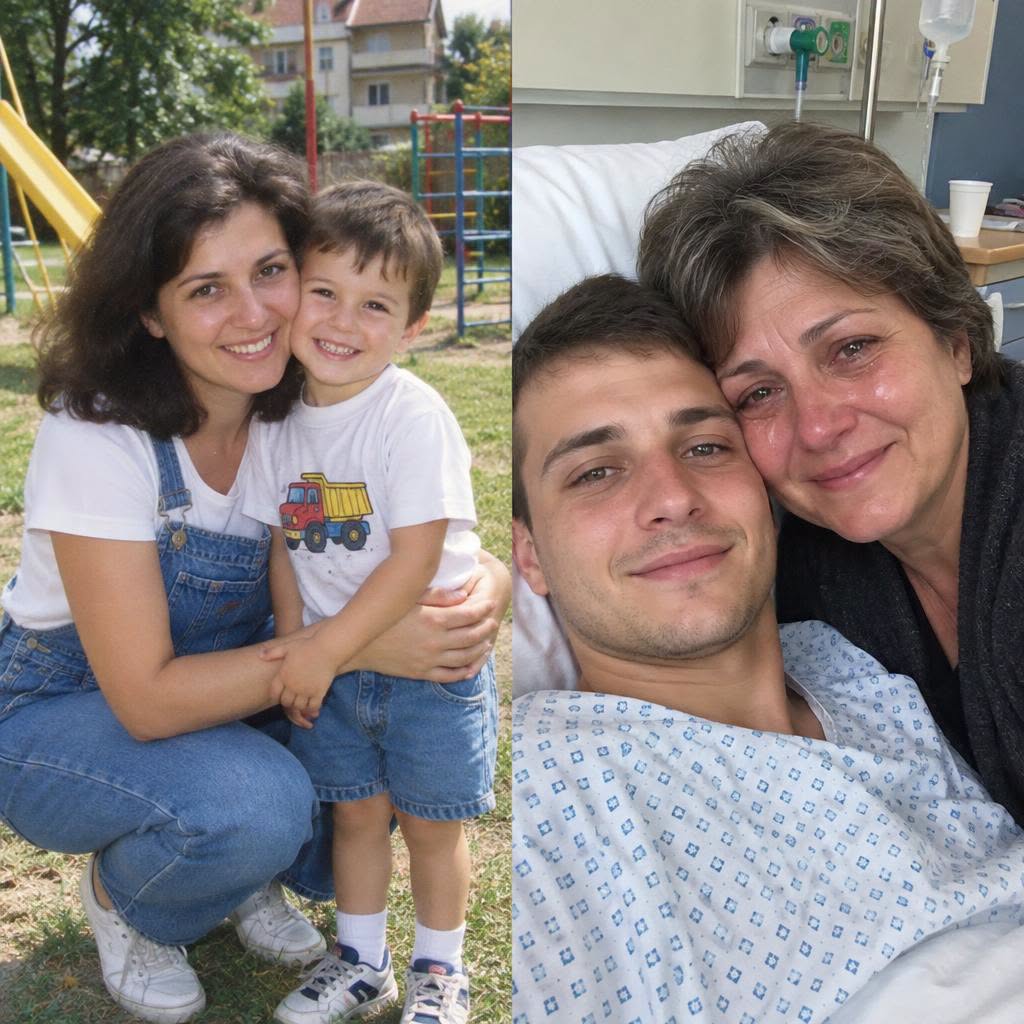
My hands shook so badly that I nearly tore the letter while opening it.
The woman introduced herself as Rebecca and quietly told me her daughter’s name was Hannah. I barely heard her. My eyes were fixed on my son’s handwriting.
Mom, there’s something you need to know about her. Her name is Hannah Reed, and she isn’t a stranger to me.
I looked up.
Rebecca’s eyes were already filled with tears.
I kept reading.
My son’s name was Daniel. Six months before his condition became severe enough that he could no longer attend college regularly, he’d met Hannah through an online support group for young people dealing with serious illnesses. Daniel had joined because he was terrified and didn’t know how to talk to me about dying. Hannah was there because she had advanced heart failure and was waiting for a transplant.
They started messaging.
At first, they spoke about hospitals, medications, doctors, and the strange experience of being teenagers while everyone around them discussed their bodies like medical charts.
Then they started talking about everything else.
Music.
Movies.
College.
Places they wanted to visit.
The families they were afraid of leaving behind.
Eventually, they became friends.
Daniel never told Hannah that he might become an organ donor, and according to the letter, he had never expected that his heart would specifically go to her. Organ allocation didn’t work like choosing a person and handing them an organ. Compatibility, medical urgency, location, timing, and transplant rules all mattered.
But somehow, Hannah’s name had become connected to the possibility.
I asked the transplant team questions, Mom. Lots of questions. I know I can’t just decide who gets what. They explained that to me. But Hannah is waiting, and if by some impossible coincidence I’m compatible and the system determines she can receive my heart, I want you to know I’d be happy about that.
I stopped reading.
“You knew him?” I asked Rebecca.
She nodded.
“Only through Hannah at first. Daniel called me once when she was admitted to the hospital. He wanted to make sure she wasn’t alone.”
“Why didn’t anybody tell me?”
“Because he asked us not to.”
That hurt.
Then I reached the next paragraph.
Please don’t be angry that I kept Hannah from you. You were already selling pieces of your life trying to save mine. Every time I saw you come home without something you used to own, I knew what you’d done. I couldn’t give you another sick child to worry about.
I covered my mouth.
I’d thought Daniel hadn’t noticed.
The missing car.
My jewelry.
The savings I’d spent.
He had noticed all of it.
The letter continued.
And I need you to understand something else. Hannah is not my girlfriend. I know you’ll probably wonder. I love her, but not like that. She became the person I could tell the truth to when I was still pretending to be brave for you.
That sentence broke me.
For the final year of his life, I’d believed my son and I were fighting the same battle together.
In reality, we had both been protecting each other with silence.
I hid my fear because I wanted him to believe I was strong.
He hid his fear because he wanted the same for me.
Hannah was apparently the one person with whom he hadn’t needed to pretend.
Rebecca asked if I wanted to meet her.
Not that day.
I couldn’t.
The idea of looking at another child and thinking about my son’s heart beating inside her felt unbearable. I knew intellectually that Hannah hadn’t taken anything from Daniel. My son had died from his illness; the transplant had happened because of his death, not caused it.
Grief didn’t care about logic.
For several weeks, I kept Daniel’s letter beside my bed.
Then one afternoon I called Rebecca.
We arranged to meet at a quiet park after Hannah’s doctors cleared her for the outing.
The girl who approached me wasn’t what I’d imagined.
She looked fragile. Pale. Frightened.
She stopped several feet away.
“I’m sorry,” she whispered.
Those were her first words to me.
I immediately started crying.
“No. Don’t ever apologize to me for being alive.”
Hannah began crying too.
We sat on a bench for almost two hours.
She showed me messages Daniel had sent her, and with my permission, she later gave me copies of some of them. Most were ridiculous teenage conversations. He complained about hospital food. She mocked his terrible taste in movies. He sent photographs of a plant he’d somehow managed to kill despite watering it constantly.
Then she showed me one message from three weeks before he died.
If you get your transplant before I disappear, you owe me one thing: do something ordinary. Go complain about homework. Miss a bus. Get your heart broken by some idiot. Be boring. Sick people dream about boring.
I laughed and cried at the same time.
There was no secret romance.
No miraculous plan.
Just two frightened teenagers who had met at the worst moment of their lives and somehow made that moment easier for each other.
Over the next year, Hannah and I remained in contact, but I was careful not to turn her into a replacement for Daniel.
That would have been unfair to both of us.
She wasn’t my daughter.
She wasn’t Daniel living inside another body.
His heart was an organ that had allowed her own life to continue; it didn’t transfer his memories, personality, or identity to her.
She was Hannah.
And gradually, that became enough.
On what would have been Daniel’s twenty-first birthday, Rebecca and Hannah came to my house.
Hannah brought a small box.
Inside was a photograph I’d never seen.
Daniel and Hannah had met once in person.
Months before either of them knew how their stories would end, their hospitals had participated in the same young-adult patient event. They’d arranged to find each other there.
In the photograph, Daniel was thin but still standing. Hannah was beside him in a wheelchair, holding up two fingers behind his head.
On the back, Daniel had written:
Two broken machines pretending we’re normal.
I laughed so loudly that I startled myself.
Then Hannah gave me something else.
She had enrolled in nursing school.
“Daniel kept saying he wanted his life to be useful,” she told me. “I don’t want to spend mine trying to repay him, because he told me not to. But being sick showed me how much a good nurse matters. I think I want to be one.”
That distinction mattered to me.
She wasn’t living the life Daniel would have lived.
She was living hers.
Years passed.
I eventually bought another car. I rebuilt some savings. The empty bedroom became less impossible to walk past, although I never stopped missing the person who had slept there.
Hannah graduated.
I attended with Rebecca.
Afterward, she hugged me and whispered, “He should be here.”
I shook my head gently.
“No. You should be here.”
She understood.
I still have Daniel’s original letter.
For years, one paragraph mattered more than all the others. It was near the end, written in the increasingly uneven handwriting he’d developed as his illness progressed.
Mom, if Hannah receives my heart, please don’t listen to it and think you’re hearing me. I’m not asking you to find me inside her. I just want you to know that something my body couldn’t use anymore helped somebody I cared about stay alive. And if someone else receives it instead, that’s okay too. The point was never who got my heart. The point was that I didn’t need it where I was going.
And beneath that, almost as an afterthought, he’d added:
Also, please stop saying I’m all you have. You had a whole life before me. I hope you have one after me too.
That was the last wish of his that took me the longest to honor.
My son gave Hannah his heart.
But the final thing he left me was something I hadn’t realized I needed.
Permission to keep mine.