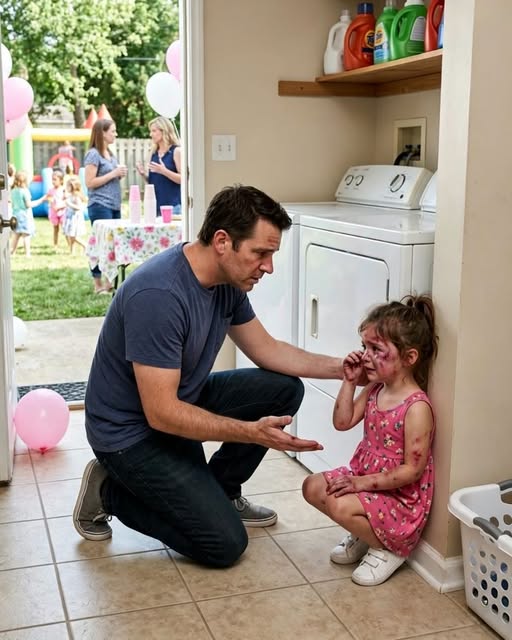
My Five-Year-Old Daughter Was Crying Behind The Washing Machine And Whispered, “Daddy… Do I Have To Say Sorry To Aunt Brooke?”—What Happened Afterward Changed Our Family Forever
Outside, my niece Sophie’s sixth birthday party kept going as if nothing had happened.
Pink balloons floated over my parents’ backyard in Austin. Kids chased each other around the bounce house while music blasted from a speaker beside the cake table.
My sister Brooke stood talking to guests.
My parents were carrying trays of food toward the patio.
Everyone seemed happy.
Except my five-year-old daughter, Emma, had disappeared.
At first, I wasn’t worried.
There were fifteen children running between the backyard, kitchen, playroom, and downstairs bathroom.
I assumed she was playing hide-and-seek.
Then ten minutes passed.
“Emma?” I called.
No answer.
I checked the bounce house.
Nothing.
I checked beneath the patio table where she sometimes hid when she became overwhelmed by noise.
Empty.
Then I noticed something strange.
Emma’s little purple shoes were sitting beside the laundry-room door.
She never took her shoes off at someone else’s house.
I opened the door.
“Emma?”
Silence.
Then I heard it.
A tiny sniffle.
I stepped farther inside.
The laundry room was narrow, with shelves along one wall and an old washing machine pushed beneath a window.
“Sweetheart?”
Another sniffle.
Then I saw her.
Emma had squeezed herself into the narrow space between the washing machine and the wall.
Her knees were pulled against her chest.
Her cheeks were wet.
Her pink party dress was wrinkled.
She was clutching her stuffed rabbit against her stomach.
The moment she saw me, her face crumpled.
“Daddy.”
I immediately crouched.
“What happened?”
She shook her head.
I reached toward her but stopped before touching her.
“Can I pick you up?”
She nodded.
I carefully lifted her from behind the washing machine and sat on the floor with her against my chest.
She buried her face in my shirt.
For almost a minute, I simply held her.
Then she whispered something I will never forget.
“Daddy… do I have to say sorry to Aunt Brooke?”
I looked down.
“Sorry for what?”
Emma’s fingers tightened around her rabbit.
“I made her mad.”
“How?”
She wouldn’t answer.
My stomach tightened.
“Emma, look at Daddy.”
Slowly, she raised her eyes.
“You’re not in trouble.”
Her lower lip trembled.
“Aunt Brooke said I was.”
“For what?”
Emma looked toward the closed laundry-room door.
Then she whispered.
“I didn’t want Sophie to open my backpack.”
I waited.
That didn’t make sense.
“What happened to your backpack?”
“Sophie wanted Mr. Buttons.”
Mr. Buttons was the stuffed rabbit Emma was holding.
She had slept with that rabbit since she was two.
“My rabbit?”
Emma nodded.
“Sophie said because it was her birthday, she could have him.”
“And what did you say?”
“I said no.”
I almost smiled.
“That’s okay.”
Emma shook her head immediately.
“No, Daddy. Aunt Brooke said it wasn’t.”
Something cold settled in my chest.
“What did Aunt Brooke say?”
Emma stared at the rabbit.
“She said birthdays mean sharing.”
“That doesn’t mean giving away your things.”
“I told Sophie she couldn’t have him.”
Then Emma started crying again.
I held her closer.
“What happened next?”
“Aunt Brooke took him.”
I looked at the rabbit.
“How did you get him back?”
Emma pointed toward her arm.
That was when I noticed a faint red mark near her wrist.
Not a serious injury.
But enough to make me pay attention.
“What happened there?”
Emma immediately pulled her sleeve down.
My voice stayed calm.
“Sweetheart, did somebody grab you?”
She hesitated.
Then nodded.
“Who?”
“Aunt Brooke.”
Every instinct inside me changed.
I forced myself not to react visibly.
“What happened?”
Emma explained in broken pieces.
Sophie had wanted Mr. Buttons.
Emma refused.
Brooke apparently decided Emma needed to “learn how to share.”
She took the rabbit.
Emma tried taking it back.
Brooke grabbed her wrist.
Emma screamed.
Then Brooke told her she was being selfish and ruining Sophie’s birthday.
Emma began crying.
According to my five-year-old, Brooke told her she could stay inside until she was ready to apologize.
So Emma hid.
Behind the washing machine.
While everyone outside continued celebrating.
I took a slow breath.
“Did Aunt Brooke tell you to hide here?”
“No.”
“Did she lock you in?”
Emma shook her head.
“She said I couldn’t come back to the party until I said sorry.”
That distinction mattered.
But it didn’t make me feel much better.
“Did anyone else see what happened?”
Emma nodded.
“Grandma.”
My mother.
I stood up.
Emma immediately grabbed my shirt.
“Daddy, don’t be mad.”
That nearly broke me.
“I’m not mad at you.”
“Please don’t make everybody fight.”
I looked at my five-year-old daughter asking me to manage the emotions of adults.
That frightened me more than the red mark.
I carried her outside.
The party was still going.
Brooke was standing beside the cake table, laughing with another parent.
My mother saw us first.
Her smile vanished.
“Where was she?”
I looked directly at her.
“Behind the washing machine.”
Mom’s face changed.
Brooke turned.
“There she is.”
She walked toward us.
“Emma, are you ready to apologize to Sophie?”
Emma tightened her arms around my neck.
I felt it immediately.
“No,” I said.
Brooke stopped.
“No?”
“She isn’t apologizing.”
Brooke looked confused.
“Daniel, you don’t even know what happened.”
“I know enough.”
“She refused to share with Sophie at Sophie’s own birthday party.”
“Her stuffed rabbit isn’t a party favor.”
Brooke rolled her eyes.
“Nobody was keeping it permanently.”
“Did Emma know that?”
“She’s five.”
“Exactly.”
Several nearby conversations became quieter.
Brooke noticed.
Her voice lowered.
“Can we discuss this inside?”
“First, answer something.”
I shifted Emma higher against my shoulder.
“Did you grab her wrist?”
Brooke’s expression changed.
“Oh, come on.”
“That’s not an answer.”
“She was trying to snatch the toy out of my hand.”
“Her toy.”
“I barely touched her.”
I looked toward my mother.
“Mom?”
She immediately looked uncomfortable.
That answered more than words could.
“You saw it?”
My mother sighed.
“Daniel, Brooke was just trying to calm things down.”
“Did you see her grab Emma?”
“It wasn’t like that.”
“What was it like?”
Brooke interrupted.
“This is ridiculous.”
Emma flinched at the volume of her voice.
I felt her bury her face against my shoulder.
That ended the conversation for me.
“We’re leaving.”
Brooke stared at me.
“You’re seriously leaving Sophie’s birthday over this?”
“Yes.”
“What about her presents?”
“I’ll send them later.”
Then my father approached.
“What’s going on?”
Brooke answered before I could.
“Daniel is throwing a tantrum because Emma refused to share.”
I looked at Dad.
“My daughter was crying behind your washing machine because she thought she had to apologize before she was allowed outside.”
His expression changed.
“What?”
Mom immediately said, “Nobody told her to hide.”
“I know.”
I looked at her.
“But apparently nobody went looking for her either.”
Silence.
My father looked at my mother.
“You knew she was upset?”
Mom folded her arms.
“Brooke was handling it.”
“She’s not Brooke’s child.”
Dad said it before I could.
Brooke stared at him.
“Oh, so now I’m the villain?”
Nobody answered.
I carried Emma toward the side gate.
Then Sophie appeared.
She was wearing a plastic birthday crown.
“Uncle Daniel?”
I stopped.
Sophie looked at Emma.
“Is Emma leaving?”
“Yes, sweetheart.”
Her face fell.
Then she held something toward Emma.
A purple bracelet.
“I made this for you.”
Emma slowly reached for it.
“Thank you.”
Then Sophie looked at me.
“I didn’t want Aunt Brooke to take Mr. Buttons.”
Everything stopped.
Brooke’s face changed.
“Sophie.”
But Sophie continued.
“I told Mommy Emma could keep him.”
Brooke stepped forward.
“That’s enough.”
Sophie looked confused.
“But Mommy, you said Emma needed to learn.”
My father turned toward Brooke.
“Learn what?”
Brooke’s cheeks reddened.
“How not to be selfish.”
Dad stared at her.
“She’s five years old.”
“So is Sophie!”
“Then why are you using Sophie’s birthday to discipline somebody else’s child?”
Brooke had no answer.
I left.
In the car, Emma remained unusually quiet.
Halfway home, she asked:
“Daddy?”
“Yes?”
“Am I selfish?”
I pulled into a parking lot.
I couldn’t have that conversation while driving.
I turned toward her.
“No.”
“But I didn’t share.”
“You’re allowed to have special things that belong to you.”
She looked at Mr. Buttons.
“Even on birthdays?”
“Even on birthdays.”
“What if somebody gets sad?”
“You can care that they’re sad without giving them everything they want.”
Emma thought about that.
Then she asked the question that stayed with me.
“Can grown-ups be wrong?”
I almost laughed.
“All the time.”
“Even Grandma?”
“Yes.”
“Even you?”
“Especially me.”
That finally made her smile.
That night, after Emma fell asleep, my father called.
He apologized.
Not vaguely.
Not with excuses.
He said he should have noticed Emma was missing.
He should have intervened when Brooke grabbed her.
And he should not have assumed my mother would handle it.
Then he said something unexpected.
“This isn’t really about Emma.”
I waited.
“What do you mean?”
“Brooke has always been like this.”
Dad sounded exhausted.
“When you were kids, we let her control everything because it was easier than dealing with her reactions.”
I knew exactly what he meant.
Growing up, Brooke always got the larger bedroom.
She chose restaurants.
She decided holiday plans.
If she became upset, everyone adjusted.
I had called it favoritism.
Dad called it something else.
“We trained the whole family to keep Brooke comfortable.”
That sentence hit hard.
Because he was right.
And apparently, the pattern had reached our children.
The next morning, my mother called.
Her apology was different.
“I’m sorry Emma got upset.”
I recognized the wording immediately.
“That’s not an apology.”
She became defensive.
“What do you want me to say?”
“That you watched an adult grab my daughter and then allowed a five-year-old to believe she had done something wrong.”
“I didn’t allow anything.”
“You knew she was crying.”
“Daniel—”
“Did you go check on her?”
Silence.
That was the answer.
Then Mom said something revealing.
“I didn’t want to undermine Brooke in front of Sophie.”
I closed my eyes.
“So protecting Brooke’s authority mattered more than checking on Emma?”
“That’s not fair.”
“No. What happened to Emma wasn’t fair.”
I ended the call.
For the next two weeks, we stayed away.
Then something happened I didn’t expect.
Brooke came to my house.
Alone.
No parents.
No Sophie.
I almost didn’t let her inside.
Then she said, “I need to apologize to Emma.”
I crossed my arms.
“To Emma or to me?”
“Emma.”
That mattered.
I let her enter.
Emma was coloring at the kitchen table.
Brooke crouched several feet away.
She didn’t touch her.
“Emma, I did something wrong at Sophie’s party.”
Emma looked at me.
I nodded.
Brooke continued.
“I should not have taken Mr. Buttons.”
Emma hugged the rabbit.
“And I definitely should not have grabbed your wrist.”
Brooke swallowed.
“I was wrong.”
Emma remained silent.
Then Brooke said the most important part.
“You do not have to forgive me because I apologized.”
I looked at her.
That surprised me.
Emma eventually whispered, “Okay.”
Brooke nodded.
“And you never have to hug me if you don’t want to.”
Emma thought for several seconds.
Then she asked:
“Can I show you my drawing?”
Brooke’s eyes filled with tears.
“Yes.”
That wasn’t forgiveness.
It wasn’t instant reconciliation.
But it was a beginning.
Later, Brooke told me why she had changed.
Sophie had asked her a question after the party.
“Mommy, if I say no to somebody, can they grab me too?”
Brooke said the question destroyed every excuse she had made.
She realized she had been teaching both girls something dangerous.
That adults could override their boundaries if they believed their reason was good enough.
Brooke started therapy.
My parents changed too.
Slowly.
Dad stopped smoothing over conflicts.
Mom began apologizing without adding “but.”
And I learned something about myself.
For years, I had tolerated family behavior I would never tolerate from strangers.
I called it keeping the peace.
But peace that requires one person to stay uncomfortable isn’t really peace.
Six months later, Sophie came to our house for Emma’s birthday.
When Emma opened her gifts, Sophie noticed Mr. Buttons sitting beside her.
“Can I hold him?”
Emma hesitated.
Then shook her head.
“No.”
I watched Brooke.
She smiled at Sophie.
“You heard her.”
Sophie shrugged.
“Okay.”
Then they ran outside together.
That tiny moment meant more to me than any dramatic apology.
Nobody cried.
Nobody argued.
Nobody demanded an explanation.
A five-year-old said no.
And the adults simply respected it.
Sometimes I still think about finding Emma behind that washing machine.
Her knees against her chest.
Her rabbit squeezed against her body.
Her tiny voice asking whether she needed to apologize.
At five years old, she had already begun wondering whether keeping other people happy mattered more than her own comfort.
That terrified me.
But something good came from that afternoon.
Our family finally confronted a pattern that had existed for decades.
Brooke learned that authority does not make every decision correct.
My parents learned that avoiding conflict can become a form of choosing sides.
And I learned that my job wasn’t to teach Emma to keep adults comfortable.
My job was to teach her that her voice mattered.
Today, if Emma doesn’t want somebody touching her belongings, she says so.
If she doesn’t want a hug, she says no.
If something frightens her, she tells me.
And whenever she asks whether she is allowed to have boundaries, my answer is always the same.
Yes.
Even with relatives.
Even at birthday parties.
Even when somebody becomes disappointed.
Especially then.
Because the most important lesson my daughter learned that afternoon wasn’t how to share.
It was that love doesn’t require surrendering every boundary to keep someone else happy.
And the most important lesson our family learned was even simpler.
When a child says no, the adults in the room should be the first people willing to listen.