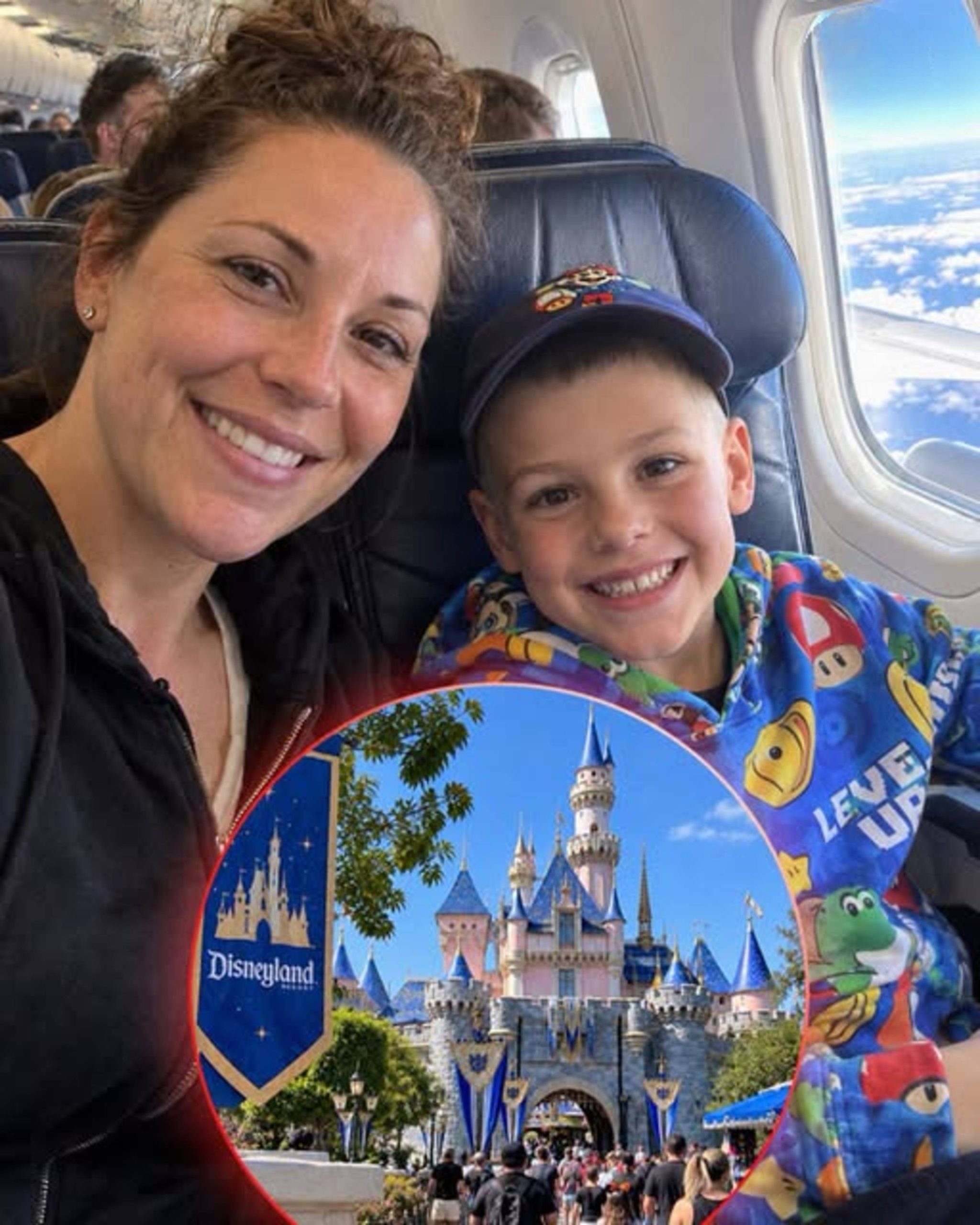
Our terminally ill son had spent months dreaming about his first flight to Disneyland. He talked about it almost every day, as though simply imagining the trip could make the future feel bigger than the hospital rooms he’d become so familiar with. He wanted to see the castle. He wanted to ride the rides he’d only seen in videos. He wanted to meet the characters, eat too much candy, and come home with something ridiculous from the gift shop.
We wanted to give him that dream.
But halfway there, the captain made one announcement that silenced the entire cabin.
The change was immediate.
Conversations stopped.
People looked up from their phones.
A flight attendant froze in the aisle.
Then, slowly, strangers around us began wiping their eyes.
Stella gripped my hand.
And suddenly, nothing about our Make-A-Wish trip felt ordinary anymore.
Mike treated the airplane safety card like an instruction manual for surviving space.
He held it with both hands, carefully studying every picture before turning the page.
He pointed at the emergency exits.
“What happens if we have to use those?”
“We won’t,” I told him.
“But what if we do?”
“Then the people who work on the plane will help us.”
He nodded, apparently satisfied.
Then he leaned across Stella to inspect the window.
“Mom?”
“Yes, sweetheart?”
“Do clouds feel wet when we fly through them?”
Stella smiled.
“I think so, sweetheart.”
Mike frowned thoughtfully.
“How wet?”
I almost laughed.
“I don’t know.”
“Like rain?”
“Maybe.”
He considered that answer seriously, then turned back toward the window as though he had just been given an important scientific problem to solve.
I looked away before he saw my face.
For months, my son had asked questions about medicine, blood counts, chemotherapy, scans, and whether hair remembered how to grow after it fell out.
He had asked whether hospitals had special machines that could tell doctors exactly where cancer was hiding.
He had asked whether medicine hurt more than the disease.
He had asked whether he would ever be allowed to play soccer again.
He had asked questions no eight-year-old should have needed to ask.
Hearing him ask about clouds felt almost indecently beautiful.
It was such a normal question.
Such a wonderfully ordinary question.
For a few seconds, he wasn’t a sick child.
He was just a little boy on his first airplane ride, wondering whether clouds were wet.
He pressed his forehead against the glass as the plane rolled toward the runway.
Outside, a baggage worker lifted both hands and waved.
Mike immediately waved back with his entire arm.
“Dad! Look!”
“I see him.”
“He waved at me!”
“He did, sweetheart.”
Mike grinned.
The engines began to rise.
He grabbed both armrests.
Then the plane accelerated down the runway.
Mike’s eyes widened.
“We’re going!”
He laughed.
It wasn’t a polite little laugh.
It was the loud, uncontrolled laugh of a child who had waited months for something and was finally watching it happen.
The ground dropped beneath us.
Buildings became smaller.
Cars became dots.
Mike pressed his face against the window.
“We’re flying!”
Stella laughed through tears.
Beside me, she reached across the narrow space and closed her hand around mine.
Neither of us spoke.
We had learned that certain moments broke if we named them.
If we said, *This might be the last time*, the joy disappeared.
If we said, *Look how happy he is*, the fear came rushing back.
So we simply held hands.
And watched our son look at the world from above.
For a few minutes, everything felt almost normal.
Almost.
Then Mike turned around.
“Dad?”
“Yeah?”
“Do you think Disneyland has clouds?”
I smiled.
“Probably.”
“Then I want to see those too.”
I nodded.
“You will.”
I didn’t know how to answer anything else.
Because eight months earlier, I hadn’t known whether my son would ever see the sky from an airplane.
Eight months earlier, he had been playing soccer in our backyard.
It had been an ordinary afternoon.
The grass was too long because I’d been putting off mowing it.
Mike had kicked the ball toward the fence, and I remember yelling at him not to send it into the neighbor’s yard.
He laughed.
Then he stopped chasing it.
At first, I thought he was tired.
He stood near the fence with one hand pressed against his side.
“Cramp?” I called.
He shook his head.
“You okay?”
He nodded.
But something about the way he was standing made me walk toward him.
That night, he developed a fever.
We thought it was the flu.
Then another fever came.
Then another.
Three days later, we were sitting in a doctor’s office.
There were two chairs pulled close to the desk.
The doctor sat across from us.
He had a folder in front of him.
Stella was holding Mike’s hand.
I remember looking at the doctor’s face and knowing something was wrong before he said anything.
He explained that our eight-year-old son had cancer.
The word didn’t make sense.
Not at first.
Cancer was something that happened to other people.
Adults.
Older people.
People whose names appeared in stories.
Not Mike.
Not our boy.
Not the kid who left soccer balls in the kitchen and complained when we made him brush his teeth.
By the time the doctor used the word *terminal*, Stella had already stopped breathing normally.
She stared at him.
I stared at the wall.
Neither of us understood how one word could rearrange an entire life.
I remember watching the doctor’s pen roll slowly toward the edge of his desk.
It fell.
No one picked it up.
That tiny sound—the pen hitting the floor—stayed with me.
It was strangely ordinary.
And somehow that made everything worse.
After that, our life became appointment cards, plastic wristbands, medication schedules, hospital elevators, and food Mike was too nauseated to eat.
The kitchen filled with things we never thought we’d need.
Medicine bottles.
Protein drinks.
Packets of crackers.
Thermometers.
His backpack became lighter because he stopped carrying books.
His soccer cleats remained beside the back door.
Mud dried in the grooves.
I could not bring myself to clean them.
Every time I looked at those cleats, I saw the boy who had been running through the backyard before cancer changed everything.
So I left them there.
Weeks became months.
Hospital rooms replaced playgrounds.
Doctors replaced coaches.
The language of our household changed.
We stopped talking about weekends and started talking about blood counts.
We stopped planning vacations and started planning treatments.
And somewhere in the middle of all that fear, Mike began talking about Disneyland.
At first, it was a joke.
“Dad, if I get better, can we go?”
Then he asked again.
And again.
Eventually, it became his dream.
He watched videos of the rides.
He memorized pictures of the castle.
He wanted to meet Mickey Mouse.
He wanted to ride the biggest roller coaster he could find.
He wanted to eat breakfast shaped like a character.
He wanted a pair of ridiculous ears.
He wanted everything.
And we promised him we’d try.
Then Make-A-Wish became involved.
Suddenly, the dream wasn’t just something we talked about.
It was becoming real.
There were forms.
Calls.
Plans.
Dates.
People we had never met working behind the scenes to make a little boy’s impossible wish happen.
And now, months later, we were sitting on an airplane.
Mike was staring at clouds.
Stella was holding my hand.
I was trying not to think about the diagnosis waiting in the back of my mind.
Then the captain’s voice came over the speakers.
“Ladies and gentlemen…”
The cabin quieted.
Mike looked up.
I glanced toward Stella.
Something about the captain’s tone was different.
Then he continued.
“We have a very special passenger on board today.”
People began looking around.
The flight attendants exchanged glances.
Mike pointed at himself.
“Is he talking about me?”
Stella covered her mouth.
The captain continued.
He spoke about a young boy traveling toward his dream.
A boy who had spent months fighting something no child should ever have to fight.
A boy whose wish was to visit Disneyland.
And then he said Mike’s name.
The cabin erupted in applause.
Mike’s mouth fell open.
He looked at us.
Then at the strangers around him.
People were clapping.
Some were crying.
A woman across the aisle covered her face with both hands.
A man behind us wiped his eyes.
The flight attendant standing nearby was crying too.
Mike didn’t understand why everyone was emotional.
He just smiled.
Then he waved.
The applause grew louder.
Stella squeezed my hand so hard it hurt.
I didn’t care.
I squeezed hers back.
For the first time since the diagnosis, our fear wasn’t the only thing in the room.
There was joy too.
Real joy.
The kind that comes from strangers deciding, for a few minutes, to carry part of your family’s burden.
Mike looked at me.
“Dad?”
“Yeah?”
“Are they all going to Disneyland too?”
I laughed through tears.
“No, buddy.”
“Then why are they clapping?”
I looked at my son.
At his thin face.
At the excitement in his eyes.
At the boy who had spent months asking questions about whether he would live long enough to see the things other children took for granted.
“Because they’re happy you’re going,” I said.
Mike smiled.
Then he turned back toward the window.
And for the rest of the flight, he watched the clouds.
He didn’t talk about cancer.
He didn’t ask about blood counts.
He didn’t ask whether his medicine would work.
He just watched the sky.
And for those few hours, that was enough.
For the first time in months, we weren’t counting days.
We were counting clouds.
And when Disneyland finally appeared in the distance, Mike pressed both hands against the window.
“There it is!”
Stella cried.
I did too.
But this time, neither of us looked away.
Because sometimes the most beautiful moments aren’t the ones where everything is fixed.
They’re the moments when, despite everything, a child gets to feel like a child again.
And that day, thousands of feet above the ground, surrounded by strangers who had never met us before, our son got exactly that.
A dream.
A sky full of clouds.
And a journey toward a place where, for a little while, cancer didn’t get to decide what happened next.