The doctor motioned me toward the treatment doors. Our newborn had stopped getting worse, he said, but before I could go back, he needed me to understand what came next.
The burns were serious enough that the hospital was arranging a transfer to a pediatric burn center. Our baby was receiving pain medication and fluids, and the doctors were watching closely for complications. He was careful not to promise me anything beyond the next few hours.
Then he glanced toward the room where the social worker had taken my wife.
“Because of the circumstances of the injury, our child protection team has also been notified.”
I stared at him.
For the first time that night, two separate realities settled into place at once.
My baby had survived the immediate emergency.
And whatever happened next was no longer going to depend on the version of the story my wife wanted people to hear.
I asked if I could see the baby.
A nurse led me through the doors.
Nothing prepared me for how small our newborn looked surrounded by equipment and adults moving with quiet urgency. I had spent the drive imagining the worst, then spent the last hour trying not to imagine anything at all. Now I stood beside the bed and had to grip the rail because my legs felt unreliable.
I didn’t touch anywhere the nurses hadn’t told me I could touch.
I just rested one finger against the baby’s tiny hand.
The fingers curled weakly around mine.
That nearly broke me.
The nurse beside me said, “Talk. Your baby knows your voice.”
So I did.
I said every useless, desperate thing a father says when he has no power to fix what is happening. I said I was there. I said I wasn’t leaving. I said we were going to get through this one hour at a time.
When I finally stepped back into the hallway, my wife was waiting near the social worker’s office.
Her eyes were swollen. Her phone was no longer in her hand.
“Can I see the baby?” she asked.
I looked at the social worker.
“She can,” the woman said. “But we need to finish a few questions first.”
My wife’s mouth tightened.
“I already told you what happened.”
The social worker remained calm. “And we’re trying to establish the timeline.”
My wife looked at me as though I was supposed to stop it.
I didn’t.
She turned back toward the social worker. “I picked up the wrong water. I put the baby in. The baby cried. I realized it was hot. That’s it.”
The social worker asked, “And approximately how long passed between the first cry and when you removed the baby?”
“I don’t know. Seconds.”
“Were you still on the phone?”
My wife hesitated.
“Yes.”
“Did the person you were speaking with hear the baby?”
Another pause.
“Probably.”
I couldn’t stop myself.
“She texted that she’d warned you.”
My wife’s face changed.
“I said she’s misunderstanding what happened.”
“No,” I said. “You said we were misunderstanding her message. That’s different.”
The social worker lifted one hand before the argument could grow.
“We don’t need to settle this between you two right now. We need accurate information.”
My wife folded her arms around herself.
Then the social worker asked for the friend’s name and phone number.
My wife refused at first.
She said her friend hadn’t done anything wrong. She said dragging another person into this would only make everything more confusing. She said the hospital already had enough information.
The social worker listened without interrupting.
Then she said, “Your friend may be the only other person who experienced part of what happened in real time.”
That was when my wife finally gave her the number.
The friend answered on the second attempt.
I wasn’t allowed to sit in for that conversation. Neither was my wife.
We ended up on opposite sides of the same hallway, separated by maybe twenty feet and more distance than I had ever felt between us.
After several minutes, my wife’s mother arrived.
My wife must have called her before her phone had been taken for the interview because she came through the elevator doors looking terrified and furious.
She hugged her daughter first.
Then she turned to me.
“This was an accident,” she said immediately. “You need to make sure these people understand that.”
I stared at her.
“Our baby is being transferred to a burn center.”
“I know. She told me. But accidents happen with newborns. Everyone is exhausted.”
“This wasn’t dropping a bottle.”
Her expression hardened. “She’s the mother of your child.”
“And that child is lying behind those doors.”
My wife started crying again.
Her mother lowered her voice. “Don’t destroy your family over one terrible mistake.”
Before I could answer, the social worker came out carrying a yellow legal pad.
She asked my wife to come back into the room.
My wife stood.
“What did she say?”
“We’ll discuss that with you.”
My wife looked at me, then at her mother.
Neither of us followed her inside.
Twenty minutes later, the door opened again.
The social worker asked to speak with me alone.
I sat across from her and felt my stomach tighten before she said a word.
“Your wife’s friend confirmed that she heard the baby crying during the call.”
I nodded once.
“She also said she told your wife to check on the baby.”
I thought of the message preview.
“How many times?”
The social worker didn’t answer immediately.
“More than once.”
That was the first reversal I wasn’t prepared for.
The message had sounded like one warning ignored in confusion.
According to the friend, it hadn’t been one.
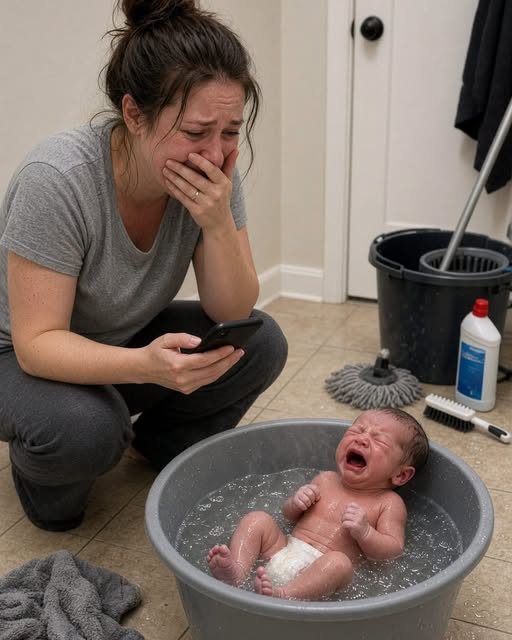
The friend said the crying changed after my wife lowered the baby into the BASIN. She became uncomfortable enough to interrupt the conversation and ask whether everything was okay.
My wife had answered that the baby always fussed during washing.
A short time later, the friend told her again to check.
Then the crying weakened.
Only after that did my wife stop talking.
I closed my eyes.
The social worker said, “I need you to understand something. We’re not asking you to decide tonight whether your wife committed a crime. That’s not your role. We’re asking whether you can follow a safety plan while the circumstances are reviewed.”
“What safety plan?”
“If the baby eventually comes home to you, your wife may not be permitted to be the sole caregiver until the assessment is complete.”
The words hit differently than the questions had.
Until that moment, part of me had still been living inside the old structure of my life. Hospital. Treatment. Recovery. Then home.
Now home itself had conditions attached to it.
I asked, “You’re asking me whether I would stop her from being alone with our own baby?”
“If that is the condition for discharge, yes.”
I didn’t answer immediately.
I thought about my wife’s face when I arrived. I thought about how terrified she had looked. I thought about all the nights we’d taken turns walking the floor because the baby wouldn’t sleep.
Then I remembered the doctor asking how long the exposure lasted.
A few seconds, she’d said.
I realized immediately.
Neither statement matched what the person on the phone had described.
“If that’s what keeps the baby safe,” I said, “I’ll follow it.”
When I left the room, my wife knew from my face that something had changed.
“You believe her over me.”
“This isn’t about choosing her.”
“She wasn’t even there.”
“She heard you.”
“She heard a phone call.”
“She heard our baby screaming and told you to check.”
My wife looked away.
Her mother started to defend her again, then stopped when she saw her daughter’s expression.
“What aren’t you telling us?” she asked.
My wife said nothing.
That was the only time her mother tried to pressure me to make the problem disappear. After that, she stopped defending the story and started asking her daughter the same question I was asking.
What actually happened?
The transfer team arrived before we got an answer.
I rode behind the ambulance to the pediatric center.
My wife rode with her mother.
For the next two days, the story stopped feeling like a story and became a routine of doors, nurses, medication schedules, forms, whispered updates, and watching monitors I didn’t understand.
Our baby remained stable.
That word became the most beautiful word I had ever heard.
Stable.
Not healed. Not safe forever. Not untouched by what happened.
But alive.
A specialist explained that recovery would take time and that there could be follow-up treatment after discharge. I listened, wrote everything down, and asked questions until I had no more questions left.
My wife was allowed to visit under the hospital’s conditions.
She spent most of the first day sitting beside the bed without speaking.
Her phone stayed in her bag.
At one point she reached toward the baby’s hand, then stopped before touching it.
The movement served no purpose. She simply let her hand fall back into her lap.
On the third morning, I went home with my sister to collect clean clothes, chargers, and the few baby things the hospital had asked us to bring.
Walking into that house was worse than I expected.
Everything looked ordinary.
The bottle rack was beside the sink. A folded blanket was on the couch. One tiny sock was under the coffee table.
In the bathroom, the BASIN was still there.
I stopped in the doorway.
My sister moved beside me but didn’t say anything.
The cleaning container had already been set aside for investigators, but the room itself looked exactly like a room where nothing should have gone catastrophically wrong.
That was what I couldn’t get past.
There hadn’t been a fire. There hadn’t been an equipment failure nobody could have predicted. There hadn’t been some invisible threat.
There had been water hot enough for cleaning.
There had been a newborn.
And there had been several chances to stop before those two things met.
Pick up the container.
Notice what it was.
Pour the water.
Test it.
Lower the baby.
Hear the first scream.
Hear the warning from the phone.
Look down.
Any one of those moments could have changed the ending.
My sister finally said, “You don’t have to decide everything about your marriage today.”
“I know.”
“But you do have to decide what happens when the baby comes home.”
I looked at the BASIN again.
“I already did.”
That evening, the social worker asked me to return to a conference room.
My wife was there with her mother.
So was a hospital child-protection specialist.
They had spoken again with the friend.
This time, my wife didn’t argue about her being misunderstood.
The specialist said they wanted one more clear account before documenting their recommendations.
My wife stared at the table.
“What happens if I tell you I don’t remember?”
The specialist answered, “Then we document that you don’t remember.”
“What happens if I tell you something different from what I said before?”
“We document that too.”
My wife began rubbing her palms together.
Then she looked at me.
“I didn’t know the water was that hot.”
“I believe you.”
Her eyes filled.
“But I heard the crying.”
Nobody moved.
She swallowed.
“At first I thought it was normal crying. I thought the baby was just angry about being washed.”
I could hear my own pulse.
“She told you to check.”
“Yes.”
“How many times?”
“Twice.”
My wife’s mother covered her mouth.
I asked the question I had been afraid to ask since the hallway.
“Why didn’t you?”
My wife started sobbing.
“Because I was listening to what she was telling me. I thought I would look in a second.”
A second.
The smallest possible word for the space in which everything had gone wrong.
“And then?” I asked.
“The crying changed.”
She wiped her face.
“It got quieter.”
“And that’s when you looked?”
She nodded.
“Why did you tell the doctor you noticed immediately?”
She didn’t answer.
I asked again.
“Why?”
“Because I knew how it sounded.”
That was the collapse.
Not a secret plan. Not an intentional act. Not some hidden hatred of our child.
Something more ordinary and, in that room, almost harder to accept.
She had made a reckless mistake.
Then, after realizing how severe the consequences were, she had tried to shrink the length of it because she was terrified of what the truth would say about her.
My wife kept talking.
“I panicked. I thought if I said I didn’t notice right away, everyone would think I was a monster.”
I said, “So you made me defend a version that wasn’t true.”
“I wasn’t trying to make you—”
“You called me from the ambulance. You let me walk into this hospital believing the only mistake was the water.”
She whispered, “I’m sorry.”
I looked toward the treatment floor beyond the conference-room wall.
“I’m not the person who needs that apology most.”
The child-protection specialist didn’t turn the meeting into a lecture. She simply explained what would happen next.
The hospital would provide its medical findings to the appropriate authorities. The safety assessment would continue. If our baby was eventually cleared to leave the hospital, the discharge plan had to identify a caregiver the team considered safe.
For the immediate future, that was me.
My wife would not be left alone with the baby while the plan remained in effect.
She nodded through tears.
This time, she didn’t argue.
The next several weeks were the hardest of my life.
Our baby’s condition improved enough that the conversations changed from surviving the next night to managing recovery. Nurses taught me what I needed to know for home care. Specialists scheduled follow-up appointments. Every small improvement felt enormous.
My wife kept visiting when she was permitted.
She stopped asking when everyone would “believe” the accident was an accident.
Instead, she started saying something different.
“I should have checked.”
Then eventually, “I should have checked the water before the baby ever touched it.”
There was a difference between those sentences and the ones she’d used in the first hospital.
No explanation followed them.
No attempt to make the timeline shorter.
No sentence beginning with but.
The investigation did not produce some dramatic revelation that she had meant to harm our child. Nothing I learned ever convinced me she had.
But intent wasn’t the only thing that mattered anymore.
Our newborn had depended completely on the adult holding that little body over the water.
And for those minutes, my wife had given more attention to a phone conversation than to the signals directly in front of her.
Later, when the case reached family court, I didn’t ask for revenge.
I asked for a temporary arrangement that followed the hospital safety recommendations.
I became the primary caregiver while our baby’s recovery continued. My wife’s visits remained supervised for a period while she completed the steps required of her and participated in counseling and parenting education.
She cried when the temporary order was explained.
So did I.
There was no victory in that courtroom.
Only consequences.
Our marriage did not survive in the form it had before that day.
I couldn’t return to being the husband who automatically filled in the kinder version of every mistake she made. She couldn’t look at me without knowing I had been the person who refused to repeat her minimized story when repeating it would have been easier.
We separated.
I never told our families she had tried to hurt the baby on purpose because I didn’t believe that was true.
I also stopped allowing anyone to describe what happened as though the temperature of the water were the only problem.
The water was the first failure.
Ignoring the screaming was the second.
Lying about the timeline was the third.
Each one changed what had to happen next.
Months later, our baby was doing far better than I had dared to imagine in that first hospital hallway. There were still medical appointments and reminders of what happened, but there were also ordinary mornings again—bottles, laundry, bad sleep, tiny noises from the crib, and the ridiculous relief of hearing a strong cry from the next room.
The first time that cry woke me from a dead sleep after we were home, I was standing beside the crib before I was fully conscious.
I picked up my baby and started laughing because the sound that had once terrified me was suddenly proof of something precious.
You are here.
I hear you.
I’m coming.
My wife eventually became more consistent during supervised visits. One afternoon, before approaching the baby, she took her phone out of her pocket and placed it on the far side of the room.
Then she turned back and checked the water with her hand and the bath thermometer before touching the BASIN.
Nobody praised her for it.
Nobody needed to.
That check should always have happened.
But I watched her do it twice.
The same ordinary container that had once marked the moment our family failed our newborn was now something she was not allowed to approach casually.
That was the part I finally understood.
Accountability didn’t require me to believe my wife was evil.
It required me to stop protecting her from the truth of what her choices had done.
And every time my baby cried after that, I answered.