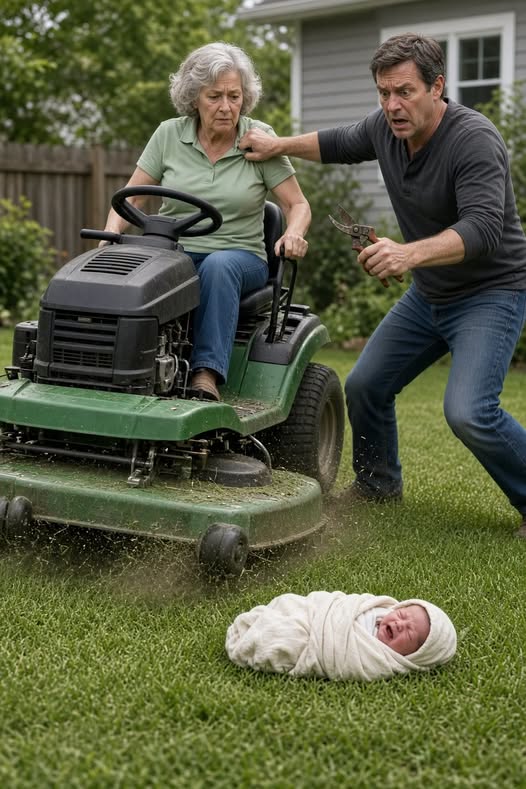
The deputy kept one finger on the phone screen while I stared at the thumbnail beside him. My stepmother was standing next to the bassinet in the middle of the night, close enough that her shadow fell across my sleeping baby’s face.
For a few seconds, nobody moved.
Then Dad stepped toward me.
“Play it.”
I looked at him. “Are you sure?”
He nodded once.
The deputy opened the recording.
The video showed our back patio shortly after midnight. The yard was dark except for the small pool of light above the kitchen door. My baby slept in the bassinet beneath the maple tree because I had been afraid the house would wake him. The monitor picked up the soft hiss of the night air, then the patio door opened.
My stepmother stepped outside.
She wasn’t carrying anything.
She walked directly toward the bassinet.
Dad’s jaw tightened.
The deputy raised a hand, telling everyone to stay quiet.
My stepmother leaned over my sleeping baby and stood there for nearly twenty seconds. Then she looked toward the house, pulled something from her robe pocket, and placed it on the ground beside the bassinet.
The recording ended.
Nobody spoke.
“What’s on the ground?” Dad asked.
The deputy replayed the final seconds and enlarged the image as much as the phone allowed.
It was a folded kitchen towel.
My stomach dropped.
I recognized it immediately.
It was the same towel my stepmother had used earlier that evening when she told me she had spilled formula near the sink.
The deputy looked at me.
“Did you see her put that there before?”
“No.”
“Did you leave the baby unattended after midnight?”
“No. I was in my room. The baby was asleep in the bassinet beside my bed.”
He looked back at the screen.
“Then this recording doesn’t explain why she was outside. It only tells us she was there.”
That distinction mattered.
The deputy didn’t turn the video into something it wasn’t. He didn’t accuse her of anything the footage couldn’t prove. He simply asked for every recording surrounding that time.
There were twelve.
Most showed nothing more than darkness, tree branches moving, or the occasional moth passing the lens.
But the ninth clip made Dad sit down.
At 12:41 a.m., my stepmother came outside again.
This time, she wasn’t alone.
Dad appeared behind her.
I looked at him.
He looked back at the screen.
In the recording, my stepmother pointed toward the bassinet and said something too faint for the monitor to capture clearly. Dad answered. Then both of them disappeared back into the house.
“I don’t remember that,” Dad whispered.
My stepmother’s face had gone completely still.
The deputy asked, “Do you want to tell us what happened during that conversation?”
She shook her head.
“I was half asleep.”
Dad stood up.
“You woke me up.”
She looked at him.
“I don’t remember.”
“You told me the baby had been crying.”
She didn’t answer.
Dad stared at her for several seconds, then looked toward me.
“I thought she was asking me to move the bassinet inside.”
My voice came out quietly.
“You never told me that.”
He closed his eyes.
“I know.”
The deputy asked whether there were more cameras on the property.
There was one over the garage and another facing the driveway. Neither belonged to me. Dad had installed them years earlier for security.
He gave the deputy permission to access the recordings.
The garage camera showed my stepmother walking across the yard at 12:39.
The driveway camera showed her returning at 12:47.
But the footage between those times was the part nobody expected.
She had gone to the detached shed.
She came back carrying a red plastic fuel container.
My breath caught.
The deputy paused the video.
“Is that yours?”
I shook my head.
Dad stared at it.
“That’s for the mower.”
The deputy looked at him.
“Where was it stored?”
“In the shed.”
“Was the mower fueled that night?”
“I don’t know.”
The deputy wrote something down.
My stepmother finally spoke.
“I was going to mow the next morning. That’s all.”
The deputy didn’t respond immediately.
Instead, he asked Dad to walk him through the property.
The two men left the patio.
I stayed with my baby.
My stepmother remained on the ambulance stretcher under supervision, her injured shoulder immobilized.
For the first time since I had come home, she looked smaller than the woman who had controlled every room she entered.
But I wasn’t relieved.
Not yet.
Because the video had answered one question and created another.
Why had she been near my baby in the middle of the night?
And why had she brought the fuel container back toward the mower?
The deputy returned about ten minutes later.
He carried a clear evidence bag.
Inside was a small black object.
My phone was still in my hand when I recognized it.
“That’s the old monitor battery pack,” I said.
Dad frowned.
“Why was it in the shed?”
Nobody answered.
The deputy explained that the battery compartment on the monitor had been opened at some point. He had found the loose pack on a shelf near the mower equipment.
My baby monitor had never stopped recording because it was connected to the camera’s backup power.
But someone had apparently handled it.
My stepmother immediately said, “I didn’t touch it.”
The deputy looked at her.
“I didn’t say you did.”
That was the moment she made her mistake.
She stopped talking.
The deputy returned to the recordings.
He searched the monitor’s motion history from the previous three nights.
At first, there was nothing unusual.
Then he found a pattern.
Every night, sometime after midnight, the patio door opened.
Every night, my stepmother went outside.
And every night, she stood near the bassinet for less than a minute before returning inside.
Three nights.
Three visits.
My father watched all three.
On the third recording, his expression changed.
He remembered something.
“She asked me why the baby monitor light kept blinking.”
I looked at him.
“When?”
“Two nights ago.”
“And what did you tell her?”
“I told her it was probably the motion sensor.”
He rubbed his forehead.
“She asked if it saved video. I said I didn’t know.”
The deputy looked at me.
“Did you ever tell her it saved clips automatically?”
“No.”
That detail landed harder than anything else.
She had been checking the camera.
Not because she wanted to make sure the baby was safe.
Because she wanted to know what it could see.
The deputy asked the hospital to preserve my stepmother’s clothing and personal items for the investigators. He also requested the mower, fuel container, shed contents, and the camera’s original storage data.
Then he turned to Dad.
“I need you to understand something. The recording of the mower is strong evidence about what happened in the yard, but these earlier recordings will have to be examined separately. Nobody should assume they prove more than they actually show.”
Dad nodded.
He seemed grateful for the distinction.
Then he looked at me.
“I owe you an apology.”
I didn’t answer.
He stepped closer.
“I should have believed you when you told me what she was saying.”
I held my baby tighter.
“You didn’t have to believe everything immediately. You just had to listen.”
Dad swallowed.
“You’re right.”
The deputy interrupted gently.
“There’s one more thing.”
He held up the monitor phone.
The camera had captured audio from the night before the mower incident.
At 2:13 a.m., my stepmother had stood beside the bassinet again.
This time, the microphone caught her voice.
She wasn’t speaking to the baby.
She was speaking to someone on the phone.
“If she stays here, he won’t ever choose me.”
A pause.
Then:
“I need her gone before he gets used to having her here.”
Dad stared at the phone.
My stepmother looked away.
The deputy asked whether we knew who she had been calling.
I didn’t.
Dad did.
“Her sister.”
My stepmother’s eyes snapped toward him.
Dad kept going.
“She talks to her every night.”
The deputy made another note.
For the first time, my stepmother looked frightened.
Not because of the injury.
Because the story she had been telling Dad for weeks had started falling apart without me having to say another word.
Still, there was one thing I couldn’t stop thinking about.
The baby.
The deputy noticed.
“You need somewhere safe tonight?”
I looked at Dad.
He nodded before I could answer.
“She can stay here.”
The deputy’s expression stayed neutral.
“Only if she wants to.”
Dad looked at me.
“Anywhere you want. I’ll take you.”
That was different from the father who had stood beside the ambulance asking what I had done.
I looked toward the house.
For weeks, that place had felt like a favor I was afraid to lose.
Now I understood that a home wasn’t just walls someone allowed you to sleep behind.
It was supposed to be the place where you didn’t have to wonder whether your child was safe while you closed your eyes.
I told Dad I wanted to leave for the night.
He didn’t argue.
He went inside and packed a small bag for me while I stayed outside with the baby.
When he returned, he handed me the bag and something else.
My house keys.
I stared at them.
“Why are you giving me these?”
“Because you shouldn’t have to ask permission to come back to your own father’s house.”
I almost cried.
But then I saw the look on his face.
He wasn’t asking me to forgive him.
He was accepting that he had failed to protect me when I needed him to.
That mattered more.
At the hospital, investigators spoke with my stepmother separately.
The evidence from the mower was straightforward: the machine had crossed the area she claimed she was mowing, the tire tracks pointed toward the bassinet, and the monitor captured her statement before I reached her.
My attack on her was also documented.
I had admitted it immediately.
The investigators treated those facts separately instead of pretending one erased the other.
My attorney later explained that protecting my baby did not mean I was automatically free from consequences for what I had done. The circumstances, the evidence, and the decisions made by law enforcement and prosecutors would determine what happened next.
For once, I didn’t have to invent an answer.
I only had to tell the truth.
Two days later, the sheriff’s office contacted me again.
They had recovered the original recordings.
The footage showed something that hadn’t been visible on my phone’s small screen.
On the morning of the mower incident, before my stepmother came outside, she had entered the shed.
She checked the fuel level.
Then she checked the mower blades.
Then she looked directly toward the maple tree.
She had already decided where she was going.
The deputy also told me investigators had found the same kitchen towel from the midnight recording inside the shed, along with dirt matching the soil around the bassinet.
That evidence did not answer every question.
But it connected the nighttime visits to the morning preparation.
And it gave investigators a timeline they could test instead of a story they had to guess at.
My stepmother’s sister was interviewed too.
She initially denied knowing anything.
Then investigators showed her the phone records and asked about the late-night calls.
She admitted my stepmother had complained for weeks that my return had changed Dad’s attention.
She also admitted that my stepmother had repeatedly said she wanted me out of the house.
But she denied knowing anything about the mower.
That distinction stayed important.
One person’s anger did not automatically make another person part of a crime.
My stepmother eventually faced charges related to the incident, while the investigation into the earlier conduct continued separately.
My own case was reviewed based on the evidence and the circumstances surrounding the intervention.
Nothing happened as quickly as television makes these things happen.
There were interviews.
Reports.
Medical records.
Evidence reviews.
Statements from neighbors.
And difficult conversations with my father.
But there was one conversation I will never forget.
It happened three weeks later, after the baby had finally started sleeping for longer stretches.
Dad came to the apartment where I was staying.
He stood in the doorway holding a cardboard box.
“I found these.”
Inside were my old baby clothes, some family photographs, and the little wooden toy my mother had bought before she died.
I picked it up.
“You kept this?”
“Your stepmother wanted it thrown away.”
I looked at him.
He shook his head.
“I should have stopped a lot of things before they became emergencies.”
I didn’t tell him he was wrong.
Because he wasn’t.
He sat down across from me.
“I can’t undo what happened.”
“No.”
“But I can make sure I never ask you to ignore your instincts again.”
I looked down at my sleeping baby.
“That’s all I wanted.”
He nodded.
Months later, the baby monitor was still in a box on the top shelf of my closet.
I couldn’t bring myself to throw it away.
Not because I wanted to remember the fear.
Because it had recorded the truth when the people around me couldn’t see it.
The monitor had started as something ordinary—a way for a tired mother to hear her newborn from another room.
It became the witness that changed the entire story.
And I learned something I wish I had understood before that morning.
When someone keeps telling you that you misunderstood what you saw, what you heard, or what you felt, you don’t always need a louder argument.
Sometimes you need the truth preserved long enough for everyone else to finally hear it.
That afternoon in the yard, I had only been thinking about getting my baby away from a moving mower.
I didn’t know the camera had already been watching.
I didn’t know my father would eventually see what I had been trying to explain for weeks.
And I certainly didn’t know that one tiny recording from the middle of the night would expose a pattern that had started long before the mower ever crossed the grass.
My baby was safe.
My father finally understood.
And the woman who had spent weeks insisting that I was the problem could no longer control the story simply by saying I was tired, emotional, or confused.
The evidence had its own voice.
This time, everyone listened.