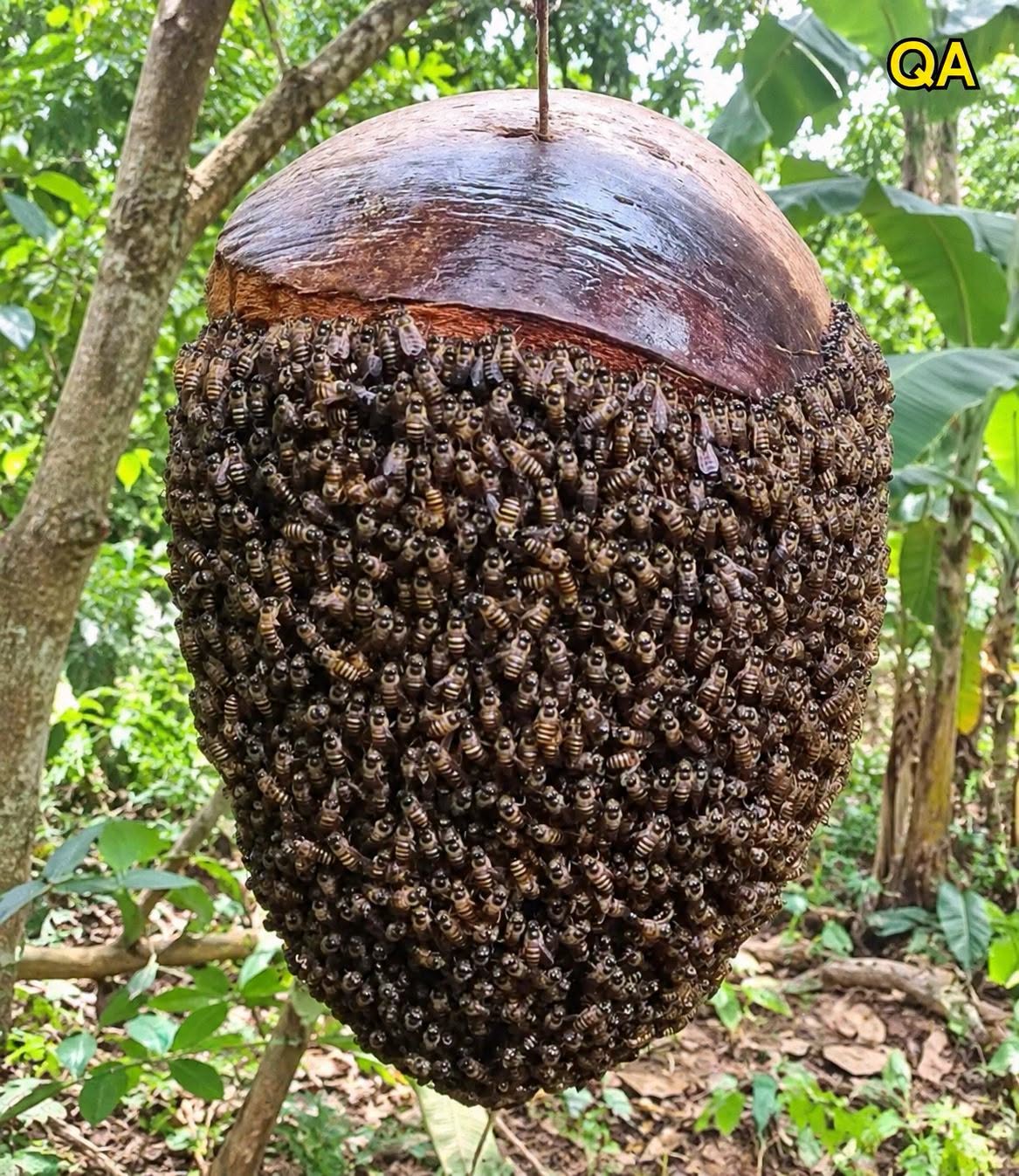
Bees don’t just buzz. They build worlds.
Inside every healthy hive, thousands of tiny bodies move through a society so organized that it can seem almost impossible to believe it is happening without a central commander. There is no single bee standing above the others giving orders. Instead, individual insects respond to changing conditions, communicate through movement and scent, and carry out tasks that collectively keep the entire colony alive.
From the outside, a hive can appear quiet and mysterious. But inside, it is constantly moving.
Workers crawl across honeycomb, tending larvae, cleaning cells, feeding the queen, processing food, repairing damaged areas, regulating temperature, and guarding entrances. Others leave the hive and disappear into the landscape, traveling enormous distances relative to their tiny bodies in search of nectar and pollen.
Every flight carries risk.
A foraging bee may encounter wind, rain, predators, pesticides, exhaustion, or simply become lost. Yet she continues because the food she brings home can determine whether thousands of other bees survive.
One of the most remarkable things about honeybees is that their jobs are not necessarily fixed for life. Young workers generally begin with tasks inside the hive. They may clean cells, feed developing larvae, or care for the queen. As they grow older, their responsibilities can change.
Eventually, many become foragers.
That means a bee’s life can be divided into different stages, with each stage contributing something different to the colony.
The transition is not simply a promotion in the human sense. It is a response to the needs of the hive. If more young bees are needed to care for larvae, workers can remain inside. If food is scarce, more bees may become involved in foraging.
The colony effectively reorganizes itself according to circumstances.
And that becomes even more impressive when winter arrives.
Honeybees do not simply leave the hive and migrate to warmer places. They cannot survive the winter by flying continuously, nor do they enter the deep hibernation associated with some mammals.
Instead, they stay together.
Thousands of bees gather into a dense cluster around the queen. The outer bees form an insulating layer while those toward the center remain warmer.
Then something extraordinary happens.
The bees generate heat with their bodies.
They contract their flight muscles, creating warmth without actually flying. The cluster can adjust itself as temperatures change, tightening when conditions become colder and shifting as necessary to maintain a survivable environment.
It is a living heating system made entirely of insects.
Inside that cluster, the colony is fighting the cold one tiny body at a time.
Honey stored during warmer months becomes crucial during this period. The bees consume their reserves while maintaining the colony’s temperature. If food runs out, the colony can starve even if the outside world eventually becomes warm again.
The hive’s survival therefore depends on decisions and work that happened weeks or months earlier.
The flowers visited during summer.
The nectar collected.
The honey stored.
The cells maintained.
All of it becomes part of the colony’s winter survival.
And bees are not machines.
They become exhausted.
A foraging bee can spend hours traveling between flowers and the hive, carrying loads of pollen or nectar back to the colony. Flying consumes enormous amounts of energy for such a small animal.
After intense activity, bees can rest.
They may become motionless for periods of time, tucked into quiet spaces within the hive or elsewhere. Researchers have documented sleep-like states in honeybees, including changes in posture and responsiveness.
Even their tiny nervous systems require periods of rest.
That detail makes their lives feel surprisingly familiar.
They work.
They rest.
They age.
They become vulnerable.
And eventually, they die.
Some bees never return from their final foraging flight.
A worker may leave the hive one morning and simply disappear from the colony’s story. There may be no ceremony, no moment of recognition, and no individual understanding of what happened.
Yet the hive continues.
Another worker takes on another task.
Another bee leaves for flowers.
Another feeds larvae.
Another cleans a cell.
The colony survives through replacement and cooperation.
That is one of the strangest and most beautiful aspects of bee society.
An individual bee has a short life, but the colony can persist for years.
The individual is temporary.
The system continues.
And every bee contributes to that larger system without needing to understand the entire structure.
A forager doesn’t need to understand the nutritional needs of every larva.
A nurse bee doesn’t need to know where the day’s nectar came from.
A guard doesn’t need to know what happened in the farthest field.
Each bee responds to immediate signals and needs.
Together, those countless small responses produce something that looks remarkably like collective intelligence.
Communication plays a central role.
When a successful forager returns to the hive, she can communicate information about food sources through movement. The famous waggle dance allows honeybees to convey directional and distance information about profitable food locations.
A bee cannot speak.
Yet somehow, a colony can exchange information about where resources are located across the surrounding landscape.
That communication can influence where other bees forage.
The result is an enormous network of tiny decisions.
And the impact of those decisions extends far beyond the hive.
Every time a bee lands on a flower, she may pick up pollen and carry it to another plant. That simple movement can help flowers reproduce.
Across fields, gardens, orchards, forests, and wild landscapes, pollinating insects connect plants that might otherwise remain isolated.
Bees are therefore part of a much larger ecological system.
They help plants produce seeds and fruit.
Those plants support other insects.
Those insects become food for birds, reptiles, mammals, and countless other creatures.
The effects continue outward.
A single bee visiting a flower may seem insignificant.
But multiplied across thousands of bees and millions of flowers, those individual actions become part of the machinery that supports entire ecosystems.
Humans benefit from this process as well.
Many crops depend on pollinators to produce fruits, seeds, or higher yields. The food on a supermarket shelf can therefore be connected to countless insects working quietly in fields and orchards.
We rarely see