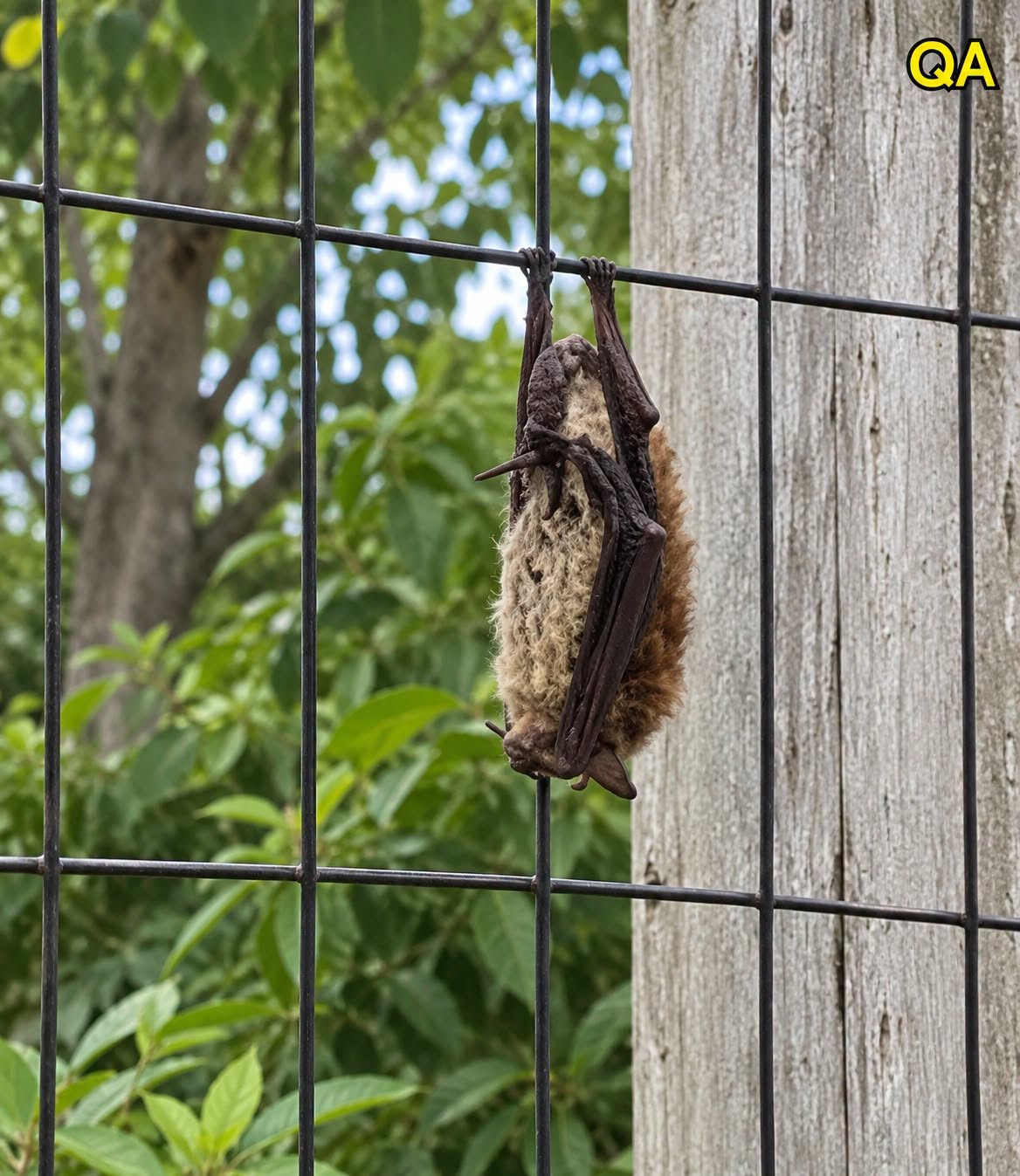
A storm passed. The rain eventually stopped, the clouds moved on, and the world outside slowly returned to normal. Roads dried. People went back to their routines. Trees stopped dripping, and the quiet of the neighborhood returned.
But one small, aging bat was still hanging onto a cold metal fence.
She had been there through the rain and wind, soaked, exhausted, and barely strong enough to hold herself in place. For three days, no one knew she was there. No one was looking for her. Cars passed. People walked by. Life continued around her while she remained almost invisible, clinging to the metal with whatever strength she had left.
Then a stranger looked twice.
That second glance changed everything.
The bat would eventually be known as Bea Arthur, a senior brown bat whose life nearly ended unnoticed on a fence in Gilbertsville, Pennsylvania. When the storm arrived, she had apparently been unable to find a safe place to shelter. The cold, wet conditions left her dangerously weak, and instead of flying away when the weather cleared, she remained exactly where she had been—hanging on and waiting.
For three days, Bea endured.
Her tiny body had no protection from the elements. Every hour spent exposed meant more energy lost. Bats are remarkably capable animals, but an aging or injured bat can become vulnerable very quickly. Without enough strength to fly, find food, or reach a protected roost, even a small amount of bad weather can become life-threatening.
And Bea was already old.
When the homeowner finally noticed her, something about the little animal didn’t look right. She wasn’t behaving like a healthy bat that had simply landed temporarily. She was still there, barely moving, and clearly needed help.
The homeowner could have walked past.
It would have been easy to assume she would eventually fly away.
Instead, the person stopped.
They looked closer.
And then they reached out for help.
That single decision brought Pennsylvania Bat Rescue into Bea’s story.
Suddenly, the little bat who had spent days alone on a fence was no longer alone.
She was carefully rescued and brought somewhere warm and safe, where people could assess her condition and give her the care she desperately needed.
For Bea, the rescue wasn’t about returning immediately to the wild.
It was about survival.
At the sanctuary, her personality began to emerge.
She was shy.
She was delicate.
And despite everything she had endured, she was described as sweet.
There was something remarkable about seeing such a tiny creature finally able to relax after spending days exposed to the weather. Instead of gripping a freezing piece of metal, Bea had a safe place to rest. Instead of struggling against wind and rain, she could settle into warmth. Instead of being completely alone, she was surrounded by people who understood exactly what she needed.
She eventually found a favorite hammock.
It might sound like a small thing, but for Bea, it represented something much bigger.
Comfort.
Security.
A place where she could rest without having to fight the elements.
Age and injury meant that Bea could not safely return to the wild. She would not be able to hunt reliably or protect herself the way a healthy wild bat could. For some rescued animals, permanent sanctuary care can feel like an unfortunate ending.
But Bea’s story shows why that isn’t necessarily true.
Being unable to return to the wild doesn’t mean an animal’s life has lost its value.
It simply means the definition of rescue has changed.
For Bea, rescue meant having another chance to live safely.
It meant having food when she needed it.
It meant warmth during cold nights.
It meant a hammock she could return to.
It meant being surrounded by other non-releasable bats rather than disappearing alone on a fence where nobody knew she was struggling.
And perhaps most importantly, it meant someone noticed.
That is what makes Bea’s story so moving.
Her rescue did not begin with someone searching for her.
It began with someone happening to look twice.
The first glance might have been easy to dismiss.
The second glance became an act of compassion.
There are countless small creatures living around us that most people never notice. They hide beneath roofs, in trees, behind buildings, under bridges, and in quiet corners of the places we pass every day. When something goes wrong, they often cannot call for help.
They simply wait.
Bea waited for three days.
She couldn’t explain that she was exhausted.
She couldn’t tell anyone that she needed shelter.
She couldn’t knock on a door.
All she could do was hold on.
And someone finally saw her.
Today, Bea’s story carries a message much larger than one little bat. It reminds us that rescue does not always look dramatic. Sometimes there is no dramatic chase, no heroic moment, and no spectacular transformation.
Sometimes rescue is simply stopping.
Looking closer.
Calling someone who knows what to do.
And refusing to walk away from a vulnerable animal because its situation is inconvenient or unfamiliar.
Bea may never again fly freely beneath the night sky, hunting insects under the stars. Her life took a different path. But that doesn’t make the life she has now meaningless.
She has warmth.
She has safety.
She has care.
She has a favorite place to rest.
And she has a story that might never have existed if one person hadn’t taken a second look.
The storm eventually passed.
The fence eventually dried.
The world continued moving.
But Bea’s story didn’t end there.
Instead of disappearing quietly after three difficult days, she was given something every living creature deserves when it is vulnerable: a chance to be cared for.
Her tiny body may have been fragile, but her survival became a reminder of something powerful.
Sometimes the greatest act of rescue isn’t saving an animal and sending it back into the wild.
Sometimes it is simply giving a life that cannot return to the wild somewhere safe to continue.
And sometimes, the difference between life and death is nothing more than one person looking twice—and deciding not to look away.