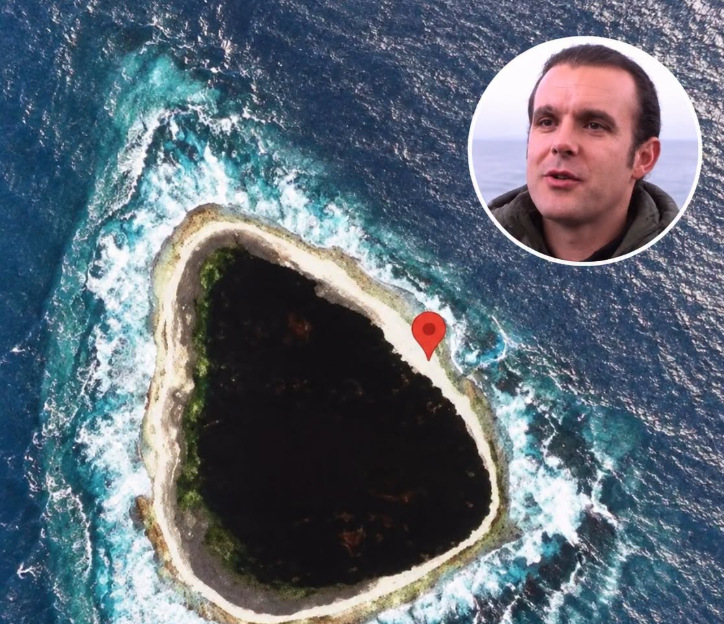
A black wound in the middle of the Pacific.
That’s what millions of people thought they had found when they stumbled across a strange image on Google Maps. Far from cities, shipping routes, and familiar coastlines, there appeared to be a perfect dark void surrounded by brilliant blue water. The contrast was so dramatic that it looked almost unnatural—as if someone had cut a hole into the middle of the ocean and left nothing behind.
There was no obvious explanation.
The surrounding Pacific stretched endlessly in every direction, bright and blue beneath the sun, while the strange shape at the center seemed almost completely black. It looked less like an island and more like an absence.
And the internet immediately noticed.
Rumors began spreading almost as quickly as people could share screenshots. Some wondered whether Google had deliberately censored something. Others suggested a secret military installation hidden far from civilization. A few went even further, suggesting that the strange image could be evidence of some unexplained phenomenon—a portal, an underwater structure, or something that simply wasn’t supposed to be visible.
The more mysterious the image appeared, the more dramatic the theories became.
But the truth was not hiding behind a government cover-up.
It wasn’t a glitch.
It wasn’t a tear in reality.
And there was certainly no mysterious hole swallowing the Pacific.
The strange black shape was Vostok Island, an extraordinarily remote speck of land belonging to Kiribati.
From the ground, Vostok is a small tropical island surrounded by an enormous ocean. From above, however, it can look almost completely different. Its interior is covered by extraordinarily dense vegetation, creating a dark mass that absorbs and reflects light differently from the bright waters surrounding it.
The result is an image that can look almost surreal.
Instead of seeing the familiar greens associated with many tropical islands, viewers looking at satellite imagery can see what appears to be an enormous black or extremely dark center. Around it, waves and shallow waters create a bright ring of blue and white.
The visual effect is extraordinary.
It is easy to understand why someone seeing the image without context might believe something strange was happening there.
The island is also remarkably isolated. Vostok is part of the Southern Line Islands of Kiribati, far from the densely populated areas that most people associate with the Pacific. There are no major cities, no busy streets, and no ordinary signs of human activity that would immediately explain what the image represents.
From a computer screen, it can look like another world.
But the real surprise begins when you stop looking at Vostok from space and look beneath the surrounding water.
The darkness on the map isn’t a doorway into something terrifying.
It is a sign of how much life the island is capable of supporting.
Divers exploring the waters around Vostok encountered an underwater environment filled with marine life. Sharks moved through the blue. Barracuda flashed through the water. Schools of jacks and surgeonfish moved together in enormous formations, creating the impression of living clouds beneath the surface.
What had looked lifeless from above was anything but lifeless below.
The contrast was almost poetic.
From a satellite, the island looked like a black hole.
From underwater, it was bursting with movement.
The remote location that helped create the mystery also helped protect the surrounding environment from the constant human activity found in more accessible destinations. There were no crowded beaches filled with tourists, no enormous hotels rising along the shoreline, and no busy harbor cutting through the landscape.
Instead, there was isolation.
There was reef.
There was jungle.
There was an ocean full of creatures moving through waters that appeared remarkably untouched.
One diver reportedly described the experience as the best dive of his life, calling it among the most pristine places he had ever encountered.
And suddenly, the story changed completely.
The internet had looked at the image and imagined something frightening because the darkness seemed unnatural. But the reality was almost the opposite.
The darkness was life.
The dense vegetation was responsible for much of the strange appearance from above. The surrounding ocean reflected sunlight in ways that made the contrast even more dramatic. Put those elements together, and a perfectly ordinary natural feature could suddenly look like one of the strangest places on Earth.
It was a reminder of how easily a photograph—or in this case, a satellite image—can distort our understanding of a place.
We see a shape before we understand what created it.
We see darkness and imagine danger.
We see something unfamiliar and fill the empty spaces with our own theories.
But sometimes the explanation is far more fascinating than the mystery.
Vostok Island doesn’t need a secret base or an unexplained portal to be extraordinary.
Its isolation, dense vegetation, surrounding reefs, and abundant marine life are remarkable enough.
The strange image that sent people searching for answers wasn’t evidence of something being hidden.
It was evidence of something remarkably wild.
And perhaps that is what makes the story so memorable.
The internet wanted a mystery.
Google Maps appeared to show a black hole in the Pacific.
People imagined censorship, secrets, and things that shouldn’t exist.
But when explorers finally reached the remote island and entered the waters around it, they didn’t discover horror.
They discovered abundance.
They discovered sharks moving through clear blue water, barracuda cutting through the current, and huge schools of fish turning together beneath the surface.
They discovered a place where nature had been allowed to remain powerful enough that, from space, it could actually look impossible.
The black hole was never a hole.
It was a forest.
And beneath it was an underwater world so alive that the reality turned out to be far more extraordinary than the rumor.