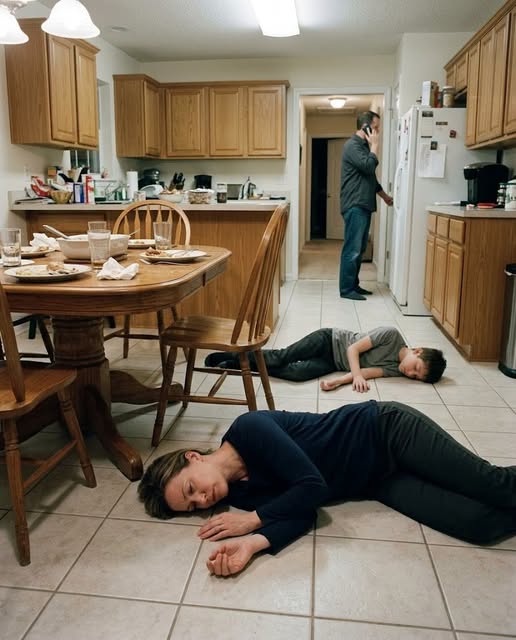
The officer who had gone into the garage returned carrying two phones in one gloved hand. He looked at Daniel before he looked at me.
“They were inside his toolbox.”
Daniel said nothing.
Until that moment, some part of me had still been waiting for an explanation impossible enough to save the life I thought I knew. Maybe Daniel had panicked when Noah and I collapsed. Maybe I had misunderstood the phone call. Maybe there was some chain of innocent choices that would make sense once everyone stopped shouting.
But there was no innocent reason to hide both of our phones in a toolbox while we lay unconscious on the kitchen floor.
A paramedic guided Noah into a chair while another checked me. Daniel finally spoke when an officer asked him to step away from the table.
“My wife is confused,” he said. “They both fainted. I moved the phones because I was trying to clear the counters.”
The officer glanced toward the garage door.
“You cleared them into a closed toolbox?”
Daniel’s jaw tightened.
“I wasn’t thinking clearly.”
Neither was I, but I knew enough to keep my hands away from the blue plate.
The sealed freezer bag beneath my shirt had already been handed to an officer, who photographed it before placing it inside another evidence bag. I explained exactly how I had collected it, where the food had been sitting, and that I had returned the plate to the table before Daniel came back.
Daniel stared at me when he realized what I had saved.
That look frightened me more than his excuses.
It was not confusion.
It was calculation.
Noah and I were taken to the hospital. By then the weakness in my legs had deepened, and Noah could barely keep his eyes open. The emergency physician told us they were treating the symptoms while blood and urine samples were sent for testing. She would not guess what we had ingested, but she asked several times whether either of us took prescription sedatives.
We did not.
I asked about Daniel.
The officer accompanying us said only that he was being questioned and that the kitchen had been secured.
Noah waited until the officer stepped into the hallway before speaking.
“Mom, he checked my pulse.”
“I know.”
“He knew I was still alive.”
I turned toward him.
Noah’s eyes were red, but his voice was steady.
“He touched my neck. Then he said it would be easier for everybody.”
I had heard the sentence. Hearing Noah repeat it made it real in a different way.
Daniel had not discovered us unconscious and panicked.
He had inspected us.
We spent the night under observation. The next morning, a detective named Elena Rivera came to the hospital. She did not begin by asking whether Daniel and I had been fighting. She asked about ordinary things: who bought groceries, who normally cooked, whether Daniel had eaten the same meal, whether he had access to medications, whether he knew the old pantry phone still worked.
That last question stopped me.
Daniel absolutely knew about the phone.
Or at least he had once.
Years earlier, he had teased me for refusing to remove it.
“Who keeps a corded phone anymore?” he had asked.
Apparently, someone who would one day need it to survive her husband.
Rivera wrote something down.
Then she asked whether Daniel had eaten dinner with us.
“No,” I said. “He said he’d been tasting everything while he cooked and wasn’t hungry.”
Noah looked at me.
Neither of us had thought about that detail the night before.
Rivera had.
Two days later, preliminary testing found a heavy sedative in both our systems. The same substance was detected in the food I had sealed in the freezer bag.
The amount in the remaining food was high enough that Rivera stopped calling the case a possible accidental exposure.
She also told me something else.
Daniel had a current prescription for the same medication.
He told investigators that some tablets might have been crushed accidentally near the kitchen counter several days earlier.
Rivera did not tell me what she thought of that explanation. She did not need to.
Noah and I had eaten from different plates. Daniel had prepared both portions. Neither of us took his medication. Daniel had not eaten the meal himself.
And our phones had been hidden in his garage.
The first major break came from Daniel’s call records.
The call I had overheard was real.
It had lasted seventy-eight seconds and had been placed less than three minutes after Noah and I collapsed.
But it had not gone to anyone I recognized.
The number belonged to a prepaid phone.
For almost a week, that was all Rivera would tell me.
During that week, Noah and I stayed with my sister, Leah. It was the first quiet stretch we had after the hospital, and it was worse than I expected.
The danger had passed, but our bodies did not believe it.
The first evening, Leah made soup. Noah stood in the kitchen doorway watching her ladle it into bowls.
He did not sit down.
Leah noticed.
“Oh, honey,” she said, immediately setting the ladle aside. “I should have asked.”
She was trying to help, but she made one mistake. She reached toward Noah’s bowl as if to taste it for him.
Noah recoiled so quickly that the chair behind him scraped across the floor.
Leah froze.
I almost told him everything was safe.
Then I realized that was exactly the kind of sentence I could no longer promise for him.
So I opened a sealed can from the pantry, handed him the opener, and let him prepare his own dinner.
It was not graceful. It was not normal. But he ate.
For the next few days, that was enough.
Daniel’s mother called me twice. I did not answer the first time. On the third day, she left a voicemail saying she was not asking me to forgive him or even speak to him. She only wanted to give the police something she had found.
Rivera collected it before I ever saw her.
It was a folder from Daniel’s home office that his mother had removed months earlier when Daniel asked her to store several boxes during a renovation.
Inside were insurance documents.
There was substantial coverage on my life.
There was additional coverage connected to Noah.
The policies themselves were not proof of a crime. Rivera made that clear. Families buy insurance every day.
The timing was harder to dismiss.
Daniel had increased the coverage less than two months before the dinner.
That discovery changed the investigation again, but not in the way I expected.
The financial records did not show a husband preparing to become comfortably wealthy.
They showed a man running out of time.
Daniel’s contracting business had been losing money for more than a year. He had personally guaranteed loans I knew nothing about. Payments were overdue. Several transfers had been made between company accounts in amounts large enough to draw attention, then covered temporarily with money from another line of credit.
My signature appeared on paperwork connected to our house.
I had never signed it.
When Rivera placed a copy in front of me, I stared at my own name written by someone who had spent fifteen years watching me sign birthday cards, checks, school forms, and tax documents.
It was close.
It was not mine.
That was when the investigation stopped being only about what Daniel had put in our dinner.
Someone had been helping him hide money.
Her name was Lydia Mercer, the outside bookkeeper Daniel had used for years.
I knew her well enough to recognize her at company Christmas parties and not well enough to know anything about her life. Daniel had always described her as meticulous, difficult, and indispensable.
The prepaid number Daniel called after we collapsed had contacted Lydia’s personal phone repeatedly during the previous month.
When investigators questioned her, Lydia denied owning it.
She admitted the company was in trouble but blamed Daniel entirely. She said she had warned him that moving money between accounts could become fraud. She insisted she knew nothing about the insurance policies, the forged signature, or what happened in our kitchen.
For several days, that seemed possible.
Then police searched Daniel’s vehicle.
Hidden beneath the spare tire was the prepaid phone.
Its message history had been deleted.
The deletion should have made me feel hopeless.
Instead, Rivera smiled for the first time since I met her.
“Deleting something and destroying it are not always the same thing,” she said.
Digital investigators began recovering fragments.
The first fragments were about money.
Then came references to timing.
One message from Lydia asked whether I would be home Friday night. Another asked whether Noah had plans to go out.
Daniel had replied that we would both be there.
Lydia still denied knowing what he intended.
She claimed Daniel had told her he was planning to leave me suddenly and needed to know when he could remove documents from the house without interference.
That explanation bought her time.
It also gave Daniel a new defense.
Through his attorney, he now claimed the dinner had been a terrible medication accident followed by panic. He said he hid our phones because he feared I would see financial messages and call the police about the forged paperwork while he was trying to decide what to do.
It was an ugly story.
But unlike murder, parts of it were supported by evidence everyone could already see.
For the first time, I understood why Rivera had refused to promise me an easy case.
The food sample proved Noah and I had ingested Daniel’s medication. It did not show his hand crushing the tablets.
The insurance showed motive, not action.
The forged signature showed financial crimes, not attempted murder.
And I had heard only Daniel’s side of the phone conversation.
I knew what I had heard.
A courtroom would require more than my certainty.
That was the lowest point.
Noah and I had survived the kitchen, survived the hospital, and helped uncover an entire hidden financial life, yet I began to fear Daniel would reduce the most terrifying night of our lives to a series of coincidences.
Then Lydia disappeared.
She missed a scheduled interview with investigators. Her attorney said he could not reach her. Daniel’s defense immediately suggested that if anyone had committed a crime, police should be looking at the bookkeeper who had suddenly run.
For forty-eight hours, every news story about the case seemed to shift toward her.
I hated myself for wondering whether Daniel might actually succeed in pushing everything onto someone else.
On the third morning, Rivera called me.
“We found Lydia,” she said.
My hand tightened around the phone.
“Where?”
“She came in with another attorney.”
I waited.
Rivera’s next sentence changed the case.
“She kept copies of the messages.”
Lydia had not vanished to escape police. She had gone to her sister’s house two states away after Daniel’s attorney contacted her attorney and suggested, according to Lydia, that their stories needed to remain consistent.
That frightened her enough to stop protecting him.
But the messages she surrendered did not protect Lydia either.
She had lied about what she knew.
Weeks before the dinner, Daniel had told her he needed the insurance money before lenders exposed the forged home documents. Lydia had helped him calculate how long certain claims could take. She had searched company computers for information about beneficiary paperwork. She had also known he was considering using his prescription medication to make two deaths appear accidental.
Her involvement was not a misunderstanding.
She had encouraged him.
The message that mattered most was sent the afternoon Daniel cooked for us.
Lydia wrote: “You’re certain both of them will eat?”
Daniel answered: “I’m cooking. They won’t suspect me.”
Later she sent another message referring to my blue plate and Noah’s darker one.
Daniel replied that he had already separated the portions.
That explained something I had not been able to stop thinking about.
The food had not been contaminated in one pot by accident.
The portions had been prepared separately.
Lydia’s saved messages also contained the line investigators had been missing. Shortly before dinner, Daniel told her he would call only after we were down.
The seventy-eight-second call came exactly when he promised.
Lydia eventually admitted what he said during it.
According to her statement, Daniel told her we had eaten, collapsed, and were no longer moving.
Then he said the words I had heard through the wall.
“It’s done.”
Lydia had asked whether he was sure.
Daniel answered that soon we would both be gone.
For months afterward, people asked me how I had managed to stay still while Daniel checked my wrist.
I never found a satisfying answer.
I was not calm. I was not brave in the way people wanted the story to sound. I was terrified enough that every sound in that kitchen seemed painfully loud: the refrigerator motor, Daniel’s shoes, Noah breathing on the floor.
I simply knew that moving before Daniel left could take away the only advantage we had.
The case moved slowly after Lydia began cooperating. She faced charges of her own and eventually entered an agreement requiring her to testify and provide the records she had preserved. Daniel continued denying that he intended to kill us, even after the recovered financial documents, food testing, call records, and Lydia’s messages were assembled into one timeline.
He finally changed his plea shortly before trial was scheduled to begin.
I was in the courtroom when he stood before the judge.
He looked smaller than he had in our kitchen.
Not weaker. Not remorseful.
Just stripped of the control he had possessed when he believed Noah and I could no longer hear him.
When the judge asked whether he understood the consequences of his plea, Daniel said, “Yes.”
It was the first uncomplicated truth I had heard from him since dinner.
He received a lengthy prison sentence for the attack and related offenses. Lydia received a lesser sentence under her cooperation agreement, along with consequences for her role in the financial scheme. The forged home documents were unwound through a process that took far longer than I wanted, and the business Daniel had tried to save eventually collapsed anyway.
None of that restored what Noah and I had lost.
For a while, food became a negotiation. Noah preferred sealed containers. I checked labels twice. If someone cooked behind me, I caught myself watching their hands.
Then ordinary life began returning in pieces too small to notice at first.
Noah started making breakfast.
I stopped standing beside him while he cooked.
Leah invited us to dinner again, and this time Noah walked into her kitchen before she could ask. He lifted the lid from a pot, smelled the sauce, and stole a piece of bread from the counter.
She laughed.
So did he.
Nearly a year after the night Daniel cooked for us, Noah came home carrying a shopping bag.
He pulled out two inexpensive ceramic plates.
Both were blue.
I stared at them longer than I meant to.
Noah noticed.
“We can get another color,” he said.
I shook my head.
“No. Blue is fine.”
That evening, he cooked pasta while I sat at the kitchen table and did absolutely nothing to help him.
When he placed one of the new blue plates in front of me, he smiled.
“This one’s ours.”
And for the first time since the night I pressed my cheek against the cold tile and pretended not to wake up, a blue plate was only a plate.