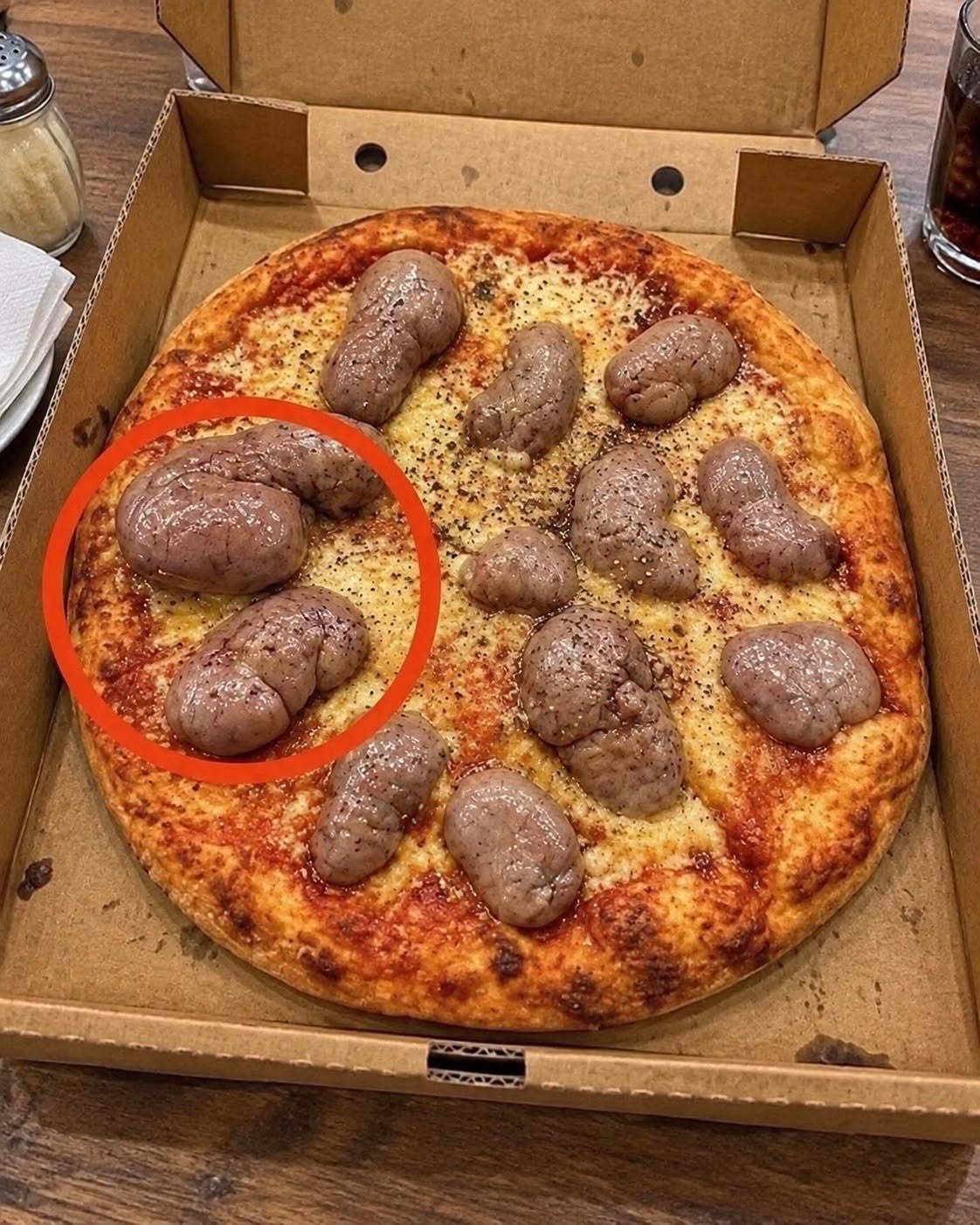
The horror hit before the first bite.
One second, I was starving. The kind of hungry where you can practically taste the food before the box is even open. I had been thinking about pizza all afternoon, imagining hot crust, melted cheese, salty toppings, and that first perfect bite.
Then I opened the box.
My appetite disappeared instantly.
I froze.
For several seconds, I simply stared.
The pizza looked wrong.
Not burnt. Not undercooked. Not even badly made.
Wrong.
Strange, glistening blisters bulged beneath the layer of melted cheese, rising into translucent little domes that caught the light whenever I moved the box. Some were barely noticeable. Others were large enough to make the cheese look as though something underneath it was trying to push its way through.
I leaned closer.
That was a mistake.
The closer I looked, the worse it became.
The bubbles had an almost organic appearance. They weren’t the normal golden pockets of air I was used to seeing on pizza. These looked wet, glossy, and strangely alive.
My stomach turned.
I actually stepped backward from the kitchen counter.
“What is that?”
I said it aloud even though nobody else was there.
For a moment, I considered closing the box and throwing the entire thing into the trash.
Then another thought hit me.
What if it wasn’t harmless?
What if something had contaminated the cheese?
What if the pizza had been stored incorrectly?
What if bacteria had somehow caused those strange formations?
And then my imagination went even further.
I pictured chemicals.
Spoiled dairy.
Some bizarre manufacturing mistake.
Something microscopic and dangerous multiplying beneath the cheese while I had been sitting there waiting eagerly for dinner.
Suddenly, the pizza didn’t look like dinner anymore.
It looked like evidence.
I pulled out my phone.
Within seconds, I was searching.
“Pizza cheese weird bubbles.”
Then:
“Transparent bubbles under mozzarella.”
Then:
“Is bubbly pizza cheese dangerous?”
The results only made me more confused.
Some people insisted that bubbling cheese was completely normal. Others described certain kinds of spoilage that could supposedly cause unusual textures and odors. Then I found pictures of pizzas covered in dramatic cheese bubbles that looked almost identical to mine.
That should have made me feel better.
It didn’t.
Instead, I fell deeper into the rabbit hole.
I started reading culinary forums.
Then pizza-making groups.
Then discussions written by people who seemed to know far more about cheese than I ever expected an ordinary person to know.
There were arguments about mozzarella.
Arguments about moisture.
Arguments about oven temperature.
Arguments about fermentation.
Someone mentioned steam.
Someone else mentioned fat.
Another person explained how cheese could form pockets during baking.
I kept scrolling.
Ten minutes passed.
Then twenty.
Then nearly thirty.
My pizza was still sitting untouched on the counter.
It was getting colder by the minute.
I had gone from being desperately hungry to conducting what felt like a forensic investigation.
I even started comparing photographs.
I zoomed in on my pizza.
Then I zoomed in on pictures posted by pizza makers.
The similarities were unsettling.
Still, I wasn’t convinced.
There was something about those translucent domes that made them look different from ordinary bubbles.
I imagined myself taking one bite and immediately realizing something was terribly wrong.
What if my mouth went numb?
What if I became sick?
What if the pizza had somehow been contaminated during preparation?
At that point, I realized something embarrassing.
I wasn’t investigating the pizza anymore.
I was investigating my own fear.
Then I found a comment from someone who identified himself as a veteran pizzaiolo—a professional pizza maker who had apparently spent years working with high-temperature ovens.
His explanation was almost laughably simple.
He said the strange bubbles were most likely caused by steam becoming trapped beneath the cheese as the pizza baked.
Heat causes moisture to turn into steam. The steam expands. Cheese stretches around it. Fat melts. The surface rises.
And suddenly, what looked horrifying was simply chemistry and physics doing exactly what they were supposed to do.
I read the explanation twice.
Then a third time.
Steam.
That was it?
I stared at the pizza again.
The terrifying translucent domes suddenly looked a little less sinister.
I moved the box closer to the kitchen light.
Sure enough, some of the bubbles had already collapsed.
Others had browned around the edges.
There was no strange smell.
No chemical odor.
Nothing leaking from beneath the cheese.
Just pizza.
I still wasn’t completely convinced.
So I performed one final test.
I picked up a slice.
The crust bent slightly under the weight of the toppings. The cheese stretched in long, glossy strands.
I hesitated.
My mind was still telling me to put it down.
But my stomach had other plans.
I took a tiny bite.
Nothing happened.
I chewed.
The crust was crisp around the edges and soft in the center.
The cheese was warm, salty, rich, and unbelievably good.
Then I took another bite.
And another.
The strange bubble I had been staring at suddenly collapsed beneath my teeth with a tiny burst of steam.
I froze for half a second.
Then I laughed.
All that fear.
All that frantic searching.
All those imaginary disasters.
And the thing I had convinced myself might be dangerous was actually one of the best parts of the pizza.
The bubbles weren’t evidence of contamination.
They weren’t some horrifying biological growth.
They weren’t a sign that something had gone terribly wrong.
They were simply the visible result of heat, moisture, fat, and cheese interacting inside an extremely hot oven.
The pizza hadn’t changed.
Only my understanding of it had.
And that realization stayed with me long after the box was empty.
We are often frightened by things we don’t understand.
Something unfamiliar can look threatening simply because we don’t know what we’re seeing. A strange texture becomes contamination. An unusual sound becomes danger. A harmless anomaly becomes a disaster in our imagination.
Sometimes the mystery is real.
But sometimes the explanation is much simpler.
Sometimes what looks horrifying is just physics doing its job.
Sometimes the thing that makes us hesitate is exactly what makes the experience memorable.
And sometimes, if we’re willing to pause before panicking, the terrifying mystery sitting in front of us turns out to be nothing more than dinner.
That night, I didn’t just devour the pizza.
I swallowed a harder truth with it:
The unknown isn’t always dangerous.
Sometimes it’s just poorly lit, badly understood—and unexpectedly delicious.