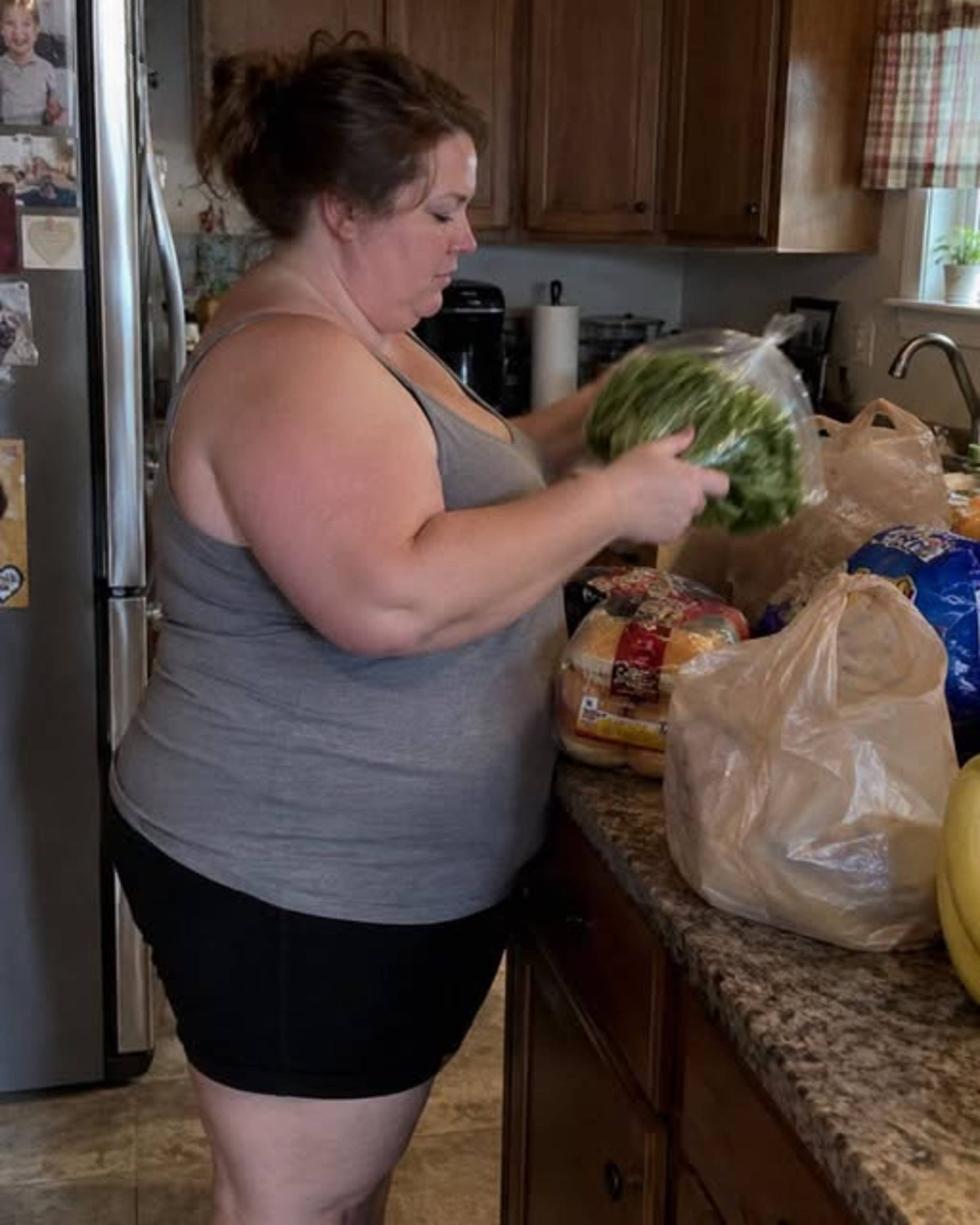
For the past month, I’d been secretly eating food my wife bought for herself, and I genuinely believed I was doing it because I loved her.
I told myself I was helping.
I told myself I was making things easier for her.
I told myself that if the temptation wasn’t sitting in front of her every night, then maybe she’d have one less battle to fight.
What I didn’t realize was that I wasn’t just eating her food.
I was making a decision for her.
And then she put one particular box in our pantry, waited for me to empty it, and showed me that she’d known exactly what I was doing all along.
Before you call me controlling, hear me out.
My wife Melissa was forty-six, and she’d struggled with her weight for years.
It wasn’t something we talked about constantly, and it certainly wasn’t something I ever wanted her to feel ashamed of.
But I knew how much it affected her.
I saw the way she sometimes stood in front of the bedroom mirror and quietly changed outfits three or four times before leaving the house.
I saw how she’d avoid photographs.
I noticed when she stopped buying certain clothes because she didn’t like how they looked on her.
And I remembered the times she’d come home from shopping frustrated because something she’d liked in the store didn’t fit the way she’d hoped.
She rarely complained about it directly.
Melissa wasn’t someone who wanted sympathy.
Instead, she’d usually make a joke, shrug her shoulders, and move on.
But I knew.
I’d been married to her long enough to know when a joke was actually covering something painful.
Then, recently, she started a doctor-supervised weight-loss program.
And something changed.
For the first time in a long time, Melissa seemed genuinely hopeful.
She wasn’t chasing some impossible overnight transformation.
She was following a plan.
She had appointments.
She planned meals.
She kept track of what she ate.
She listened carefully to her doctor.
And, slowly, it was working.
The changes weren’t dramatic from one day to the next, but they were noticeable over time.
Her clothes started fitting differently.
She had more energy.
She seemed more comfortable in her own skin.
One morning, she came downstairs wearing a pair of jeans she’d avoided for years.
She looked at herself in the hallway mirror and smiled.
“I forgot I even had these,” she said.
I smiled back.
“They look good.”
She turned around once, almost playfully.
“I think they actually fit.”
I could hear the happiness in her voice.
I wanted that happiness to continue.
But there was one part of her routine I didn’t understand.
Every grocery trip, Melissa still came home with junk food.
Donuts.
Cookies.
Chips.
Candy.
Pudding.
Pop-Tarts.
Things that seemed completely out of place beside the carefully measured meals she was preparing.
At first, I didn’t think much of it.
People don’t have to completely eliminate every food they enjoy just because they’re trying to lose weight.
I understood that.
But then I’d see her stare at the bags after putting the groceries away.
Sometimes she’d sigh.
Sometimes she’d shake her head.
And one night, after she’d eaten two donuts, she sat at the kitchen table staring at the empty wrappers.
“I wish I just didn’t buy this stuff,” she said quietly.
I remember looking at her.
“You don’t have to eat it.”
“I know.”
She pushed one wrapper around with her fingertip.
“But if it’s here, I think about it.”
That sentence stayed with me.
And that’s when I started doing what I convinced myself was the loving thing.
I ate it.
Not all at once.
Not dramatically.
Just a little here.
A little there.
If Melissa bought eight donuts, I ate six.
I’d wait until she went upstairs, then quietly take another one.
If she brought home cookies, I’d finish most of them after she went to bed.
Candy disappeared into my desk drawer.
Sometimes I’d eat something while working and tell myself I was simply taking care of the problem before it became a temptation for her.
It became a strange little secret between me and the pantry.
I became aware of what she bought.
I knew which foods were most likely to tempt her.
I learned how quickly certain things disappeared.
And every time I removed something from the house, I felt like I was helping.
There was one afternoon when Melissa had a particularly difficult day.
She came home exhausted.
She dropped her purse on the counter and let out a long breath.
“I don’t even want to talk about it.”
I didn’t ask.
I knew she needed space.
Later, I noticed she’d bought a bag of barbecue chips.
She didn’t even eat them that evening.
I did.
I stood in our garage, leaning against the workbench, eating barbecue chips I didn’t even like.
They were too salty.
Too greasy.
And halfway through the bag, I wondered why I was doing this.
Then I thought about Melissa.
I imagined her coming into the kitchen later, seeing the bag, and reaching for it without thinking.
So I finished them.
I threw the empty bag away.
And I felt strangely proud of myself.
That was the problem.
I genuinely believed it was love.
Melissa kept losing weight.
Her doctor was pleased.
Her clothes were fitting better.
She started wearing things she’d avoided for years.
And most importantly, she seemed happier.
So I never questioned what I was doing.
Why would I?
In my mind, the results proved that my little secret was working.
Then last week, she brought home a box of chocolate snack cakes.
That caught my attention immediately.
Melissa doesn’t even like chocolate snack cakes.
I’d known her long enough to know that.
She preferred other sweets.
She’d never once asked me to buy those.
So when I saw the box sitting on the kitchen counter, I looked at it twice.
“Chocolate snack cakes?” I asked.
Melissa glanced over.
“What about them?”
“You like those?”
She shrugged.
“Not particularly.”
That answer should have made me suspicious.
Instead, I just smiled.
“Okay.”
She put the box away.
And I forgot about it.
At least, I tried to.
But over the next three days, every time I opened the pantry, I saw it.
The bright box.
The untouched cakes.
Twelve of them, although I didn’t know that number yet.
I would stand there for a moment, staring.
Then I’d close the pantry door.
I told myself I wasn’t going to touch them.
I really meant it.
But temptation and habit have a way of working together.
By the third day, I was tired after work.
I opened the pantry.
The box was still there.
I took one.
Then another.
Then a third.
I stood at the kitchen counter eating them while scrolling through my phone.
Afterward, I felt guilty.
Not because I had eaten three snack cakes.
Because I knew Melissa had bought them for a reason.
I just didn’t know what that reason was.
By Friday, the box was empty.
I didn’t think much of it.
I threw the empty packaging away and went on with my evening.
Then Melissa opened the pantry.
She stood there for several seconds.
“Where are the cakes?”
I looked up from my phone.
“What cakes?”
“The chocolate ones.”
“Oh.”
I hesitated.
“Those?”
“Yes.”
I tried to sound casual.
“All of them?”
She slowly turned toward me.
“Pretty much.”
Something about her expression made my stomach tighten.
She wasn’t angry.
She wasn’t shouting.
She wasn’t even disappointed.
She was just watching me.
Calmly.
Almost patiently.
“Why?” she asked.
I shrugged.
“I guess I ate them.”
“I know.”
That stopped me.
“What?”
She walked back toward the kitchen.
Then she pointed at the empty space where the box had been.
Written underneath in black marker was one number:
**12**
I stared at it.
“What’s that?”
Melissa looked at me.
“I wrote down how many were in the box.”
My stomach dropped.
“Twelve.”
“Exactly.”
She folded her arms.
“I knew exactly how many were in there.”
I swallowed.
“You counted them?”
“Of course.”
I looked at the pantry.
Then at her.
Suddenly, every donut.
Every cookie.
Every bag of candy.
Every late-night snack I’d quietly taken.
Every time I’d convinced myself I was protecting her.
It all came rushing back.
“You knew?”
Melissa nodded.
“I’ve known for a while.”
The room suddenly felt much smaller.
“You knew I was eating your food?”
“I knew food was disappearing.”
“Why didn’t you say anything?”
She was quiet for a moment.
Then she answered in a voice that was almost painfully calm.
“Because I wanted to know why you were doing it.”
I couldn’t answer.
I’d spent weeks telling myself I was helping my wife.
Now I realized she’d been watching me the entire time.
And the box of twelve wasn’t really about chocolate snack cakes.
It was a test.
A test I’d walked straight into without ever realizing there was one.
Melissa stepped closer.
“I need you to understand something, Adam.”
I looked at her.
“You didn’t make me stronger by taking away my choices.”
Her words hit harder than I expected.
“I thought I was helping.”
“I know.”
“I thought if the food wasn’t there, you’d have an easier time.”
“I know.”
“Then what’s the problem?”
Melissa looked toward the pantry.
“The problem is that you decided what I was allowed to struggle with.”
I had nothing to say.
Because she was right.
I had taken something complicated and personal and turned it into a secret mission I controlled.
I’d told myself it was love because that made it easier to live with.
But love isn’t supposed to require one person secretly controlling the other person’s choices.
Melissa wasn’t asking me to solve her.
She wasn’t asking me to hide every temptation from her.
She was asking me to trust her.
And standing there beneath the kitchen light, staring at that handwritten number on the pantry shelf, I finally understood why she’d bought that box of twelve.
She hadn’t wanted the cakes.
She’d wanted the truth.
And she’d gotten it.