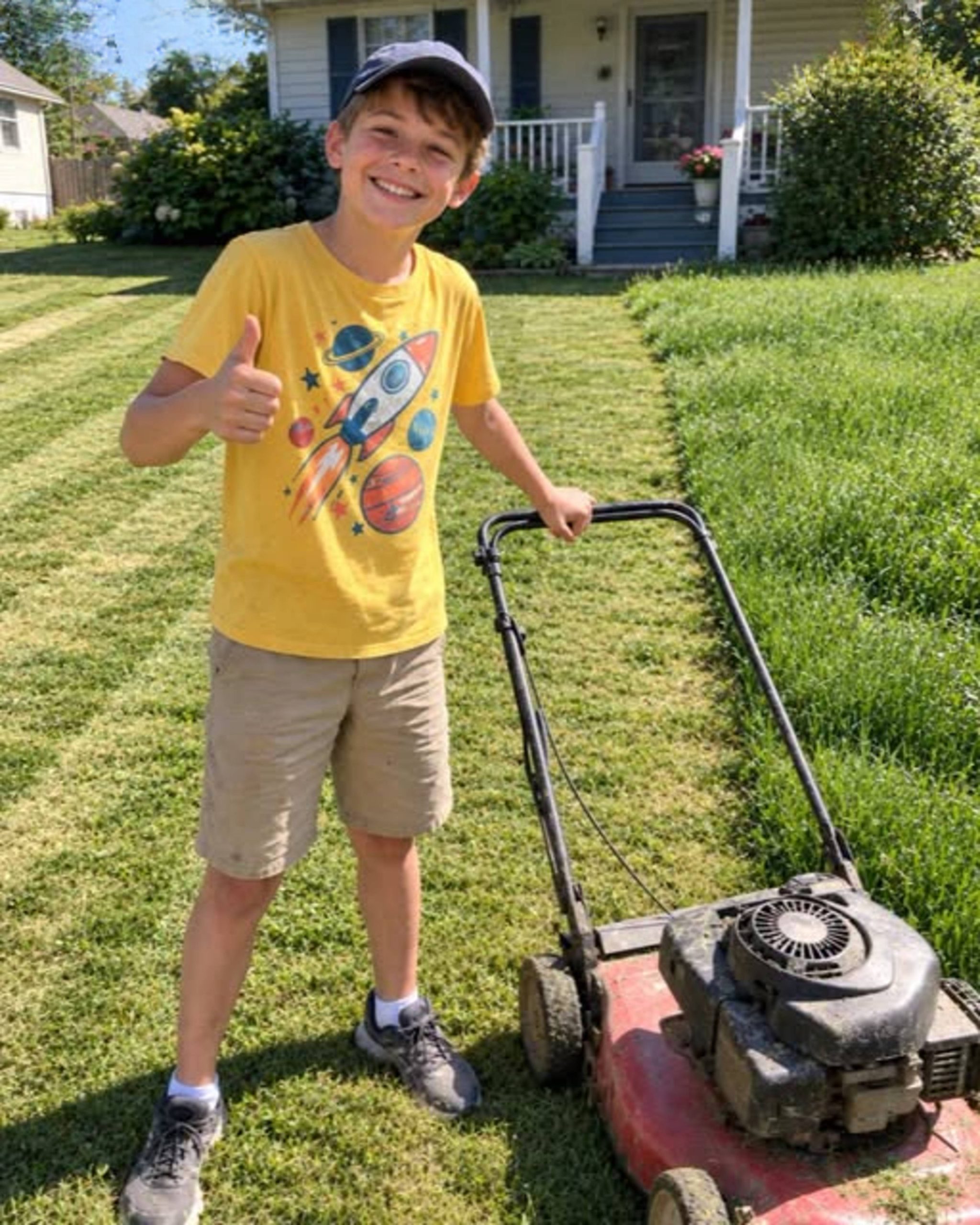
I thought my twelve-year-old had spent the summer quietly helping elderly neighbors with their yards.
Then, just days before school started, two police cars pulled up outside our house and asked for him by name.
Have you ever gone from being incredibly proud of your kid to absolutely terrified for them in a matter of minutes?
Because that happened to me three weeks before my son started seventh grade, and I still think about how differently that afternoon could have gone.
My son, Justin, is twelve.
He’s not one of those children parents describe as perfect while everyone who knows them quietly rolls their eyes.
Justin forgets homework.
He leaves wet towels on his bedroom floor.
He somehow believes empty cereal boxes belong back inside the pantry.
And despite having a perfectly good laundry basket, he seems to believe clothes become clean simply by being thrown somewhere near it.
He’s ordinary.
Messy.
Sometimes stubborn.
But he has a good heart.
I learned exactly how good that heart was during the summer.
I just didn’t realize that the same instinct that made me so proud would soon make me wonder how much I had missed.
A few days after school ended, I looked out our kitchen window and saw Justin pushing our ancient lawn mower down the sidewalk.
I opened the back door.
“Justin?”
He stopped.
“Where are you going?”
He turned around.
“Mrs. Hall needs help.”
Mrs. Hall lived four houses away.
She was seventy-eight and stubborn enough to make age feel personally offensive.
She had always insisted she could do everything herself.
Apparently, that included mowing her lawn in ninety-degree heat.
Justin had seen her struggling with the mower earlier that afternoon.
He had apparently watched for several minutes before deciding he couldn’t simply stand there.
So he went home, got our mower, and walked back.
When he finally returned an hour later, his shirt was soaked through with sweat.
His hair was sticking to his forehead.
He looked exhausted.
But he was smiling.
“She tried to pay me twenty dollars,” he said.
I smiled.
“Did you take it?”
He looked at me like I’d just suggested something outrageous.
“Mom.”
That should tell you everything.
He hadn’t done it for money.
The next morning, Justin appeared at breakfast while I was making coffee.
He sat down.
Started eating cereal.
Then, without looking up, he asked:
“Do you think other old people around here need their lawns done?”
I shrugged.
“I don’t know.”
He nodded slowly, like I’d just confirmed something important.
And suddenly, he had a summer project.
Twice a week, sometimes three times, Justin pushed our ancient mower around the neighborhood.
At first, it was just lawns.
Then it became other small jobs.
Pulling weeds.
Dragging branches to the curb.
Sweeping leaves from walkways.
Moving trash bins.
Helping someone carry bags from the car.
If he saw an elderly neighbor struggling with something outside, he’d stop and ask if they needed help.
He never made a big announcement about it.
He didn’t ask me to post photographs.
He didn’t tell his friends.
He just did it.
I gave him rules.
“No going inside strangers’ houses.”
He nodded.
“Keep your phone charged.”
Another nod.
“Tell me where you’re going.”
“Okay.”
“And if someone asks you to do something that makes you uncomfortable, you leave.”
“Okay, Mom.”
I thought those rules were enough.
I thought I knew what he was doing.
Every few days, someone would mention him to me.
Mrs. Hall told me he’d saved her from spending the afternoon in the heat.
Mr. Peterson said Justin had helped clear branches after a storm.
Another neighbor told me my son had carried several heavy bags to her porch without being asked.
One afternoon, I found a plate of cookies sitting on our front steps.
There was a handwritten note attached.
“Thank you for raising such a kind boy.”
I brought it inside and put it on the counter.
Justin barely reacted when I showed him.
“That’s nice.”
“That’s all you have to say?”
He shrugged.
“I just helped.”
I remember looking at him and feeling incredibly proud.
At twelve, he was already learning something many adults never seem to understand.
You don’t need to be rich to help someone.
You don’t need special skills.
Sometimes you just notice that someone needs help and decide not to walk away.
As summer continued, Justin’s little routine became almost predictable.
He’d eat breakfast.
Finish whatever schoolwork I’d given him.
Grab his phone.
Take the mower.
And disappear into the neighborhood for an hour or two.
Sometimes he’d come back sweaty.
Sometimes covered in grass.
Sometimes complaining about the heat.
But he always came home smiling.
I never imagined that one of those afternoons would be different.
Three weeks before school started, I was washing dishes after lunch when I heard a car door slam outside.
Then another.
I glanced through the kitchen window.
Two police cars were parked in front of our house.
My first thought was that there had been an accident.
My second was that someone had been hurt.
Then I saw two officers walking toward our front door.
My hands went cold.
I dried them quickly and opened the door before they could knock.
“Can I help you?”
One of the officers looked at me.
“Is Justin here?”
Everything inside me seemed to stop.
“Why?”
The officer glanced at his partner.
“We need to speak with him.”
My mind immediately started racing.
What had happened?
Where had he been?
Who had he been with?
Had someone accused him of something?
Had he witnessed something?
Was he in trouble?
I turned toward the hallway.
Justin was upstairs.
I could hear his bedroom door opening.
He came down the stairs holding his phone.
He looked confused.
Then he saw the police officers.
His face changed.
“What’s going on?”
The officer looked directly at him.
“Justin, we’d like to ask you some questions about the work you’ve been doing around the neighborhood.”
Justin looked at me.
I looked back at him.
For the first time all summer, I realized I didn’t actually know everything my son had been doing.
I knew where he said he was going.
I knew which neighbors he helped.
I knew he was mowing lawns.
But there were apparently things he hadn’t told me.
The officer continued.
“We’ve received information about something unusual.”
Justin’s fingers tightened around his phone.
“Am I in trouble?”
“No,” the officer said.
“Not necessarily.”
That word—*necessarily*—made my stomach drop.
I stepped closer to my son.
“What happened?”
The officer looked at me.
“That’s what we’re trying to understand.”
Then he asked Justin a question that made both of us go completely silent.
“How many houses have you been helping?”
Justin looked down.
“I don’t know.”
The officer nodded.
“And how many of those homeowners have you been inside the property of?”
Justin hesitated.
I felt my heart sink.
“Justin?”
He finally looked at me.
“Mom, I can explain.”
And suddenly, the summer project I had been so proud of didn’t seem nearly as simple as I had believed.
Because whatever Justin had been doing, someone had considered it important enough to call the police.
And now two officers were standing in our living room asking my twelve-year-old son questions about it.