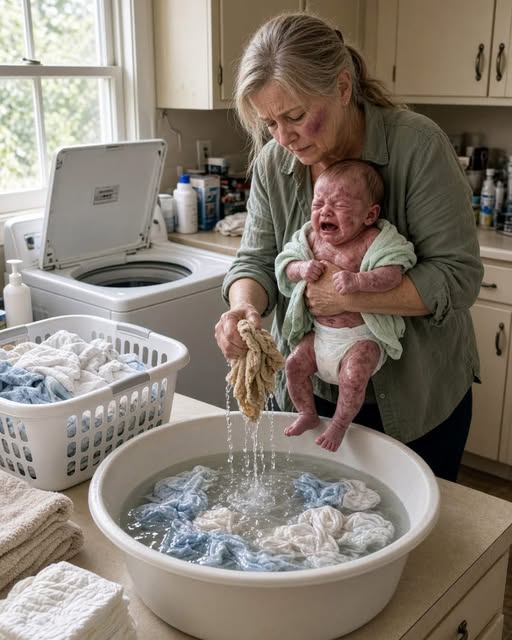
The officer did not ask us to watch the recording from the beginning. He started at the point where my mother was already standing beside the basin, with the phone positioned where it could see everything.
My husband leaned forward.
I couldn’t.
I stared at the table instead, gripping the edge so hard my fingers hurt. The baby was still in the hospital, being monitored for the injuries my mother had caused, and now we were being asked to watch evidence of what happened in our own home.
The first few seconds were enough.
There was no sudden accident. No moment where the basin slipped unexpectedly. No frantic attempt to help a struggling baby.
My mother had prepared the scene.
She had placed the phone where the basin remained visible. She had made sure the camera could capture the baby’s condition. And while she worked, she spoke quietly to herself, as though she were organizing something that had already been decided.
My husband watched the screen without blinking.
Then the recording reached the part where he entered the room.
The sound of his voice changed everything.
He had heard the baby crying and rushed toward us. The image showed my mother reacting immediately when she realized he was taking the child away. What happened next was the moment I had remembered as chaos—the overturned basin, the impact against the stone table, the baby falling to the floor.
But on the video, it wasn’t chaos.
It was a sequence.
A sequence that began before anyone else knew there was danger.
The officer paused the recording.
“I need you to understand something,” he said. “This is not just evidence of what happened to the child. It may establish what she intended to do before the injuries occurred.”
My husband finally looked at him.
“She planned it?”
“We’re still determining exactly what we can prove. But the recording raises serious questions.”
I looked at the frozen image of my mother beside the basin.
For years, I had been the person who explained her behavior to everyone else.
She was difficult because she had been through a lot.
She was demanding because she wanted to protect me.
She asked too many questions because she worried about the family.
Whenever she crossed a line, I moved the line.
Whenever she hurt someone, I searched for the reason.
And whenever she apologized, I treated the apology as proof that the person I loved was still underneath everything she had done.
Now there was a recording.
There was no version of events I could soften for myself.
The officer turned off the phone.
Then he asked a question that seemed almost unrelated.
“Has your mother ever asked about your insurance policy?”
My husband and I exchanged another look.
“Yes,” I said.
The answer came out before I had time to think about it.
She had asked months earlier.
At first, I had barely noticed. She had wanted to know what the policy covered. She had asked whether newborn injuries were treated differently from ordinary accidents. She had wondered aloud about hospital bills and whether certain incidents could result in a larger payout.
I had been annoyed by the questions.
I had not been afraid of them.
That distinction suddenly felt unbearable.
The officer wrote down everything we could remember.
Then he asked whether she had ever mentioned taking photographs after an accident.
My husband answered this time.
“She talked about documentation. She said insurance companies needed proof.”
The officer nodded.
“Did she ever ask who would receive the money?”
Neither of us spoke.
Because we remembered.
She had.
Not directly. Not in a way that sounded suspicious at the time. She had asked questions about how claims were paid and whether the policyholder had control over the money.
I had dismissed it as another one of her intrusive conversations.
Now those conversations were being placed beside the video.
The officer closed his notebook.
“There is one more issue.”
My stomach tightened.
“What?”
“She has already given investigators a statement.”
My husband frowned.
“What did she say?”
The officer looked at him before answering.
“She says you became aggressive, rushed into the room, and caused the basin to overturn.”
For a second, I couldn’t understand the words.
Then I realized what my mother was doing.
She was trying to move the blame.
“She said my husband hurt the baby?” I asked.
“She says her actions were an attempt to protect the child after you became unstable.”
My husband stood so quickly that his chair scraped the floor.
“She knows that’s a lie.”
The officer didn’t argue.
He simply said, “That’s why the recording matters.”
My husband sat back down.
I could feel him shaking beside me.
But the most frightening part wasn’t that my mother had lied.
She had lied before.
The frightening part was how quickly she had created a new version of reality after the first one stopped working.
She had been caught on video.
So she changed the story.
And suddenly I understood something I had never wanted to admit.
My mother didn’t need me to believe her because the truth was convincing.
She needed me to believe her because I had spent years protecting her from consequences.
That night, the police told us they were continuing their investigation. The baby would remain under medical observation, and they needed additional records from the hospital. They also wanted the insurance information and any communications in which my mother had discussed the policy, the baby’s injuries, or a potential claim.
I went home with my husband after midnight.
The house was quiet.
Too quiet.
The basin was gone. The clothes had been removed. The floor had been cleaned. But the room still felt wrong.
My husband stopped at the doorway.
Neither of us wanted to go inside.
Then he noticed something on the counter.
A small notebook.
My mother had left it behind.
He reached for it, then stopped.
“Don’t touch it.”
I called the officer instead.
He told us not to disturb anything that might be relevant.
While we waited, I stood there looking at the notebook.
It wasn’t dramatic.
It wasn’t hidden.
It was just an ordinary notebook with a worn cover, the kind my mother used for grocery lists, reminders, and appointments.
But now every ordinary object in that room felt different.
When the officer arrived, he photographed it before opening it.
The first pages were exactly what I expected.
Shopping lists.
Phone numbers.
Appointments.
Notes about family birthdays.
Then he reached a later page.
He stopped.
My husband stepped closer.
I didn’t move.
The officer read the page silently, then looked at us.
“This may be important.”
My heart started pounding.
“What is it?”
He turned the notebook so we could see.
There were several dates written down.
Beside them were short notes about the baby, the insurance policy, and amounts of money.
Not a completed claim.
Not a payment.
Something earlier.
Something that suggested my mother had been thinking about the possibility of an insurance payout before the day she hurt the baby.
My husband stared at the page.
“She planned this before today.”
The officer corrected him carefully.
“It suggests prior planning. We’ll need to establish what these notes mean and when they were written.”
I felt cold.
Because one of the dates was weeks earlier.
Before the baby had ever been injured.
Before my mother had ever claimed there was an accident.
Before I had any reason to suspect that she saw my child as anything other than her grandchild.
I put my hand over my mouth.
My husband took my other hand.
Neither of us spoke.
The officer photographed the page and continued through the notebook.
A few pages later, he found another note.
This one was shorter.
It referred to photographs.
Then another mentioned making the injuries “look serious enough.”
I closed my eyes.
The room seemed to tilt.
There are moments when fear is loud.
This wasn’t one of them.
This was quieter.
It was the moment when a person you have known your entire life becomes someone you can no longer recognize.
I thought about every time my mother had held my baby.
Every time I had left the room because I trusted her.
Every time she had told me she knew what was best.
Every time I had felt guilty for questioning her.
I had thought my biggest mistake was letting her cross too many boundaries.
Now I understood that my mistake had been assuming boundaries were the only thing at stake.
The officer closed the notebook.
“We’ll take this as evidence.”
I nodded.
Then my phone rang.
It was the hospital.
For one terrible second, I thought something had happened to the baby.
I answered immediately.
The nurse told me the baby was stable.
The injuries were serious, but the doctors were continuing treatment and observation. The swelling around the eyes had begun to improve slightly.
I nearly collapsed with relief.
Then the nurse added something else.
A hospital social worker wanted to speak with us.
There had been another concern.
Someone had called the hospital asking for information about the baby’s condition.
The caller had claimed to be a relative.
The hospital had refused to provide details.
I knew immediately who it was.
My mother.
She had been removed from our home.
The police had her phone.
Yet she was still trying to find out how badly the baby was injured.
My husband looked at me.
“Why would she need to know?”
I didn’t have an answer.
But I thought about the recording.
The photographs.
The insurance questions.
The notebook.
And the fact that she had already changed her story.
Then I remembered something else.
My mother had reached for her phone before she reached for the baby.
At the time, I had thought she was trying to call someone.
Now I knew she had been trying to preserve the evidence she believed would make her plan work.
She had expected the injuries to tell a story.
She had not expected the camera to tell the truth about how they happened.
The next morning, the investigator called again.
He said they had found more material on the phone.
Not just the recording from our house.
There were messages.
There were searches.
There were conversations about insurance claims.
And there was one message sent shortly before my mother arrived at our home that morning.
The investigator said he needed us to come in and see it.
I asked who had sent it.
He went quiet for a moment.
Then he gave me a name.
It wasn’t my mother’s.
And it wasn’t a stranger’s.
It was someone I knew.
Someone who had been in our home before.
Someone who had held my newborn in their arms.
My husband looked at me as I listened.
I couldn’t speak.
Because suddenly the question was no longer whether my mother had planned what happened.
The question was how many people had known about the plan before she walked into our house with that basin.
And whether the person behind that message had expected my mother to succeed.