The graduation grass was still beneath Noah’s hands when the three young women gathered around him and revealed the papers they had carried beneath their gowns. He had expected a thank-you, maybe a photograph, maybe a few words about the years he spent raising them. He never expected to see the name he had given them written across all three documents.
Twenty years earlier, Noah’s life changed on an ordinary doorstep.
There were no warnings. No long conversation. No chance to prepare.
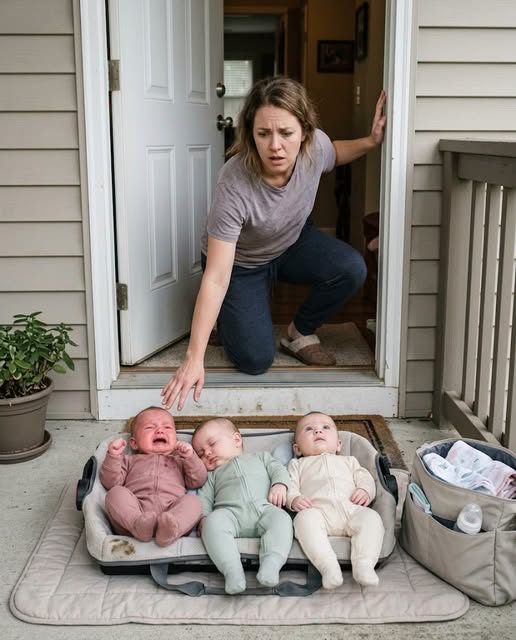
His brother left three six-month-old babies behind with three car seats, one diaper bag, and a short message written on the back of a gas receipt.
“I’m sorry, Noah. I can’t do this.”
That was all he had.
The first night was a blur of bottle warming, laundry, crying, and exhaustion. One baby needed feeding. Another refused to settle. The third finally slept against his chest while Noah sat there wondering when his brother would come back and admit he had made a mistake.
But the driveway stayed empty.
The next morning came, and Noah had a decision to make.
He could wait for someone else to fix the situation.
Or he could become the person those three little girls needed.
He chose them.
Over the years, Noah learned every part of parenting without ever expecting the title. He learned how to carry three sleeping toddlers inside without waking them. He learned how to pack lunches before work, how to stretch groceries when money was tight, and how to show up even when he was tired enough to collapse.
He sat through fevers.
He helped with homework.
He stood in school pickup lines.
He sat in bleachers where other families had two parents cheering and made sure those girls still saw one person who never missed a moment.
The girls never called him Dad.
Noah never asked them to.
He was their uncle, and he believed love did not need to force a name onto itself.
When they eventually became old enough to ask about their father, Noah did something many people would have struggled to do.
He told them the truth without turning their father into a villain.
He showed them the faded gas receipt he had kept for two decades.
One of the girls read the message twice.
“You kept this?” she asked.
Noah looked down at the paper.
“I didn’t know what else to do with it.”
She carefully handed it back.
“Then keep it.”
That moment stayed with him.
Not because it erased what happened.
Because it showed him they understood.
The years passed. The three sisters grew into young women with their own personalities, their own arguments, and their own dreams. They borrowed clothes, fought over space, worked hard, and eventually reached the same milestone: college graduation.
Noah told himself getting them there was enough.
He did not need a speech.
He did not need recognition.
He only needed to know they were ready for the next chapter.
Then, one week before graduation, a message arrived from the man who had disappeared twenty years earlier.
“I want to be there. I’m still their father.”
Noah did not hide it from the girls.
He gave them the choice.
The oldest read the message first. Then she handed the phone to her sisters.
“Let him come,” she said.
Noah looked at them carefully.
“You’re sure?”
“Yes.”
That answer stayed in his mind all week.
Graduation day arrived with families gathering, graduates wearing gowns, and phones raised everywhere as people tried to capture the moment.
Noah found his seat and noticed his brother several rows away.
He looked like someone who believed twenty years could be crossed in a single afternoon.
The two men exchanged a small nod.
Nothing more.
Then the graduates crossed the stage one by one.
Noah clapped until his hands hurt.
He remembered three car seats.
Three first days of school.
Three acceptance letters spread across his kitchen table.
After the ceremony, he started looking for the girls.
They found him first.
At almost the same moment, his brother approached.
“Come here, girls,” he said. “Let’s get a family picture.”
The middle sister stopped him.
“A family picture?”
His expression changed slightly.
“I’m your father. Whatever happened between me and Noah doesn’t change that.”
Noah stepped back because he wanted the decision to belong to them.
But the youngest sister grabbed his wrist.
“Uncle Noah. Stay.”
Her father looked at the hand holding Noah’s arm.
“You’ve had them long enough,” he said. “Don’t make this harder than it needs to be.”
Noah felt the anger rise, but he stayed quiet.
The girls were adults.
Their voices mattered more than his.
The oldest sister looked directly at the man who left them.
“You left three babies on a doorstep.”
Her sister continued.
“He stayed for everything after that.”
Then the youngest reached into the folder she had carried all morning.
“We planned something.”
She pulled out an envelope.
For a moment, nobody moved toward it.
Then she placed it into Noah’s hands.
Inside were three documents.
They were not graduation papers.
They were legal name-change documents.
Months earlier, all three sisters had changed their last names to Noah’s.
They had chosen the name of the person who raised them.
The person who packed lunches.
The person who waited up.
The person who stayed.
Noah’s knees gave out on the grass.
The three sisters immediately dropped down beside him.
“You never asked us to call you Dad,” one of them whispered.
“You never asked us to owe you anything,” another said.
“You just stayed.”
Behind them, their biological father objected.
“You can’t erase who their father is.”
The oldest sister stood.
“We’re not erasing anybody.”
She looked at the papers.
“We’re choosing what belongs to us.”
The decision was never about pretending the past did not happen.
It was about recognizing who had been there when the past was still being written.
Noah never demanded a reward for those twenty years.
He never asked for a title.
He simply showed up.
And on the day those three girls became graduates, they showed him that they had noticed every single time he did.