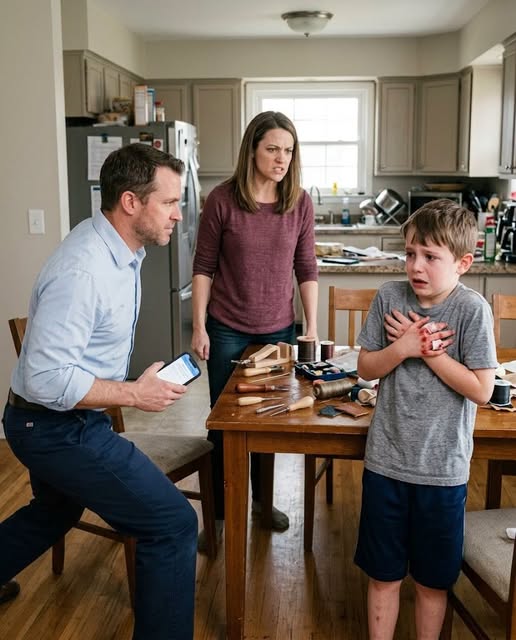
The officer opened the drawer before the mother could stop him.
Inside were several heavy leather needles, spools of thick thread, and a small notebook. The notebook looked ordinary at first, almost too ordinary to matter. Then the officer turned a few pages and saw dates written beside the boy’s name.
The room went quiet.
My son stared at the floor.
His mother stood several feet away, no longer crying. Her face had changed completely. A few minutes earlier, she had been performing panic for the officers, insisting that I had attacked her without reason and that our son had somehow injured himself while she was helping him.
Now she was watching the notebook.
The officer looked up.
“What is this?”
She answered immediately.
“Household notes.”
Her voice was flat. No tears. No trembling. Just a quick explanation delivered as if she had been waiting for someone to ask.
The officer looked back down at the pages.
My son finally spoke.
“Those are the days I got punished.”
I felt my stomach drop.
Until that moment, I had known there were other incidents. I had known enough to understand why the judge had placed strict conditions on her contact with our son. I had kept the court decree ready on my PHONE because I had learned the hard way that having an order and proving what it says are two different things when a situation turns chaotic.
But hearing my son identify those dates himself changed something.
He wasn’t repeating something I had told him.
He was telling an officer what he remembered.
The officer closed the notebook carefully.
“Sir, I need you and your son in the hallway for a moment.”
I nodded.
His partner moved closer to his mother and kept her separated from us while we stepped out of the dining room. My son walked beside me with both hands wrapped in gauze. He was still shaking, but he was no longer silent.
In the hallway, the officer asked me to explain the court order.
I unlocked my PHONE and showed him the decree again.
The judge had already imposed strict conditions concerning his mother’s contact with our son after earlier concerns had been reported. I explained what I knew, what I had witnessed that night, and what my son had just told the officers.
The officer read the order carefully.
Then he asked my son a question.
“Do you understand what I’m asking you?”
My son nodded.
“Can you tell me what happened tonight in your own words?”
He swallowed.
“Yes.”
His voice was still quiet, but this time he didn’t look at me before answering.
He told the officer about the needle.
He described what his mother had been doing before I tackled her away from him. He explained where he had been sitting and how he had tried to protect his hands. He didn’t embellish anything. He didn’t need to.
The officer listened without interrupting.
When my son finished, the officer asked another question.
“And the notebook?”
My son looked down at the bandages around his fingers.
“Those are other times.”
“What happened on those days?”
My son hesitated.
Then he said, “I can tell you.”
That was the moment I realized the night was no longer about whether I had tackled someone across a dining table.
It was about why I had done it.
Inside the house, his mother began shouting again.
I could hear her voice through the doorway.
“She is twisting everything! He is putting words in the child’s mouth!”
The officer in the hallway didn’t react immediately.
He simply listened.
My son listened too.
But something was different now.
He didn’t shrink toward me.
He didn’t ask whether he was in trouble.
He didn’t apologize for making everyone angry.
He looked at the officer and waited.
The officer finally asked him one more question.
“Is there anything else in that house you think I should know about?”
My son thought for several seconds.
Then he said, “There’s another box.”
I looked at him.
The officer did too.
“Where?”
“In the bedroom closet.”
His mother suddenly stopped shouting.
The silence that followed was unmistakable.
The officer’s eyes moved toward the dining room.
He had heard the same silence we had.
He went back inside.
His partner followed.
My son stayed beside me in the hallway.
A few seconds later, his mother started protesting again.
“You don’t have permission to search my house.”
The officer answered calmly.
“We’re dealing with an active investigation involving a child. We’ll determine what is appropriate.”
She began talking faster.
She mentioned the broken table.
She mentioned my tackle.
She repeated that I was the dangerous one.
But the officers no longer treated the broken furniture as the whole story.
They had seen the boy’s hands.
They had seen the needle.
They had seen the court order.
And they had heard the boy identify the notebook without being prompted by me.
One officer remained with her while the other asked me to stay where I was.
Then he asked my son if he could point out the closet.
My son nodded.
He led the officer down the hall.
I stayed several steps behind.
The bedroom door was open.
My son’s room was small and plain. There were books along one wall, a few clothes on a chair, and an old storage box tucked near the closet.
He pointed.
“That one.”
The officer crouched beside it.
Before he touched it, he looked back at my son.
“Are you sure?”
My son nodded again.
The officer opened the box.
There were more household items inside. Nothing dramatic. Old fabric. A few sewing supplies. Papers folded into envelopes.
Then he found another notebook.
This one was thinner.
He opened it.
My son’s mother made a sound from the hallway.
Not a scream this time.
Something smaller.
Something that sounded like recognition.
The officer noticed.
He turned a page.
Then another.
He didn’t announce what he saw.
He didn’t need to.
He asked his partner to photograph the contents before moving anything.
My son’s mother stepped forward.
The second officer stopped her.
“Stay back.”
She froze.
For the first time that night, she looked less interested in convincing the officers that I was dangerous and more interested in stopping them from looking at what was in front of them.
That difference mattered.
My son watched from the hallway.
I put my hand lightly on his shoulder.
He didn’t flinch.
The officer photographing the box asked him whether he recognized the handwriting.
My son said yes.
“Whose?”
He looked toward his mother.
Then he looked back at the officer.
“Mom’s.”
His mother immediately denied it.
The officer didn’t argue.
He simply documented the material and continued asking questions.
That was when another unit arrived.
The house became crowded with uniforms, medical equipment, notebooks, cameras, and quiet conversations happening in different rooms.
A paramedic checked my son’s hands again.
The injuries were real. So was the fear that had finally begun to leave his face.
My son asked whether he was going to have to go back with his mother.
I told him I didn’t know yet.
The officer overheard me.
“We’ll talk through the next steps,” he said.
My son nodded.
Then he surprised me.
“Can I tell him everything?”
The officer looked at him.
“You can tell me what happened. Take your time.”
My son sat down.
And he began.
He talked about the night at the dining table first. Then he described earlier incidents. He remembered dates. He remembered where things happened. He remembered what he had been told afterward.
Sometimes his voice shook.
Sometimes he stopped to think.
Nobody rushed him.
I stayed nearby, but I didn’t answer for him.
That was important.
He needed to be heard as himself.
Across the room, his mother sat in silence.
The woman who had screamed for my arrest earlier was now watching her son speak directly to an officer.
She tried once to interrupt.
The officer raised his hand.
“Let him finish.”
She stopped.
My son continued.
By the time he reached the end, the room felt completely different from the one I had entered earlier that evening.
There was no shouting.
No accusation flying back and forth.
No argument over who had broken the table.
There were questions, answers, photographs, medical notes, and the court decree on my PHONE.
The physical evidence had become part of a larger picture.
The officer eventually came over to me.
“Keep that order with you,” he said.
I told him I would.
He looked toward my son.
“And don’t discuss his statement with him tonight. Let the professionals handle the interview process.”
I nodded.
Then the officer turned toward my son’s mother.
She stood slowly.
For several seconds, neither of them spoke.
Finally she asked, “What happens now?”
The officer answered that the investigation would continue and that the relevant authorities would determine the next steps concerning the child and the existing court order.
She looked toward the broken dining table.
Then toward the drawer.
Then toward the bedroom hallway.
The table was still broken.
The leather needle was still on the floor.
But those things were no longer isolated objects she could explain away one at a time.
They had become pieces of a documented sequence.
My son sat beside me, his hands wrapped and resting carefully in his lap.
He looked exhausted.
But he looked relieved too.
As we prepared to leave, he tugged gently at my sleeve.
“Dad?”
“Yeah?”
“Thank you for coming.”
I didn’t know what to say.
So I just put my arm around him.
Outside, the night air was cold.
The officers remained inside for a while longer.
The house that had felt like a place where every word could be turned against us was finally quiet.
I looked down at my PHONE one more time.
The court order was still open on the screen.
Earlier that night, I had carried it because I was afraid nobody would believe me fast enough if something went wrong.
By the end of the night, I understood something else.
A document can establish boundaries.
It cannot make a frightened child feel safe by itself.
A phone can preserve an order.
It cannot speak for someone who is too afraid to speak.
But when my son finally found his voice, the evidence around him gave that voice somewhere to go.
And this time, people listened.