The worst moment of that afternoon was not when my son got hurt.
It was when I realized the adults around him had decided protecting a family secret mattered more than protecting a child.
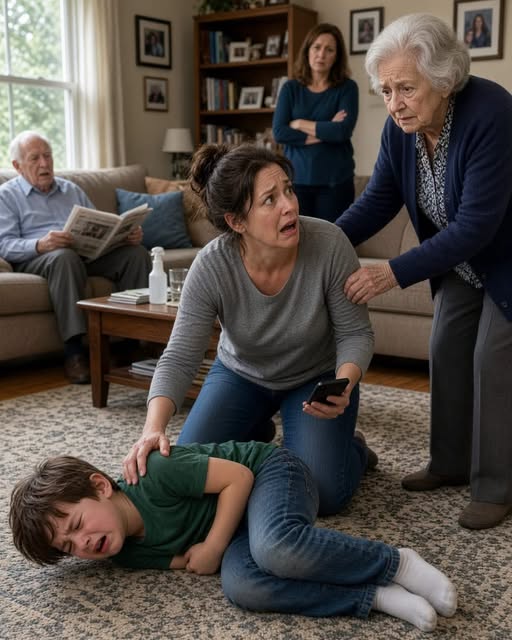
My eight-year-old son was lying on my parents’ living room floor.
He was struggling to breathe normally.
One hand was pressed against his side.
His face had gone pale.
And the person I expected to help me first was the person who tried to stop me.
My mother grabbed my phone.
“Boys fight.”
She said it like those two words could erase everything happening in front of her.
My father looked at the situation and decided I was overreacting.
My sister stood nearby defending her twelve-year-old son.
Nobody asked my child if he was okay.
Nobody moved toward him.
The room continued pretending everything was normal.
The television was still on.
The coffee was still sitting on the table.
The same house where I grew up suddenly felt unfamiliar.
I had trusted these people.
I had believed that if something happened to my child, everyone would immediately protect him.
Instead, they protected the person who caused the injury.
My son tried to tell me he was hurting.
That was enough.
I knew I needed emergency help.
But my phone was taken away.
When I asked my father to call, he refused.
That was when I stopped looking for cooperation.
I focused only on my son.
I kept him still.
I watched his breathing.
I tried to stay calm because he was watching me.
Then I noticed something beneath his sleeve.
A red light.
A symbol.
His smartwatch.
Months earlier, I had set up the emergency feature.
At the time, it was just a safety precaution.
A parent’s small attempt to feel prepared.
I never imagined it would be the thing that protected him when the adults around him failed.
The SOS alert was active.
My son had found a way to call for help.
He had done what he could.
And now help was coming.
My parents did not know what to do with that.
They had been controlling the story inside the room.
But they could not control the evidence.
When emergency responders arrived, the atmosphere changed immediately.
The explanations stopped sounding convincing.
The excuses became questions.
Why was a child injured?
Why was a parent prevented from calling?
Why had nobody contacted emergency services sooner?
The officer looked at the smartwatch.
Then he looked at the adults.
The details started connecting.
The injury.
The delay.
The attempt to keep everything quiet.
My mother had worried about my nephew’s future.
But she had forgotten something important.
My son’s future mattered too.
The paramedics examined him.
The officers documented what happened.
And the family members who had been so confident moments earlier suddenly had very little to say.
The truth did not come from an argument.
It came from a small device on an eight-year-old child’s wrist.
A device meant to keep him safe.
That day, my son learned that even when adults fail, asking for help is not weakness.
It is courage.
And the people who tried to silence him learned that some evidence cannot be hidden.