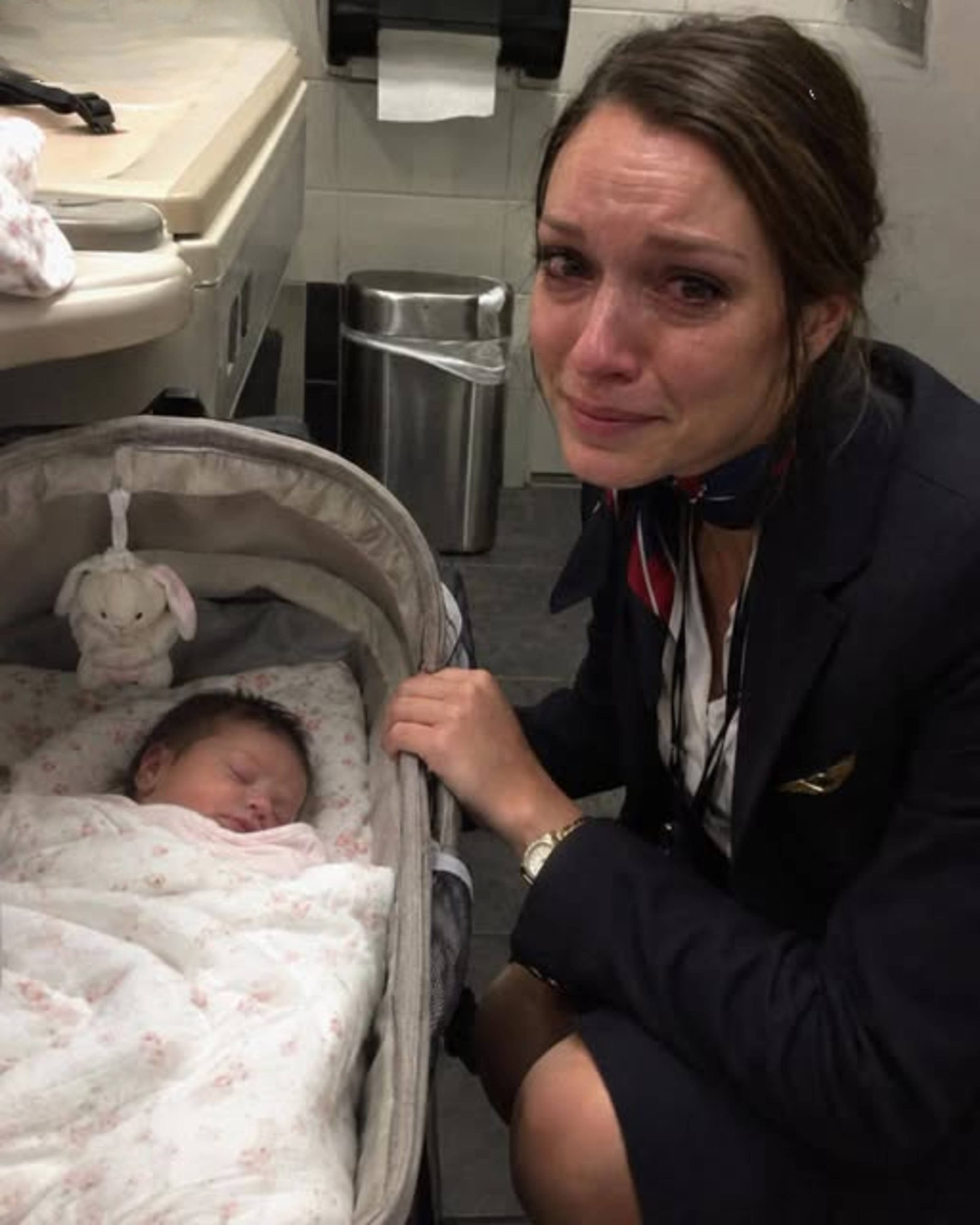
Eighteen years ago, I found an abandoned newborn crying in an airport bathroom and later adopted her. On her eighteenth birthday, an envelope appeared in my mailbox with five words that turned my entire world upside down:
*”Your daughter has been lying to you her whole life.”*
I read those words three times.
Then a stranger across the street called my name.
And I screamed.
But I’m getting ahead of myself.
After ten years as a flight attendant, I thought I knew every sound an airport could make.
I knew the constant rattle of suitcase wheels over tile. I knew the cheerful but exhausted voices of gate agents announcing final boarding. I knew the familiar ding of airport carts backing up. I knew the sound of people arguing into phones because their flights were delayed.
I knew babies screaming because their ears hurt during takeoff.
I knew tired travelers snoring in uncomfortable chairs.
I knew the hurried footsteps of people who had overslept and were running toward their gates.
Airports had their own language.
After ten years, I could almost separate one sound from another without thinking.
But eighteen years ago, after a red-eye from Denver, I heard a sound in the women’s restroom near Gate 17 that stopped me cold.
A baby crying.
Not the loud, angry cry of a hungry child.
This was different.
Weak.
Thin.
Desperate.
It sounded like the baby had been crying for so long that she barely had the strength left to make the sound.
I froze just inside the restroom door.
For a second, I wondered if I had imagined it.
The airport around me was still alive.
People were walking past outside.
Announcements echoed through the terminal.
A cleaning machine hummed somewhere down the corridor.
Then I heard it again.
A tiny, broken cry.
I didn’t even think.
I hurried into the restroom.
“Hello?” I called.
The crying stopped.
I stood still.
“Is someone in here?”
Nothing.
I checked the first stall.
Empty.
The second.
Empty.
The third.
Empty.
Then the crying started again.
This time, I knew exactly where it was coming from.
The last stall.
I walked toward it slowly.
My heart was pounding.
I pushed the door open.
There was no one inside.
But there was a newborn girl lying on the changing table.
For a moment, I couldn’t move.
She was so tiny.
Much smaller than I expected a newborn to be.
She was wrapped in a thin yellow blanket, her little face red from crying. Her fists were clenched against her chest, and her legs trembled beneath the blanket.
I looked around the empty bathroom.
There was no diaper bag.
No purse.
No coat.
No woman.
Nothing that explained how a newborn had ended up alone in an airport bathroom.
My stomach dropped.
“Where’s your mother?” I whispered.
The baby cried harder.
I stepped closer.
There was a small note pinned to the edge of the blanket.
My hands began shaking before I even touched it.
I pulled it free.
The handwriting was hurried.
There were only a few words.
*Please take care of her. Her name is Hope.*
I stared at the note.
Hope.
That was all it said.
No mother’s name.
No father’s name.
No explanation.
Nothing.
Just Hope.
“Oh… you poor thing,” I whispered.
I carefully lifted her from the changing table.
She weighed almost nothing in my arms.
The moment I pulled her against my chest, she became quiet.
I remember that part more clearly than anything else.
Her crying stopped.
Not gradually.
Almost instantly.
I held her close, afraid I was imagining it.
Her tiny face turned toward my uniform.
Her cheek pressed against my chest.
And then her little fingers curled around the fabric of my shirt.
I looked down at her.
“Hey,” I whispered.
Her eyes opened for just a moment.
They were dark and unfocused.
But she looked directly at me.
Something inside me broke.
I remember yelling for help.
I remember a cleaning employee rushing into the restroom.
I remember someone calling airport security.
I remember another employee asking whether the baby was breathing.
I remember saying, “Yes. She’s breathing. She’s okay.”
But I wasn’t okay.
I couldn’t stop holding her.
Paramedics arrived.
They checked her and wrapped her in a warmer blanket.
Someone asked me to step aside.
I couldn’t.
“She’s been alone,” I said.
“We know.”
“No, you don’t understand.”
I looked at the little girl.
“She’s been crying.”
The paramedic gently touched my arm.
“She’s going to be okay.”
I wanted to believe him.
The police came.
They searched the bathroom.
They checked surveillance cameras.
They questioned airport employees.
They tried to determine who had left her there and when.
But whoever had abandoned that baby had disappeared without leaving much behind.
There was no obvious identification.
No phone.
No bag.
No useful information.
Only the yellow blanket.
And the note.
*Please take care of her. Her name is Hope.*
I should have handed her over and walked away.
That was what everyone expected.
Instead, I followed the ambulance.
I sat in the hospital waiting room for hours.
I couldn’t explain why.
She wasn’t my child.
I knew that.
But every time I tried to leave, I imagined her waking up and looking for the woman who had held her.
Eventually, a nurse came out.
“Are you the flight attendant who found her?”
“Yes.”
“She’s stable.”
I closed my eyes.
Relief washed over me so quickly that I almost cried.
“Can I see her?”
The nurse hesitated.
“You’re not family.”
“I know.”
She looked at me for a long moment.
Then she nodded.
“Just for a minute.”
I walked into that hospital room and saw Hope lying beneath a tiny blanket.
She looked even smaller than she had at the airport.
I stood beside her crib.
“I don’t know why you were left,” I whispered.
“I don’t know who your mother is.”
Hope moved her little hand.
I reached through the bars.
Her fingers wrapped around mine.
That was the moment something changed.
I had spent ten years flying around the country.
I’d seen thousands of people.
I’d met passengers who became friends and passengers I forgot before the flight even landed.
But I had never felt anything like what I felt standing beside that tiny crib.
It wasn’t logical.
It wasn’t planned.
It wasn’t something I could explain.
But it was real.
Over the following weeks, authorities tried to locate Hope’s biological mother.
They searched records.
They reviewed airport footage.
They followed every lead they could find.
Nothing.
Days became weeks.
Weeks became months.
And somehow, I became the person who kept showing up.
I brought clothes.
I brought bottles.
I sat with her.
I learned what made her laugh.
I learned how she liked to be held.
Eventually, someone from child services asked me a question I had secretly been asking myself for weeks.
“Have you considered adopting her?”
I remember sitting in my car afterward.
I cried.
I was terrified.
I had never planned to become a mother.
But I couldn’t imagine handing Hope to another family and never knowing whether she was safe.
So I started the process.
It wasn’t easy.
There were interviews.
Background checks.
Home visits.
Paperwork.
Questions about my career.
Questions about my finances.
Questions about whether I understood what I was taking on.
I understood.
At least, I thought I did.
Months later, Hope officially became my daughter.
I kept her original name.
Hope.
I wanted her to know that before she was mine, before she had a home, before she had a family, someone had written that name down and asked the world to protect her.
I promised myself I would.
I raised her alone.
I gave up some of the flying jobs I loved.
I took routes that kept me closer to home.
I learned how to braid hair.
I learned which bedtime stories she liked.
I learned how to deal with teenage attitude.
I attended school plays and parent meetings.
I was there when she lost her first tooth.
I was there for her first heartbreak.
I was there when she learned to drive.
And through all those years, one question never completely disappeared.
Who had left her at the airport?
I asked Hope about it only once when she was old enough to understand.
“You were found at an airport,” I told her.
She stared at me.
“Was I?”
“Yes.”
“Did someone leave me?”
I hesitated.
“Yes.”
She looked down.
Then she asked, “Did you leave me?”
My heart broke.
“No.”
I took her hand.
“I found you.”
She smiled.
“Then you’re my mom.”
“Yes.”
“That’s all that matters.”
I kissed her forehead.
“Yes.”
And for eighteen years, I believed it was all that mattered.
Hope grew into a kind, intelligent, independent young woman.
She was the girl who remembered birthdays.
The girl who helped younger children at school.
The girl who always wanted to know people’s stories.
Sometimes I looked at her and couldn’t believe that tiny newborn from the airport had become this person.
She was my daughter.
No matter what had happened before me, that was the truth of our life together.
Then came her eighteenth birthday.
We had a small celebration at home.
Cake.
Pictures.
A few close friends.
Hope laughed when I showed everyone an embarrassing photograph of her at five years old wearing a princess costume and my oversized sunglasses.
“Mom!”
“You looked adorable.”
“I looked ridiculous.”
“You looked adorable and ridiculous.”
She rolled her eyes.
It was one of those ordinary family moments I had spent eighteen years being grateful for.
Later that night, after everyone had gone home, Hope hugged me.
“Thank you,” she whispered.
“For what?”
“For everything.”
I held her tightly.
“You don’t have to thank me.”
“I do.”
She pulled away.
“I’m lucky.”
I smiled.
“So am I.”
The next morning, I found the envelope.
It was sitting in my mailbox.
There was no stamp.
No return address.
My name was handwritten across the front.
I thought it might be a birthday card that had been delivered late.
I opened it while standing beside the mailbox.
Inside was a single sheet of paper.
Five words.
*”Your daughter has been lying to you her whole life.”*
I stopped breathing.
I read it again.
Then again.
My first reaction was anger.
Who would write something like that?
Then fear replaced the anger.
What did it mean?
What could Hope possibly have lied about?
The airport?
Her biological mother?
Something from her childhood?
I walked back toward the house with the letter clenched in my hand.
Then I heard a voice.
“Don’t go inside yet.”
I froze.
Across the street stood a man I had never seen before.
At least, I didn’t think I had.
He was standing beside an old car, watching me.
I looked around.
“Do I know you?”
He didn’t answer.
Instead, he took one step toward the road.
Then another.
And finally, he called my name.
My full name.
Not the name printed on the mailbox.
The name almost nobody outside my family used anymore.
My blood ran cold.
“How do you know my name?”
He stopped.
For a moment, he simply stared at me.
Then he said something that made the envelope slip from my fingers.
Something about Hope.
Something about the airport.
Something I had spent eighteen years believing was impossible.
I backed away.
“No.”
He took another step.
And I screamed.
Because suddenly, I realized the letter hadn’t been warning me about my daughter.
It had been warning me about the person who had been watching our family for eighteen years.