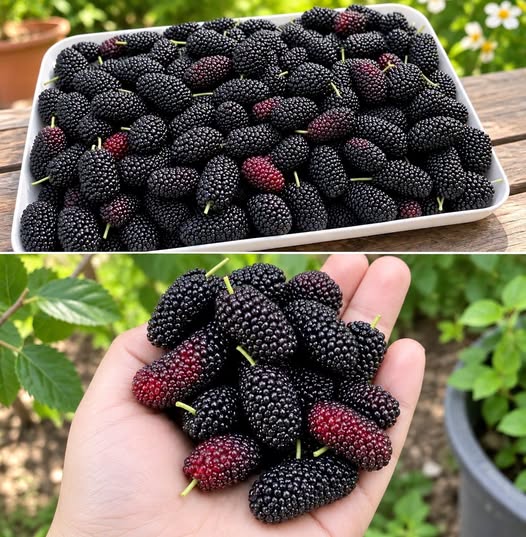
You think you’ve found wild blackberries. You reach out, certain, casual—until something feels wrong. The shape is slightly different. The plant doesn’t look quite right. The stem shouldn’t still be there. That small hesitation could be the difference between recognizing a seasonal treasure and misidentifying what’s growing right in front of you.
Because these aren’t blackberries.
What you’re probably holding is a mulberry, a fruit that can quietly mimic blackberries at a glance but tells a very different story once you look closely. From a distance, the dark color and clustered shape can make the two fruits surprisingly easy to confuse, especially when you’re walking past a tree or spotting the fruit from the ground.
But look at the plant itself, and the clues become much clearer.
Mulberries grow on trees rather than the thorny brambles commonly associated with wild blackberries. That difference alone can be one of the easiest ways to figure out what you’re looking at. Instead of reaching into a tangled patch of stems and thorns, you may find mulberries hanging from branches overhead, sometimes scattered across the ground beneath the tree when they become fully ripe.
Then there’s the shape.
Blackberries tend to form a rounded cluster made up of many small drupelets, giving them a more compact appearance. Mulberries are generally longer and more elongated, sometimes looking almost like tiny dark caterpillars made of individual sections. Their shape can vary depending on the variety, but the slimmer, tapered appearance is often a useful clue.
Another detail is the stem.
A ripe mulberry may remain attached to a thin, delicate stem, while the fruit’s overall appearance can seem softer and more fragile. If you’re accustomed to picking blackberries from brambles, the difference can be noticeable once you know what to look for.
Color provides another clue, although it shouldn’t be the only one.
Mulberries can begin with lighter colors, depending on the species, and gradually deepen as they mature. Some move from red toward a deep purple or almost black shade. At their ripest, they can look remarkably similar to blackberries, which is exactly why the confusion happens in the first place.
That dark color comes partly from anthocyanins, naturally occurring plant pigments found in many deeply colored fruits. These compounds are responsible for much of the rich red, purple and blue coloration seen in berries and other fruits.
Beneath that dramatic color is a modest but worthwhile nutritional profile.
Mulberries can provide fiber, vitamin C, potassium and a variety of plant compounds that fit naturally into an everyday, balanced diet. They aren’t a magical food, and they don’t need to be presented as one. Their value is much simpler: they’re a fruit that can add flavor and nutrients to ordinary meals and snacks.
Fresh mulberries are particularly delicate.
They’re soft, juicy and mildly sweet, and their texture can be much more fragile than that of many store-bought berries. That makes them pleasant to eat soon after picking, but it also means they can bruise easily and don’t always keep for long.
They can be scattered over yogurt, added to oatmeal, mixed into cereal or blended into a smoothie. Their natural sweetness can also work nicely alongside other fruits.
Dried mulberries are a completely different experience.
Removing the water concentrates their sweetness and makes the fruit chewier and denser. A small handful can feel much more substantial than the same amount of fresh fruit, and because the water has been removed, dried mulberries contain more sugar and calories by weight.
That’s worth remembering if you’re eating them as a snack.
The important thing is not to turn the fruit into something it isn’t.
No miracle cure.
No secret superfood.
No single berry is going to transform your health by itself.
Instead, mulberries are simply an interesting fruit worth recognizing when you encounter them. Knowing the difference between a tree-grown mulberry and a blackberry growing on a bramble can make for a more informed and enjoyable foraging experience.
And if you’re ever unsure about a wild fruit, identification should go beyond color alone. Look at the plant, leaves, fruit structure, stems and growing location, and use a reliable field guide or local expert before eating anything you cannot confidently identify.
Because sometimes the most interesting discovery isn’t finding a rare fruit.
It’s realizing that the familiar thing you thought you recognized was actually something completely different.
The next time you see a dark berry hanging from a tree, take a closer look.
It might not be a blackberry at all.
It might be a mulberry—simple, seasonal, delicate and worth recognizing for exactly what it is.