**Four months into our marriage, my husband suddenly stopped trusting me. He seemed convinced I was hiding something, but I had no idea why. Then one accident revealed what had been happening behind my back.**
The first time my husband accused me of wanting to leave him, I laughed.
Not because it was funny.
Because it was impossible.
Anthony and I had been married for four months, and three weeks earlier, I’d spent an entire Saturday driving to a pawnshop two towns away because I’d found something online that I desperately wanted to buy back for him.
He didn’t know that.
Nobody did.
It was something connected to his childhood, something he’d once mentioned losing years ago. I’d found it by accident and decided it would make the perfect surprise.
So when he stood in our kitchen and said, “If you’re already planning your escape, Christine, just tell me,” I honestly thought he was joking.
“What are you talking about?”
“Forget it.”
“Anthony.”
He walked away.
I stood there with a dish towel in my hand, completely confused.
That was when I first realized something had changed inside my marriage.
I just didn’t know what.
It had started so quietly that I couldn’t identify a beginning.
Anthony and I had been happy.
Not perfect.
Happy.
The kind of happy that didn’t need constant reassurance because it felt ordinary and secure.
I left notes in his lunch because he claimed opening them was the best part of his workday.
Every Friday, no matter how tired we were, we ate takeout on the living room floor and watched terrible movies.
He hated romantic comedies but watched them anyway because I loved them.
I hated sports but learned enough about his favorite team to know when not to interrupt him.
We had little rituals that belonged only to us.
On Sunday mornings, he made pancakes.
I always burned the first one.
He always ate it anyway.
Then we got married.
Everyone seemed happy for us.
Even Evelyn, Anthony’s mother, had made me feel welcome from the beginning.
She called me the daughter she’d never had, invited me to family dinners, and seemed genuinely happy that Anthony had found someone who loved him.
At our wedding, she hugged me so tightly that my makeup ended up on her shoulder.
“Take care of my boy,” she’d whispered.
“I will.”
She smiled.
“I know.”
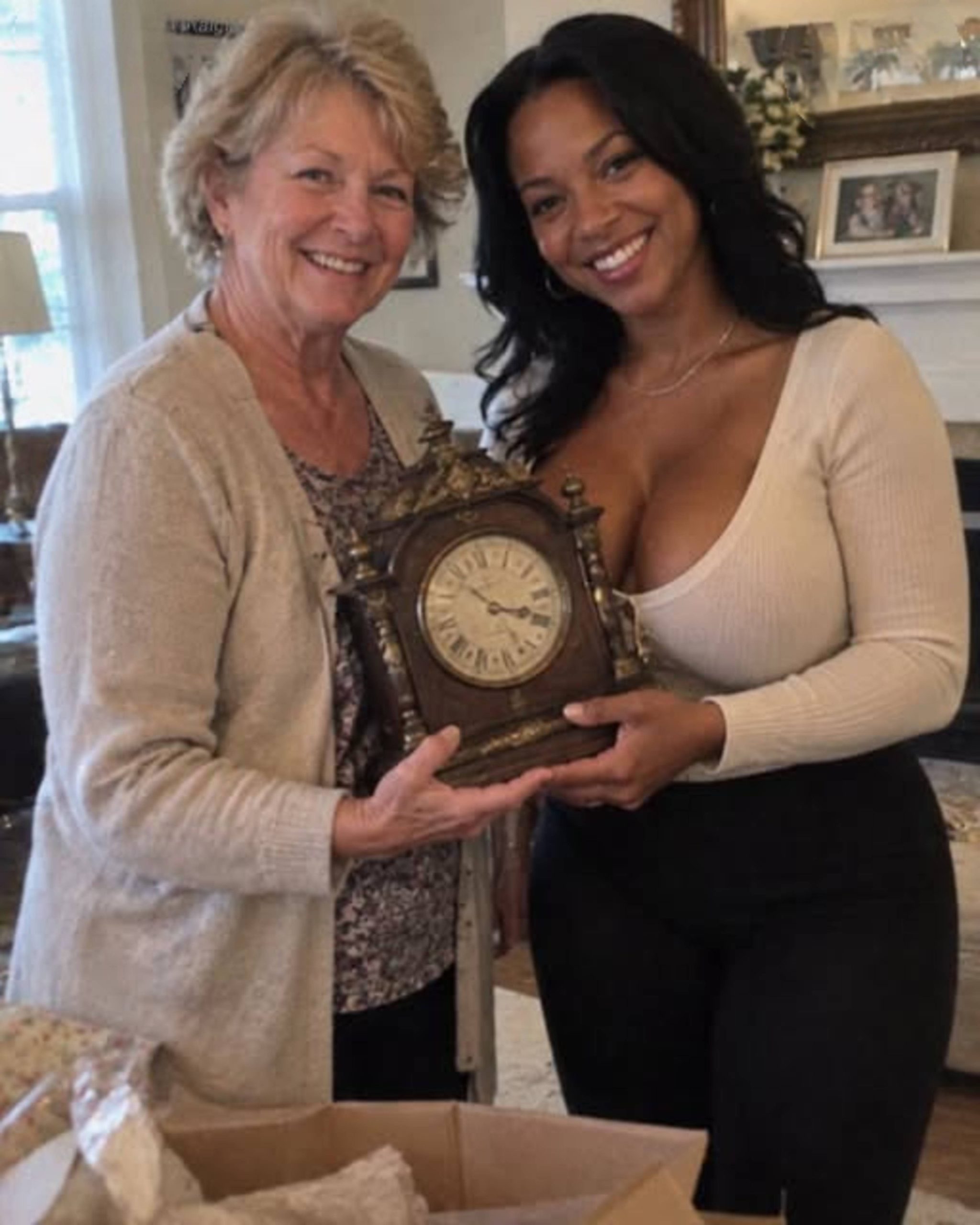
As a wedding present, she gave us an antique mantel clock.
I knew about Michael.
He was twelve years older than Anthony.
Six years earlier, after years of being estranged from Evelyn, he died in a car accident.
Anthony rarely discussed him, so I didn’t ask questions.
I knew enough to understand that Michael’s death had left a complicated wound in the family.
Instead, I turned my attention to the gift.
The clock was dark wood with a brass pendulum and tiny flowers carved around its face.
“It’s beautiful,” I told Evelyn.
Her fingers lingered on it.
“Michael loved it.”
That made me understand why she was giving it to us.
It seemed like a beautiful way to keep a piece of her son in our family.
We placed it on the mantel.
And before long, I barely noticed it was there.
Life went on as usual.
Then, little by little, Anthony started changing.
It began with small things.
He started asking where I’d been.
Not casually.
Specifically.
“Where did you go after work?”
“To the grocery store.”
“Which one?”
I laughed.
“The one near the highway.”
He didn’t laugh.
“Why?”
“Why what?”
“Why were you there for forty minutes?”
“I was shopping.”
He nodded.
But the look on his face told me he didn’t believe me.
A few days later, I came home and found him standing in the hallway.
“Who’s been here?”
“What?”
“Someone moved my shoes.”
I looked down.
His shoes were exactly where he usually left them.
“I didn’t touch them.”
He stared at me.
Then he walked away.
I began wondering whether he was stressed.
Maybe work was getting to him.
Maybe marriage was harder than he’d expected.
Maybe he was afraid of losing me.
So I tried to reassure him.
But the more I reassured him, the more suspicious he became.
One evening, after dinner with Evelyn, I was folding laundry while Anthony showered.
I remembered something his mother had said during dinner and muttered to myself.
“Your mother’s roast could break a window.”
Then I laughed.
“But she tried so hard. I’d eat a brick if it made her happy.”
Two days later, Anthony said, “You don’t have to pretend to like Mom’s cooking.”
I froze.
“Did she say something?”
He shrugged.
“She said you two talked.”
I stared at him.
“What?”
“Nothing.”
“No, Anthony. What did she say?”
He looked away.
“She just said you weren’t feeling well.”
“I never told her that.”
He shrugged again.
“You probably forgot.”
Something about the conversation bothered me.
Not because Evelyn and I hadn’t talked.
We had.
But because Anthony was describing conversations I’d had with his mother that I couldn’t remember telling him about.
And then I noticed something else.
The clock.
It was sitting on the mantel.
The brass pendulum was still.
I hadn’t heard it chime in days.
I walked toward it.
Anthony suddenly said, “Don’t touch that.”
I turned around.
“Why?”
“Because it’s old.”
“I know.”
“Just leave it.”
His reaction was strange enough that I stepped back.
That night, I couldn’t sleep.
I kept thinking about the clock.
The next morning, I asked Evelyn whether it still worked.
She looked surprised.
“It should.”
“Anthony told me not to touch it.”
Her expression changed.
“He did?”
“Yes.”
She was silent for a moment.
Then she said something that made my stomach tighten.
“Michael used to hide things in it.”
“What kind of things?”
“I don’t know.”
She looked toward the clock.
“He was always secretive.”
I laughed nervously.
“Maybe it’s just broken.”
She didn’t smile.
“No.”
“What?”
“Michael used to say the clock knew things.”
I thought she was joking.
But she wasn’t.
That evening, I came home to find Anthony standing in front of the mantel.
His hand was inside the clock.
He pulled it out quickly when he saw me.
“What are you doing?”
“Nothing.”
“You were inside the clock.”
“I was fixing it.”
“It doesn’t need fixing.”
He stared at me.
Then he said something that made my heart sink.
“Why do you keep asking questions?”
“Because you’re acting strange.”
“I’m acting strange?”
“Yes.”
He walked past me.
“Maybe I’m the one who should be asking questions.”
“About what?”
He didn’t answer.
Three days later, I got a call from the pawnshop.
The item I’d bought for Anthony had arrived.
I had completely forgotten about the surprise.
I drove across town to pick it up.
It was an old watch.
His father’s watch.
Anthony had once told me that he’d lost it when he was nineteen and had regretted it ever since.
I had found it online.
The seller was a pawnshop.
I’d paid for it weeks earlier.
When I came home, I hid the box in the hall closet.
I planned to give it to him on his birthday.
That evening, Anthony found me putting groceries away.
“What’s in the closet?”
I nearly dropped a bag.
“Nothing.”
His face changed.
“Nothing?”
“It’s a surprise.”
“For who?”
I smiled.
“For you.”
He didn’t smile back.
“Christine.”
“What?”
“Who gave you something?”
“No one.”
“Then what’s in the box?”
I sighed.
“It’s your birthday present.”
He stared at me.
Then he walked away.
I thought that was the end of it.
It wasn’t.
The next morning, I woke up to the sound of something crashing downstairs.
I ran down.
Anthony was standing beside the mantel.
The antique clock was on the floor.
Broken.
The glass face had shattered.
The wooden casing was cracked.
The brass pendulum lay several feet away.
“What happened?”
“I dropped it.”
“You dropped it?”
He looked terrified.
“Yes.”
I rushed toward him.
“Are you hurt?”
“No.”
I knelt beside the clock.
As I picked up a piece of broken wood, something fell from inside.
A tiny recording device.
I stared at it.
Anthony froze.
“What is that?”
“I don’t know.”
I picked it up.
It had a small red light.
It was recording.
My hands began shaking.
Then I heard my own voice.
*”Your mother’s roast could break a window.”*
My blood went cold.
The device had recorded me.
Not just once.
There were dozens of files.
Conversations.
Phone calls.
Things I’d said when I thought I was alone.
I looked at Anthony.
“You knew.”
He couldn’t speak.
“You knew this was in here.”
He nodded.
“Who put it there?”
Silence.
“Anthony.”
He finally whispered.
“My mother.”
Everything inside me seemed to collapse.
“Evelyn?”
He nodded.
“She put a recorder in the clock.”
“Why?”
He looked at the floor.
“She wanted to know what you were saying.”
I couldn’t understand.
“About her?”
“About everyone.”
“How long?”
“Months.”
I stared at the broken clock.
Then everything began falling into place.
The comments about her cooking.
The questions about where I’d been.
The conversations Anthony somehow knew about.
The suspicion.
The accusations.
None of it had started with me.
It had started with someone listening.
But there was another question.
“Why did you let her?”
Anthony closed his eyes.
“Because I was scared.”
“Of what?”
“Of losing you.”
I shook my head.
“That doesn’t answer the question.”
He sat down.
“After Michael died, Mom became convinced that everyone was hiding things from her.”
“That’s not my problem.”
“I know.”
“Then why?”
He looked at me.
“Because she told me you were planning to leave me.”
My mouth went dry.
“What?”
“She said she’d heard you talking about leaving.”
“When?”
“She wouldn’t say.”
“Because it wasn’t true.”
“I know that now.”
“Now?”
He looked ashamed.
“I believed her.”
I stepped backward.
“You believed your mother over your wife.”
“I was afraid.”
“You searched my things.”
“Yes.”
“You questioned where I went.”
“Yes.”
“You accused me of wanting to leave.”
He nodded.
“And you never once asked me whether it was true.”
“I know.”
The betrayal wasn’t just the recorder.
It was that he had trusted a voice coming through a hidden device more than the woman sleeping beside him.
Then the front door opened.
Evelyn walked in.
She saw the broken clock.
She stopped.
Her eyes went straight to the recorder in my hand.
“Oh.”
One word.
That was all she said.
I stood.
“You recorded me.”
She didn’t deny it.
“I needed to know the truth.”
“You had no right.”
“I was protecting my son.”
“From what?”
She looked at Anthony.
“From being abandoned.”
I laughed bitterly.
“I wasn’t abandoning anyone.”
She stared at me.
“You said things.”
“Things?”
“Things that sounded like you were unhappy.”
“I made a joke about your cooking.”
“And you said you were tired.”
“Because I was tired.”
“You said marriage was harder than you expected.”
I looked at Anthony.
“I did say that.”
He flinched.
“But I also said I loved him.”
Evelyn said nothing.
I continued.
“You took ordinary thoughts, ordinary frustrations, ordinary conversations, and turned them into evidence.”
She looked down.
“I was wrong.”
“Yes.”
Anthony stood.
“Mom, you were wrong.”
She looked at him.
“I was trying to protect you.”
“You almost destroyed my marriage.”
Her face crumpled.
“I was afraid.”
“So was I,” he said.
Then he looked at me.
“But I made the wrong choice.”
I didn’t forgive him immediately.
I couldn’t.
Trust doesn’t return because someone admits they broke it.
It returns slowly.
Sometimes painfully.
Sometimes not at all.
For several weeks, Anthony and I lived separately.
We talked with a counselor.
He confronted his fear of abandonment.
I confronted the fact that I had ignored warning signs because I didn’t want to believe something was wrong.
And Evelyn?
She apologized.
But apologies didn’t erase what happened.
She had invaded our privacy.
Anthony had participated in the invasion.
And the antique clock that had been given to us as a symbol of family became a reminder of how easily family could cross boundaries.
Eventually, Anthony and I decided to try again.
Not because everything was fixed.
Because we both believed the marriage was worth rebuilding.
He changed the locks.
We removed the clock.
He stopped allowing anyone—including his mother—to speak for him.
And I stopped laughing off behavior that frightened or confused me.
The watch I’d bought for him remained in the closet for weeks.
One evening, I finally gave it to him.
He opened the box.
He stared at it.
Then he began to cry.
“You remembered.”
“Of course I remembered.”
He held the watch in his palm.
“I don’t deserve this.”
“Maybe not.”
He looked at me.
“But I wanted you to have it.”
He put it on.
Then he took my hand.
“I don’t want to spend the rest of my life being afraid of losing you.”
I squeezed his fingers.
“Then stop treating me like someone you’re waiting to lose.”
He nodded.
And that became the new rule in our marriage.
Ask.
Don’t assume.
Talk.
Don’t investigate.
Trust.
Don’t secretly test.
The broken clock was never repaired.
I kept one small piece of its wooden frame in a drawer.
Not because I wanted to remember the betrayal.
Because I wanted to remember what it taught us.
A marriage can survive difficult conversations.
It can survive mistakes.
It can even survive fear.
But it cannot survive when suspicion is allowed to replace communication.
**The most dangerous secrets aren’t always the ones someone is hiding from you—they can be the secrets someone keeps while watching you. Trust cannot grow where surveillance and suspicion take its place.**