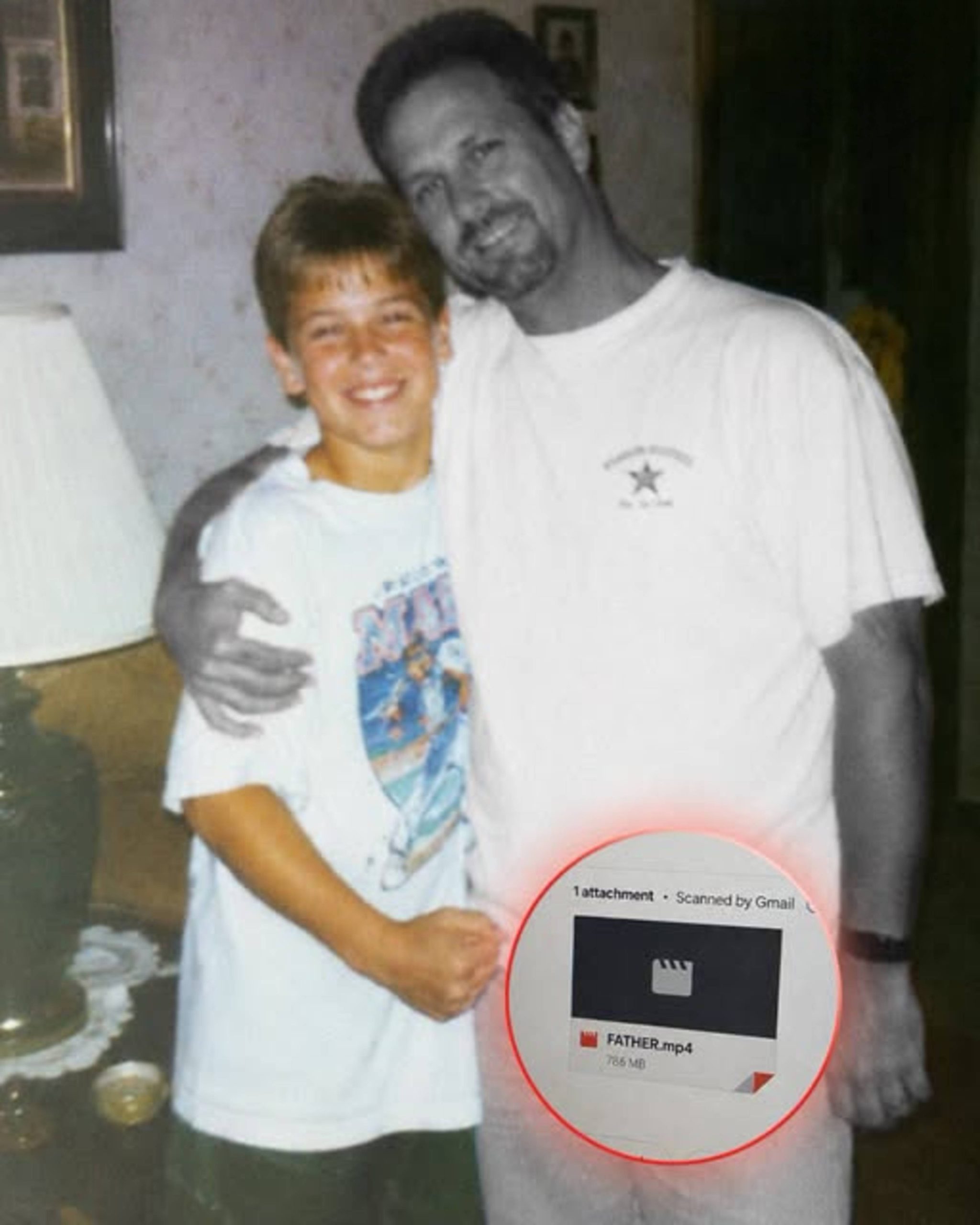
**I thought I had made peace with never understanding my father’s death. Then I received a video from an unknown sender. Before the person on screen even spoke, I knew whatever came next would change the story I had lived with for most of my life.**
My name is Gregory, and I was eleven years old when my father died.
At that age, you don’t understand death the way adults do.
You understand that someone is gone.
You understand that they aren’t coming back.
But you don’t understand why the world continues moving when yours has suddenly stopped.
The police report described my father’s death as an **accidental drowning**.
I never believed that word.
My dad was a strong swimmer.
He had crossed the lake behind our family lake house more times than I could count.
He could swim in cold water.
He could swim when the wind was strong.
He had even gone into that lake during a storm once, an incident that scared my mother so badly that she didn’t speak to him for the rest of the evening.
He knew that water.
He respected it.
And yet, on one mild evening, he supposedly slipped from the dock, disappeared beneath the surface, and never came back up.
There were no witnesses.
No clear explanation.
Just a closed case.
A funeral.
A house full of adults whispering.
And a little boy who kept waiting for someone to tell him what really happened.
### The Silence
After my father died, nobody wanted to talk about him.
At first, I thought it was because everyone was grieving.
My mother stopped mentioning his name.
Relatives changed the subject whenever I asked questions.
Even photographs gradually disappeared from the places where I’d been used to seeing them.
His fishing jacket remained in the garage for years, but nobody touched it.
His tools stayed exactly where he’d left them.
It was as though everyone was afraid that moving one object would somehow reopen the entire tragedy.
So I learned not to ask.
I learned to keep my questions to myself.
For years, I thought that silence was grief.
Now I know it was something else too.
### Paul
My mother remarried four years later.
His name was Paul.
He was a good man.
He never tried to replace my father.
That mattered to me more than he probably ever understood.
He came into our lives slowly.
Carefully.
He never told me to call him Dad.
When someone accidentally referred to him that way, he would look at me before saying anything.
He let me decide.
I called him Paul.
Even after I grew up.
Even after I got married.
Even after I had children of my own.
He never seemed offended.
In fact, once, when I apologized for still calling him by his first name, he laughed.
“You don’t owe me a different name,” he said.
I remembered that sentence for years.
Paul eventually became the person I called when something broke.
When my car wouldn’t start.
When my marriage hit a difficult patch.
When my first child was born.
When I needed advice but didn’t want to admit I needed it.
He was there.
And because he was so good to me, part of me stopped searching for answers about my father.
Maybe that was what my mother wanted.
Maybe it was what Paul wanted.
Or maybe I simply became tired of carrying a question that had no answer.
My father had been dead for twenty-seven years.
I had accepted that.
Or at least I thought I had.
### The Email
Yesterday, I received an email that changed everything.
There was no subject line.
No name I recognized.
No explanation.
Just a video attachment.
And one line beneath it.
**“I’m sorry.”**
I almost deleted it.
It looked like spam.
There was no reason I should have opened it.
But something about those two words stopped me.
I don’t know why.
Maybe it was instinct.
Maybe curiosity.
Maybe some part of me had spent twenty-seven years waiting for someone to finally say those words.
So I opened the video.
At first, all I could see was a chair.
A man was sitting just outside the light.
The room behind him was dark.
My hands started shaking before he even moved.
I don’t know why.
Maybe some part of me recognized him before my brain did.
Then he leaned forward.
And I stopped breathing.
He was old.
Much older than the man I remembered.
His face was thin.
His cheeks had hollowed.
His hair was almost completely gray.
But his eyes were the same.
So was the small scar over his left eyebrow.
The scar my father had gotten when I was six, after falling against the edge of a cabinet while fixing something in the garage.
I remembered standing beside him while my mother cleaned the cut.
I remembered him laughing.
“Don’t look so worried, buddy.”
Now those same eyes were looking into a camera.
And then the man spoke.
“Gregory.”
I dropped the phone.
### The Voice
I picked it up again with both hands.
The man swallowed.
“I don’t know if you remember my voice.”
I couldn’t move.
“I don’t know if you remember enough about me to believe this.”
He looked down.
“I should have come back sooner.”
My heart was pounding so hard I could hear it.
Then he said my father’s nickname for me.
A nickname nobody outside our family had ever used.
Not Paul.
Not my mother.
Nobody.
Only my father.
The nickname suddenly transported me back to being eleven years old.
Standing on the dock.
Holding my father’s fishing pole.
Waiting for him to teach me how to cast.
I had forgotten how clearly I remembered his voice.
Until that moment.
The man on the screen took a shaky breath.
“My name is Daniel.”
My father’s name.
Daniel.
I whispered it aloud.
Then the video continued.
“I need you to understand something before you hate me.”
I stared at the screen.
“I didn’t drown.”
### The Story Breaks Open
The video lasted nineteen minutes.
Nineteen minutes that felt like the longest and shortest period of my life.
My father explained that the night he disappeared, he had not gone to the lake to swim.
He had gone there because he believed someone was watching our family.
He wouldn’t say everything at first.
He said there had been financial problems.
A business dispute.
Documents.
Threats.
Things I was too young to understand.
He had discovered that someone close to the family had been hiding money and falsifying records.
When he confronted that person, the situation changed.
He became afraid.
Not for himself.
For my mother.
For me.
He believed that if he stayed, we would become targets.
So he made a decision that still sounded impossible to me.
He disappeared.
The drowning was staged.
The body recovered from the lake had never been his.
Someone had helped him.
Someone who had access to the lake, the property, and information about the investigation.
My father said he had spent years moving from place to place.
He couldn’t contact us without risking exposing where he was.
At first, he thought he’d return after a few months.
Then months became years.
Years became decades.
And eventually, shame became another kind of prison.
“I kept telling myself I would come back when it was safe,” he said.
“Then I kept telling myself you were better off without me.”
I paused the video.
I couldn’t watch anymore.
### The Man I Had Hated
I had spent twenty-seven years believing my father had died.
Then I spent perhaps ten minutes realizing he had chosen to leave.
The difference should have made me furious.
And it did.
I was furious.
I was eleven years old when he disappeared.
I had needed him.
I needed him at twelve.
At sixteen.
At graduation.
When I got married.
When my first child was born.
There were countless moments when I looked for him without realizing I was doing it.
And all that time, he had been alive.
Somewhere.
Watching from a distance.
Or at least that’s what he claimed.
I wanted to scream.
I wanted to throw the computer against the wall.
Instead, I called Paul.
He answered on the second ring.
“Greg?”
I couldn’t speak.
He immediately knew something was wrong.
“What happened?”
I finally said:
“My father is alive.”
Silence.
Complete silence.
Then Paul said something I’ll never forget.
“I know.”
### The Second Secret
I thought I had misunderstood him.
“What?”
Paul took a breath.
“I knew.”
I sat down.
“You knew?”
“Not at first.”
“When?”
“A long time ago.”
My hands went cold.
“How long?”
He didn’t answer immediately.
“Your mother found out about seven years after he disappeared.”
I stared at the wall.
“And you both kept it from me?”
Paul’s voice cracked.
“She was afraid.”
“And you?”
“I was afraid too.”
“Of what?”
“That if you knew, you’d spend the rest of your life waiting for him.”
I couldn’t answer.
Paul continued.
“I didn’t want to become the man who stood between you and your father.”
“But you did.”
“Yes.”
He didn’t defend himself.
That somehow hurt more.
“I should have told you,” he said.
“Yes.”
“I know.”
### The Man in the Video
I watched the rest of the video alone.
My father explained where he was living.
He didn’t ask me for forgiveness.
He didn’t ask me to call him Dad.
He didn’t even ask me to meet him.
He simply said:
“If you want to know the truth, I’ll tell you everything.”
At the end, he looked directly into the camera.
“I watched you grow up from a distance.”
My jaw tightened.
“I saw your wedding.”
I froze.
“I saw your children.”
Tears filled my eyes.
“I wanted to walk through that door a thousand times.”
He paused.
“But every time I thought about coming home, I remembered why I left.”
Then he said the words that broke something open inside me.
“I don’t expect you to understand.”
He looked down.
“I just didn’t want to die without letting you know I was still here.”
The screen went black.
### Twenty-Seven Years of Questions
I didn’t sleep that night.
I walked through my house looking at photographs.
My wedding.
My children.
My mother.
Paul.
And one photograph of my father.
He was standing beside the lake.
I had been the one who took it.
I was eleven.
He was laughing.
The sun was behind him.
For years, I had looked at that photograph and thought:
**That’s the last picture of my father.**
Now I knew it wasn’t.
I didn’t know what came next.
I didn’t know whether I could forgive him.
I didn’t know whether I wanted him in my life.
I didn’t know whether the story in that video was entirely true.
There were too many unanswered questions.
Too many years.
Too many people who had kept secrets.
But there was one thing I knew.
For twenty-seven years, I had mourned a dead man.
Now I had to figure out how to deal with a living one.
This morning, I watched the video again.
Then I wrote down the address he had given me.
I stared at it for a long time.
Finally, I picked up my phone.
My finger hovered over the call button.
I wasn’t ready to forgive him.
I wasn’t even sure I was ready to see him.
But after twenty-seven years, I was finally ready to ask the question that had followed me since childhood.
**“Dad, why did you leave?”**
And this time, I knew there was a chance he might actually answer.
**Sometimes the hardest truth isn’t discovering that someone lied about the past. It’s discovering that the person you spent years grieving was alive all along—and deciding what, if anything, the truth allows you to rebuild.**