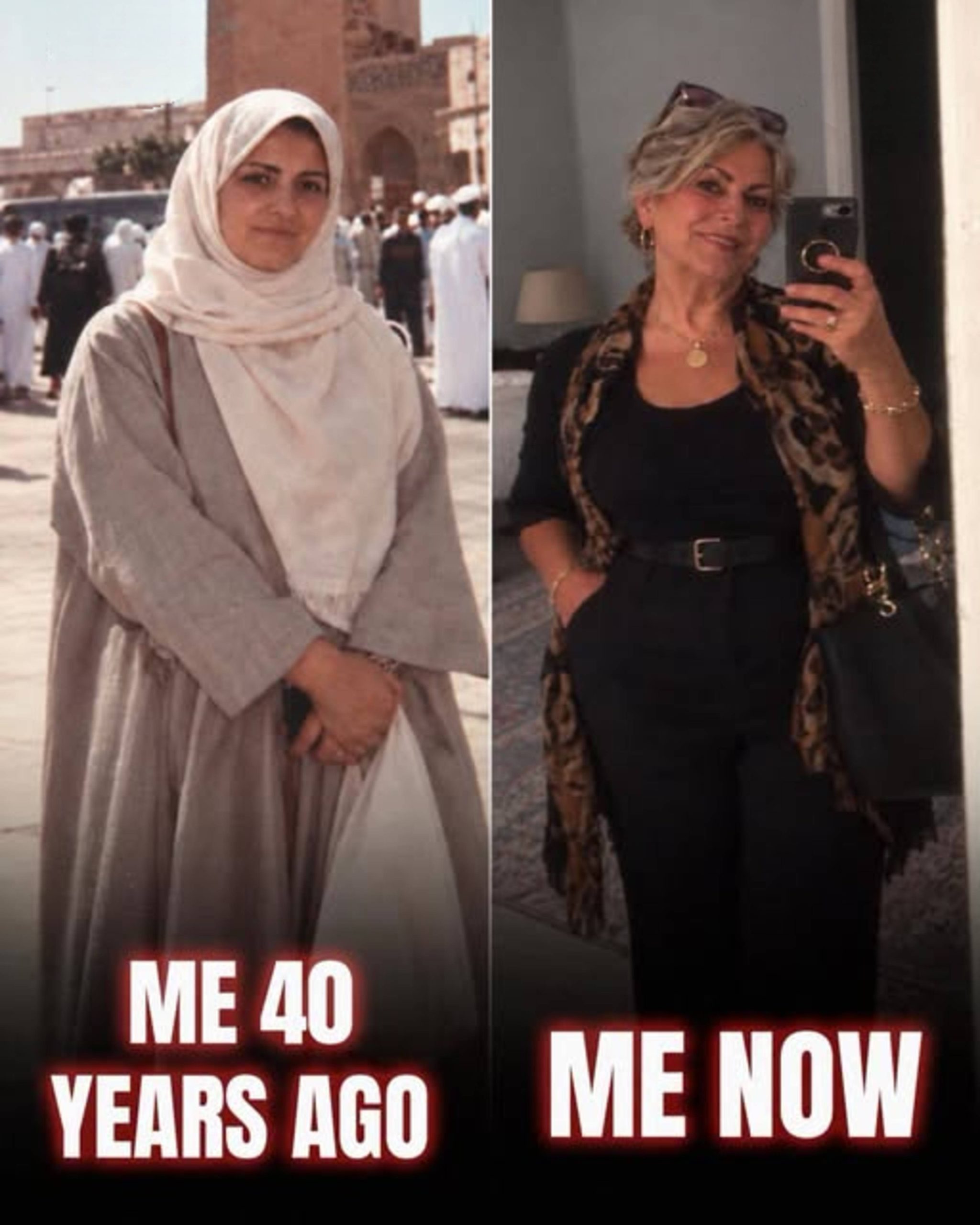
**I thought returning home after four decades would mean facing memories. I did not expect police at the airport or an old house waiting at the end of the ride.**
“We’ve been expecting you.”
The officer was holding my passport when he said it.
For a second, I thought I’d misunderstood him.
I had just walked out of the arrivals hall in Casablanca after almost forty years away.
Three police cars were parked along the curb.
A third officer was looking at my passport.
“Expecting me?”
He glanced down at the photograph.
Then back at my face.
“Samira?”
“Yes.”
“Please come with us.”
I tightened my grip around the handle of my suitcase.
“Am I under arrest?”
“No.”
The answer came quickly.
But then the officer hesitated.
And that hesitation frightened me more than the question.
Behind me, people were pouring out of the terminal.
Families were hugging.
Drivers held signs above their heads.
Children climbed into the arms of grandparents they hadn’t seen in months.
People were laughing, crying, calling relatives, dragging suitcases toward waiting cars.
Nobody seemed to notice the sixty-year-old woman standing beside a single suitcase, wondering whether something she’d done at nineteen had finally followed her across an ocean.
The officer opened the rear door of one of the cars.
“We need to take you somewhere.”
“Where?”
“Please.”
I looked at him.
“You have to tell me where.”
He glanced at the other officers.
Then he said quietly:
“To your old home.”
My heart stopped.
### The Night I Left
My name is Samira.
I was nineteen when I left Morocco.
I took one suitcase.
Two hundred and forty dollars.
And an airline ticket my mother had hidden from my father.
She didn’t turn on the bedroom light.
She just sat beside me and put her hand over my mouth before I could speak.
“Listen.”
I remember that word perfectly.
Not because she whispered it.
Because my mother almost never gave orders.
She was gentle.
Careful.
The kind of woman who apologized when someone else bumped into her.
So when she put her hand over my mouth and said, “Listen,” I knew something was terribly wrong.
She reached underneath my mattress and pulled out an envelope.
Inside was a passport.
An airline ticket.
And a photograph.
I stared at the photograph.
It was of me as a child, standing beside the old house where I’d grown up.
“What is this?”
“Your way out.”
I didn’t understand.
“Out of what?”
She looked toward the bedroom door.
“Your father knows.”
“Knows what?”
Her eyes filled with tears.
“That you found the letter.”
The letter.
I still had it.
Even after forty years.
Even after three different countries.
Even after two marriages, one divorce, and a life my younger self could never have imagined.
I had kept that letter in a box beneath my clothes.
But I had never opened it again.
Because I knew what it said.
Or at least I thought I did.
### The Secret
My father had always been a frightening man.
Not violent in the way people imagine violence.
He didn’t need to hit anyone.
His silence was enough.
He controlled where my mother went.
Who she spoke to.
What she spent.
What I was allowed to study.
What I was allowed to wear.
And most importantly, who I was allowed to become.
At nineteen, I had been accepted into a university abroad.
It was the first time I’d ever been given the possibility of a life outside our neighborhood.
My father refused.
“You will stay.”
That was all he said.
I begged.
My mother begged.
Nothing changed.
Then one afternoon, I found a letter hidden behind a loose board in my father’s study.
It had my mother’s name on it.
The handwriting belonged to a man I’d never heard of.
The letter was dated twenty-one years earlier.
I read it once.
Then again.
And everything I believed about my family cracked.
There had been another child.
A baby.
A daughter.
Born before me.
And according to the letter, she had not died.
She had been given away.
My father had told everyone she was stillborn.
My mother had believed him.
Until years later, she discovered the truth.
The letter was from someone who claimed to know where the baby had been taken.
My mother had never told me because she was afraid.
Afraid of my father.
Afraid of what would happen if he discovered she knew.
And now, somehow, I knew too.
### The Escape
That night, my mother packed my suitcase.
“You cannot stay.”
“What about you?”
She looked at me.
“I’ll be fine.”
I knew she was lying.
She pressed the envelope into my hands.
“If you stay, he will find a way to stop you.”
“Come with me.”
She shook her head.
“I can’t.”
I cried.
She didn’t.
She simply hugged me so tightly that I could barely breathe.
“Go,” she whispered.
I left before sunrise.
I didn’t say goodbye to my father.
I didn’t wake my younger cousins.
I didn’t look back at the house.
I boarded a plane with two hundred and forty dollars and a secret that was heavier than the suitcase beside me.
I thought I was leaving for a few years.
I thought I’d return.
Then life happened.
### Forty Years Away
I built a life.
Not the life I’d imagined at nineteen.
A different one.
I learned a new language.
I worked jobs I never expected to have.
I made friends.
I fell in love.
I became a mother.
Then a grandmother.
I sent letters home for years.
At first, my mother replied.
Then the letters stopped.
I called.
No answer.
I sent money.
Nothing came back.
Eventually, someone told me my father had died.
A few years later, I heard that my mother had died too.
By then, I had convinced myself that the past was buried.
But every birthday, every family celebration, every time I looked at my granddaughter, I wondered about the baby in that letter.
My sister.
If she was alive.
Where she had gone.
Whether she ever knew where she came from.
I never found her.
And I stopped searching.
Until I received a message six months ago.
There was no name.
Only an address.
The address of my childhood home.
Underneath it were six words:
**You need to come home, Samira.**
### The Car Ride
Now I was sitting in the back of a police car.
Driving toward the place I’d spent forty years trying not to dream about.
I watched Casablanca pass through the window.
The city had changed.
Buildings had appeared where empty lots used to be.
Roads had widened.
Stores had different signs.
But every few minutes, I recognized something.
A corner.
A tree.
A wall.
A smell carried through the open window.
Memory doesn’t disappear.
It waits.
The officer sitting beside me finally spoke.
“We’re not taking you there because you’ve committed a crime.”
“Then why?”
He looked at me.
“Because someone asked us to make sure you arrived safely.”
“Who?”
He didn’t answer.
My hands began shaking.
“Is it my sister?”
The officer looked surprised.
“You know?”
“I know there was a child.”
He looked at the other officer.
Then back at me.
“Yes.”
My heart began pounding.
“She’s alive?”
He nodded.
I covered my mouth.
For forty years, I’d carried a question.
Now someone had finally answered it.
### The House
The car stopped in front of a house.
My house.
The walls were older.
The garden was smaller.
The blue paint had faded.
But I knew it.
I knew every crack in the front steps.
Every window.
Every tree.
I couldn’t move.
The officer opened my door.
“She’s inside.”
“Who?”
He looked at me.
“Your sister.”
My knees nearly gave out.
I walked toward the front door.
Someone had repainted it.
But the brass handle was the same.
I touched it.
And suddenly I was nineteen again.
My mother’s hand over my mouth.
The suitcase.
The ticket.
The tears.
The promise that I’d come back.
I opened the door.
A woman was standing in the hallway.
She was approximately my age.
Maybe