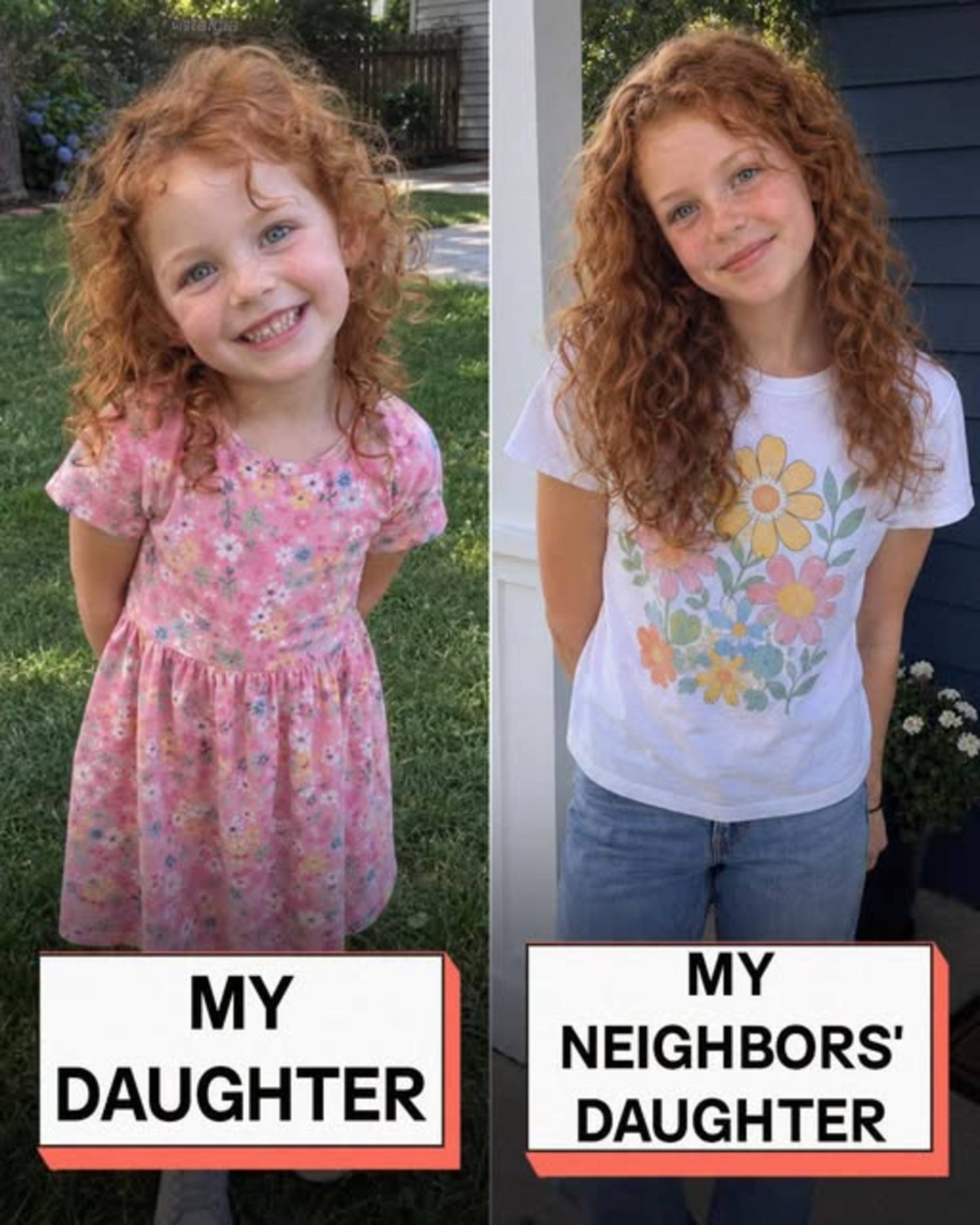
Ten years after my four-year-old daughter disappeared, I learned to live with questions nobody could answer. Then a new family moved in next door, and their teenage daughter looked so much like the little girl I had lost that I almost stopped breathing. What began as an impossible resemblance forced me to face a truth I had never stopped hoping for.
The girl next door looked at me for three seconds before I called her by a name nobody had used around her in ten years.
“Margot?”
She stopped halfway up our driveway.
“What?”
My husband, Greg, turned toward me.
“Nicole?”
Our new neighbors, Joan and Thomas, had come over to introduce themselves that afternoon. They’d moved in three days earlier because Thomas had taken a new job nearby.
Until that moment, everything had been painfully ordinary: moving boxes, polite introductions, a teenager who apparently hated unpacking.
Then Joan had called toward their house.
“Mia! Come say hello.”
A fourteen-year-old girl appeared.
For a second, I forgot what I’d been about to say.
It wasn’t just her face.
It was what she did with her hand.
Mia pressed her thumbnail into the side of her index finger, rubbed twice, then curled her fingers into her palm.
Margot, my baby, had done that whenever she was nervous.
At four, she’d started hiding her hands behind her back because I kept telling her she’d rub a hole through her finger.
Now this girl was doing it ten feet away.
Mia backed up.
I couldn’t move.
The world seemed to narrow until there was nothing in it except her face.
Brown hair.
Gray-green eyes.
A small crescent-shaped mark just beneath her left ear.
Margot had one too.
Greg touched my elbow.
“Nicole.”
I heard him, but I couldn’t answer.
The girl looked at me strangely.
“Do I know you?”
“No,” I whispered.
Then I corrected myself.
“I’m sorry. You just remind me of someone.”
“Who?”
I looked at her.
“My daughter.”
Her expression changed.
Joan immediately stepped forward.
“Mia, honey, go finish unpacking.”
The girl glanced between us.
“Okay.”
She walked away.
But before she disappeared through the doorway, she looked back at me.
And for the briefest second, I saw something in her expression that I couldn’t explain.
Recognition.
Or maybe I simply wanted it to be recognition so badly that my mind created it.
Because ten years can teach you many things.
It can teach you how to smile at people who ask whether you’re “doing better.”
It can teach you how to stop checking every missing-child poster even though you know the photograph is outdated.
It can teach you how to walk past playgrounds without counting little girls with brown hair.
But ten years cannot teach a mother how to stop being a mother.
Margot disappeared on a Saturday afternoon.
She was four.
We were at a crowded county fair.
I remember everything.
The smell of kettle corn.
The blue balloon Greg had bought her.
The yellow dress she was wearing.
The little white sandals she’d complained about because one strap was rubbing her ankle.
I remember holding her hand.
I remember letting go for what I thought was seconds.
There had been a commotion near one of the game booths.
Someone dropped a tray.
People turned.
I looked away.
When I looked back, Margot was gone.
We searched for hours.
Then days.
Then months.
The police came.
Volunteers came.
News crews came.
Strangers brought casseroles.
People prayed.
People speculated.
Someone even called and claimed to know where she was.
It was a lie.
Everything became a lie eventually.
Hope.
Rumors.
Sightings.
Promises.
The years passed.
The case remained open, but life moved forward around it.
Greg and I grew older.
Our house became quieter.
Margot’s room stayed exactly as it had been.
For the first year, I refused to touch anything.
Then I packed some things into boxes.
Then I unpacked them.
Then I stopped going into the room altogether.
We never had another child.
Not because we didn’t want one.
Because some part of me was afraid that having another baby would feel like replacing her.
It was irrational.
I knew that.
But grief doesn’t care about logic.
So when Mia appeared next door, I did the only thing I could.
I told myself I was imagining it.
That evening, Greg found me sitting in the kitchen.
“You need to be careful.”
“I know.”
“You can’t assume she’s Margot.”
“I know.”
“You said her name in front of them.”
“I know.”
He sat across from me.
“We don’t know anything.”
I looked at him.
“What if we do?”
He didn’t answer.
That night, I couldn’t sleep.
At 3:17 a.m., I got out of bed and went downstairs.
I opened the drawer where I kept the old photographs.
There she was.
Margot at three.
Margot at four.
Margot holding a stuffed rabbit.
Margot standing in the backyard with her thumb pressed against her finger.
I stared at the picture.
Then I looked toward the window.
The neighbor’s house was dark.
I whispered her name.
“Margot.”
The next morning, I saw Mia walking to the mailbox.
I almost went outside.
Instead, I stayed behind the curtain.
She did the hand movement again.
Twice.
Then she tucked her hands into her hoodie pocket.
I felt my heart hammering.
There were too many coincidences.
But coincidences aren’t proof.
So I started looking for facts.
Not answers.
Facts.
Mia’s parents had moved from another state.
Thomas had accepted a job three weeks earlier.
Mia had attended several schools because of the family’s relocations.
There was nothing unusual.
No adoption mentioned.
No missing-child connection.
Nothing.
I felt ridiculous.
Then, three days later, Mia knocked on our door.
I opened it.
“Hi.”
She looked nervous.
“Can I ask you something?”
“Of course.”
She looked toward the street.
“Why did you call me Margot?”
I swallowed.
“Because you remind me of my daughter.”
“What happened to her?”
I didn’t know whether to tell her.
But she was fourteen.
She deserved the truth if she was asking.
“She disappeared when she was four.”
Mia’s face went pale.
“I’m sorry.”
“Thank you.”
She hesitated.
“Did you ever find her?”
“No.”
She looked down at her hands.
Then she rubbed her thumb against her finger.
“That’s weird.”
“What?”
“I’ve always done this.”
She looked embarrassed.
“My parents say I did it as a baby.”
I couldn’t breathe.
“Do you have any baby pictures?”
She looked at me.
“Why?”
“I don’t know.”
She stared at me for several seconds.
Then she said:
“I think you should ask my mom.”
Joan answered the door.
The moment she saw my face, something changed.
“What happened?”
“Mia told me you have baby pictures.”
Joan’s expression hardened.
“Why?”
“Because I need to know when she was born.”
“That isn’t your business.”
“No.”
I swallowed.
“But my daughter disappeared ten years ago.”
Joan went completely still.
Mia looked at her mother.
“Mom?”
Thomas appeared behind her.
“What is this about?”
I reached into my pocket and pulled out the photograph I’d brought with me.
I held it out.
“This is my daughter.”
Joan looked at the picture.
Her face drained of color.
Thomas took it from her.
He stared at it.
Then at Mia.
Then back at the photograph.
“Joan?”
She began crying.
Mia looked frightened.
“What?”
Joan covered her mouth.
“I need to tell you something.”
The room went silent.
She sat down.
Thomas remained standing.
And then Joan said the words that changed my life.
“Mia wasn’t born as Mia.”
My knees nearly gave out.
Greg, who had followed me over, grabbed my arm.
Joan continued through tears.
“We adopted her.”
“When?”
“Ten years ago.”
“From where?”
She hesitated.
“A private agency.”
“Which agency?”
Thomas looked at her.
“Joan.”
She shook her head.
“I didn’t know.”
“You didn’t know what?”
“They told us she had been abandoned.”
My heart was pounding so hard it hurt.
“Her birth name?”
Joan looked at me.
“Margaret.”
I stopped breathing.
Greg whispered:
“Margot.”
Mia stared at all of us.
“My name was Margot?”
Joan nodded.
“They told us she was four years old.”
I sat down.
The room tilted.
“Where did you get her?”
Joan named a county two states away.
The same county where Margot had disappeared.
For ten years, I’d imagined a thousand possibilities.
I had imagined her growing up somewhere else.
I had imagined someone changing her name.
I had imagined someone telling her we didn’t want her.
But I had never imagined this.
A family had taken her in believing she had been abandoned.
They had raised her.
Loved her.
Protected her.
And somehow, my daughter had grown up believing she was someone else.
There was one problem.
None of this proved anything.
Not the name.
Not the hand movement.
Not the resemblance.
Not even the adoption records.
We needed DNA.
The police reopened the case.
Investigators arrived.
Old records were requested.
The adoption agency was contacted.
Mia agreed to testing.
The wait was unbearable.
I barely slept.
Every time I looked at her, I saw both children.
The fourteen-year-old standing in front of me.
And the four-year-old who had vanished from my hand.
I didn’t want to steal her from Joan and Thomas.
That thought terrified me.
They were her parents.
They had raised her.
They had loved her when I couldn’t.
But I was her mother too.
The DNA results came back twelve days later.
I was sitting beside Greg when the detective walked into the room.
He didn’t speak immediately.
He just sat down.
My hands began shaking.
Finally, he said:
“Nicole, the results confirm that Mia is your biological daughter.”
I covered my mouth.
Greg started crying.
I couldn’t move.
Ten years.
Ten years of waiting.
Ten years of wondering.
Ten years of talking to an empty bedroom.
And suddenly, my daughter was alive.
She was fourteen.
She was funny.
She was awkward.
She liked music I’d never heard of.
She hated tomatoes.
She had a favorite teacher.
She had friends.
She had memories that didn’t include me.
That was the hardest part.
Finding your missing child doesn’t mean you get to press rewind.
You don’t get your four-year-old back.
You meet the fourteen-year-old she became.
Mia didn’t immediately call me Mom.
I never asked her to.
The first time we met after the results, she stood across from me with tears in her eyes.
“Do you hate my parents?”
I shook my head.
“No.”
“But they took me.”
“They didn’t know.”
“They raised me.”
“Yes.”
“Are you angry?”
I thought about it.
“I am angry at whoever took you.”
She looked down.
“What about me?”
I walked toward her slowly.
“Never.”
She began crying.
So did I.
I held out my hand.
She looked at it.
Then she took it.
Her fingers curled around mine.
And without thinking, she pressed her thumbnail against the side of her index finger.
Rubbed twice.
Then curled her fingers into her palm.
I laughed through my tears.
“You still do that.”
She smiled.
“I guess I do.”
“Your dad used to call it your thinking hand.”
She looked at me.
“What else do you remember?”
I sat beside her.
“Everything.”
We talked for hours.
I told her about the blue balloon.
The yellow dress.
The rabbit.
The monkey bars.
The way she used to hide her hands when she was nervous.
She remembered almost none of it.
But she listened.
And I listened to her.
I learned about the life she had lived.
The schools.
The friends.
The family vacations.
The Christmas traditions.
The little things that made her *Mia.*
I never asked her to stop being Mia.
Because Margot had been missing for ten years.
Mia had been living.
She deserved both names.
Both histories.
Both families.
Months later, she came over for dinner.
She walked into the house and stopped at the bottom of the stairs.
“Can I see her room?”
I nodded.
We climbed the stairs together.
The room was still there.
Not exactly as it had been.
But enough.
The old bookshelf.
The faded curtains.
The box of photographs.
Mia stood in the doorway.
“This was mine?”
“Yes.”
She walked to the shelf.
There was a little stuffed rabbit sitting there.
She picked it up.
Then she frowned.
“I know this.”
I froze.
“What?”
She held it against her chest.
“I don’t know how.”
I didn’t move.
She closed her eyes.
Then whispered:
“Mom?”
It was the first time she had called me that.
My heart broke and healed at the same time.
I crossed the room.
She stepped into my arms.
And for a few seconds, neither of us said anything.
I simply held my daughter.
Not the four-year-old I had spent ten years searching for.
Not the fourteen-year-old I had just met.
Just my daughter.
The girl who had somehow found her way back home.
I used to believe that hope was cruel.
That it kept mothers trapped in the past.
Now I understand something different.
Hope doesn’t always bring the past back.
Sometimes it simply keeps a door open long enough for the future to walk through.
**Ten years ago, I lost my daughter. For ten years, I thought I was waiting for a miracle. I never imagined the miracle would move into the house next door, carrying a different name, a different childhood, and the same little nervous hand that had never forgotten me.**