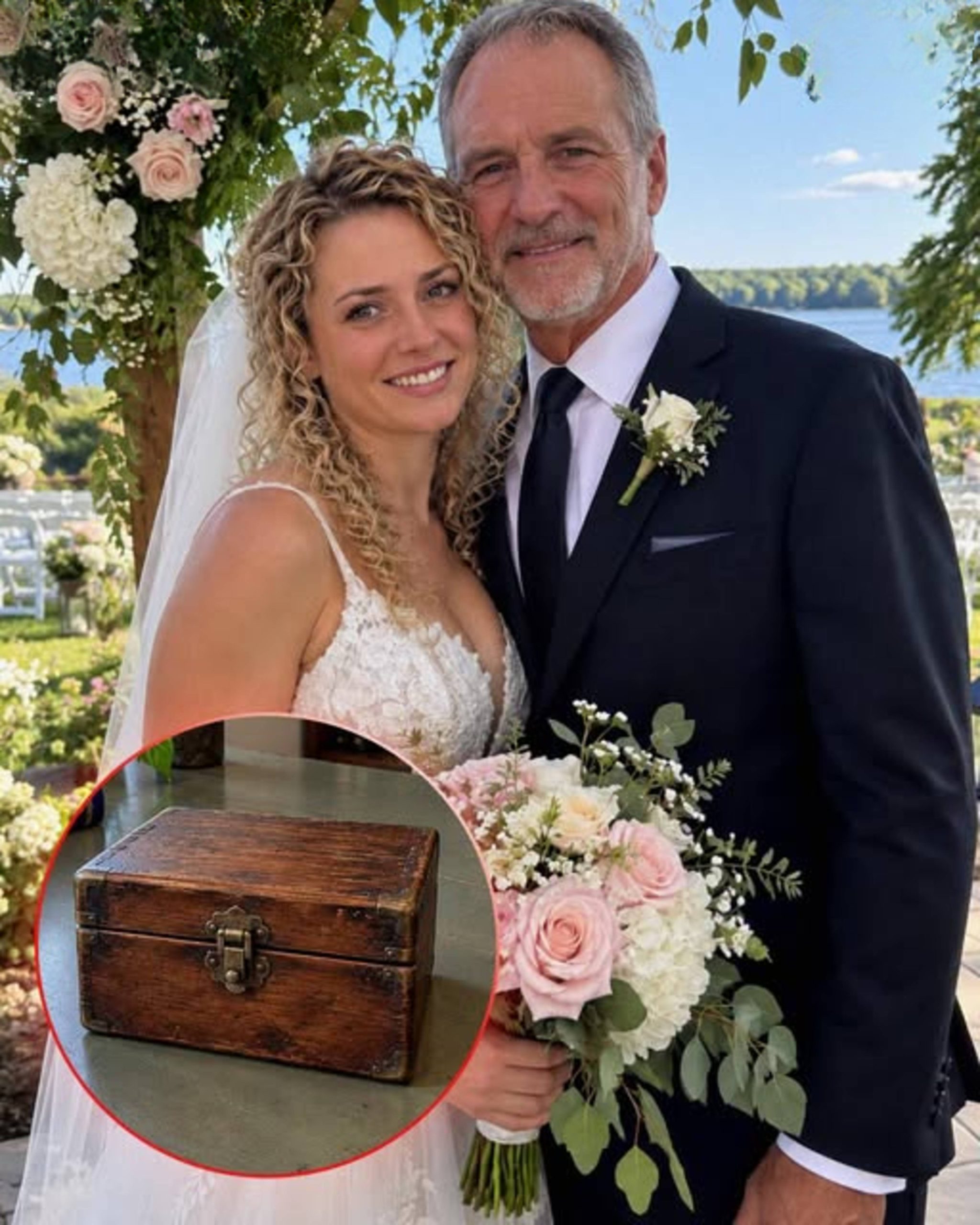
A struggling waitress thought she had found safety when a wealthy widower offered her a life far from unpaid bills and aching feet. But inside his grand house, not everyone believed she belonged, and one sentence from her new husband would haunt her long after the wedding.
The apartment smelled like instant noodles and rain through a window that never sealed right. I sat on the bed counting tips into small piles on the comforter: rent, electric, groceries.
The grocery pile was always too thin. My feet throbbed inside socks I had worn for twelve hours, and I was thirty-two years old, still living month to month, still holding my breath underwater.
The charity dinner was a last-minute pickup: black slacks, white shirt, a tray of champagne flutes balanced against my forearm.
I had skipped lunch and dinner to fit the uniform, and the chandeliers above me kept swimming. That was where Russell found me, silver at the temples, wearing a suit that probably cost more than my car.
He took a glass, paused, and asked my name. When I told him, he didn’t look through me the way men usually looked through servers. He asked whether my feet hurt.
I almost dropped the tray.
Then he made the catering captain nod from across the ballroom and angled a chair behind a column, where I could sit without being seen.
It was such a small thing.
A chair.
Ten minutes of rest.
But when you’ve spent years being treated as though your exhaustion is your own fault, someone noticing that you’re hurting can feel dangerously close to being loved.
We talked about nothing important: his late wife’s garden, the book I read on the bus, and how he had not eaten a homemade meal in three years, though his kitchen was the size of my apartment.
He listened when I spoke.
Really listened.
He didn’t interrupt. He didn’t glance at his phone. He didn’t look toward the ballroom as though searching for someone more interesting.
When I told him I lived alone and worked double shifts whenever someone called in sick, he didn’t pity me. He simply said, “You shouldn’t have to work yourself into the ground just to survive.”
I laughed because I didn’t know what else to do.
“That’s how the world works.”
He looked at me for a long moment.
“Maybe it doesn’t have to.”
He called the next morning.
Then he called every morning after that, gentle and punctual, as if kindness could become a habit.
Sometimes we talked for ten minutes. Sometimes an hour.
He sent me pictures of the roses in his wife’s old garden. I told him about customers who complained about water being too cold or coffee being too hot. He remembered little things I mentioned once and forgot myself.
He remembered that I hated raisins.
That I liked old movies.
That I took the bus instead of driving when parking downtown cost too much.
The first time he picked me up from work, I stood outside the restaurant in my uniform, embarrassed by the grease stain on my sleeve.
He rolled down the window of his black sedan and smiled.
“You look tired.”
“I am.”
“Then come home.”
I remember the way those words made my chest tighten.
Come home.
Nobody had said that to me in years.
Three months later, in a small restaurant where the waiter knew him, Russell slid a ring across the table.
He said he was not asking me to love him, only to let him take care of me.
I stared at the ring until the diamonds blurred.
I told myself I was being practical.
Anyone drowning would grab a hand.
I said yes, and some friends called me reckless.
One asked whether I was marrying him or his bank account.
I pretended to be offended.
But alone that night, I stared at the ring and wondered the same thing.
Russell never pressured me about money. In fact, he insisted that I keep working until the wedding because he wanted me to know that marrying him didn’t mean becoming helpless.
That made me trust him even more.
His children came to the engagement gathering.
His daughter, Marlene, did not shake my hand.
She looked at me as if I had tracked mud across an antique rug.
His son, Andrew, shook my hand quickly and then looked at his father.
“Dad,” he said quietly, “are you sure?”
Russell’s expression hardened.
“About what?”
Andrew hesitated.
“About everything.”
The room became uncomfortable.
Russell put his hand on my shoulder.
“I know exactly what I’m doing.”
Marlene finally spoke.
“She knows exactly what she’s doing too.”
I felt the words before I understood them.
Russell turned toward her.
“Marlene.”
“What?” she said. “We’re all thinking it.”
I wanted to disappear.
I wanted to tell them they were wrong.
That I hadn’t known who Russell was when we met. That I hadn’t searched his name. That I didn’t know the value of his house until he brought me there.
That I had fallen for the man who noticed my feet hurt.
But instead, I stood there holding a glass of sparkling water while Marlene stared at me like an intruder.
Russell ended the gathering early.
In the car, I said, “Maybe she’s right.”
He looked at me.
“About what?”
“Maybe I don’t belong in your world.”
He reached across the console and took my hand.
“You belong wherever I say you belong.”
At the time, those words comforted me.
I didn’t understand how dangerous they could become.
The wedding was beautiful.
Too beautiful.
The flowers alone cost more than I had made in three months at the restaurant.
I wore a simple dress because I couldn’t bring myself to wear anything extravagant. Russell cried when he saw me walking toward him.
For one day, I let myself believe that everything difficult was behind me.
We moved into his house after the honeymoon.
It had marble floors, a library, three fireplaces, and more bedrooms than I could count.
The first morning, I woke before sunrise out of habit.
I went downstairs and started making coffee.
A housekeeper found me standing barefoot in the kitchen.
“Mrs. Hale,” she said carefully, “you don’t need to do that.”
“I know.”
But I did it anyway.
I needed something familiar.
Something that reminded me I was still myself.
For a few weeks, things were peaceful.
Then the small comments began.
Marlene came for dinner and asked where I had purchased my dress.
When I told her, she smiled.
“Oh. I thought so.”
Another time, she watched me help Russell clear the table.
“You don’t have to perform the domestic-wife thing for Dad,” she said.
I froze.
Russell didn’t hear her.
I pretended I hadn’t either.
But each comment left a tiny crack.
Then came the financial questions.
How much did I have saved?
Did I have any investments?
What had I owned before marrying Russell?
I answered honestly.
Nothing worth mentioning.
Marlene’s eyebrows rose.
“I see.”
I began to understand that to her, my entire life could be reduced to a balance sheet.
One evening, after she had left, I finally broke down.
“I can’t keep doing this.”
Russell found me crying in the upstairs bathroom.
“She hates me.”
He sighed.
“She doesn’t hate you.”
“She thinks I married you for money.”
He was silent.
That silence hurt more than I expected.
Then he said, “Marlene has always been protective of what she thinks belongs to her.”
“Am I something that belongs to you?”
His face changed.
“No.”
He stepped closer.
“You’re my wife.”
I wanted to believe him.
I did believe him.
Until the night everything changed.
It happened six months after the wedding.
Russell had hosted a dinner for several business associates. I spent most of the evening trying to make conversation with people who spoke about investments, private schools, vacation homes, and countries I had never visited.
At one point, I walked into the hallway and heard voices coming from the study.
Marlene.
Andrew.
Russell.
I stopped before entering.
“You can’t seriously be doing this,” Marlene said.
“Doing what?”
“Changing everything for her.”
“She is my wife.”
“She was a waitress six months ago.”
The room went quiet.
Then Marlene said the sentence I would never forget.
“She didn’t marry you. She married the life you could buy her.”
My heart dropped.
I expected Russell to defend me immediately.
Instead, there was a long silence.
Then Russell spoke.
Quietly.
Almost sadly.
“I know.”
I felt the floor disappear beneath me.
I backed away before anyone could see me.
I went upstairs, closed the bedroom door, and sat on the edge of the bed.
I stared at my wedding ring.
For the first time, it felt heavy.
Not expensive.
Heavy.
When Russell came upstairs later, he found me packing a suitcase.
“What are you doing?”
“Leaving.”
He looked stunned.
“Why?”
“Because you know.”
“Know what?”
“That she was right.”
He walked toward me.
“She wasn’t.”
“You said you knew.”
“I knew she was afraid. I knew she was suspicious. I knew she believed you were using me.”
“That’s not what you said.”
He stopped.
For a moment, neither of us spoke.
Then he sat down.
“I should have defended you differently.”
“Yes.”
“I should have told her she was wrong.”
“Yes.”
“I thought if I agreed with her that I understood her fears, I could eventually make her accept you.”
I looked at him.
“And what did you think I was supposed to feel while you did that?”
He had no answer.
That was the moment I realized something important.
Russell had rescued me from poverty.
But he had not rescued me from the feeling that I needed to earn my place beside him.
I could live in a mansion and still feel like someone else’s guest.
I could wear diamonds and still feel ashamed of the hands that had once carried trays.
I could be called Mrs. Hale and still wonder whether everyone was waiting for the day I would be exposed as an impostor.
Russell reached for my hand.
This time, I didn’t pull away.
But I didn’t take his hand either.
“I don’t need you to take care of me,” I said. “I needed you to choose me.”
His eyes filled with tears.
“I did.”
“Then you have to learn to say it when I’m not in the room.”
That night, I didn’t leave.
But something changed.
Russell spoke to his children the next morning.
He told Marlene that she had every right to worry about her father’s future, but she did not have the right to humiliate his wife.
He told Andrew that wealth did not make their family better than anyone else.
And then he told them something neither of them expected.
“If she walks away from me tomorrow, she leaves with my love, my respect, and the life we’ve built together. Not because she came for my money, but because she is my wife.”
Marlene didn’t apologize immediately.
Neither did I expect her to.
Trust isn’t repaired with one speech.
It took months.
There were awkward dinners. Difficult conversations. Boundaries.
I also returned to work—not because I needed the money anymore, but because I wanted something that belonged entirely to me.
Russell supported it.
And slowly, I began to understand that accepting help wasn’t the same as surrendering yourself.
Years later, when people asked me how I went from waiting tables to living in a house with marble floors, I never told them I had married rich.
I told them I had once been so desperate for safety that I almost confused being provided for with being valued.
Russell eventually learned the difference too.
And Marlene?
She and I never became the close mother-and-daughter pair people imagine in movies.
But one Christmas, she handed me a small box.
Inside was an old photograph of Russell and his late wife standing in the garden.
On the back, Marlene had written:
*Thank you for giving Dad a reason to laugh again.*
I cried when I read it.
Not because she had finally accepted me.
Because, for the first time, I understood that I didn’t need permission to belong.
I had never been an intruder.
I had simply been waiting for someone else to tell me I was worthy of the room I was already standing in.
**Sometimes the hardest thing about escaping poverty isn’t learning how to live with more—it is learning that you were worthy of love before you ever had anything to offer.**