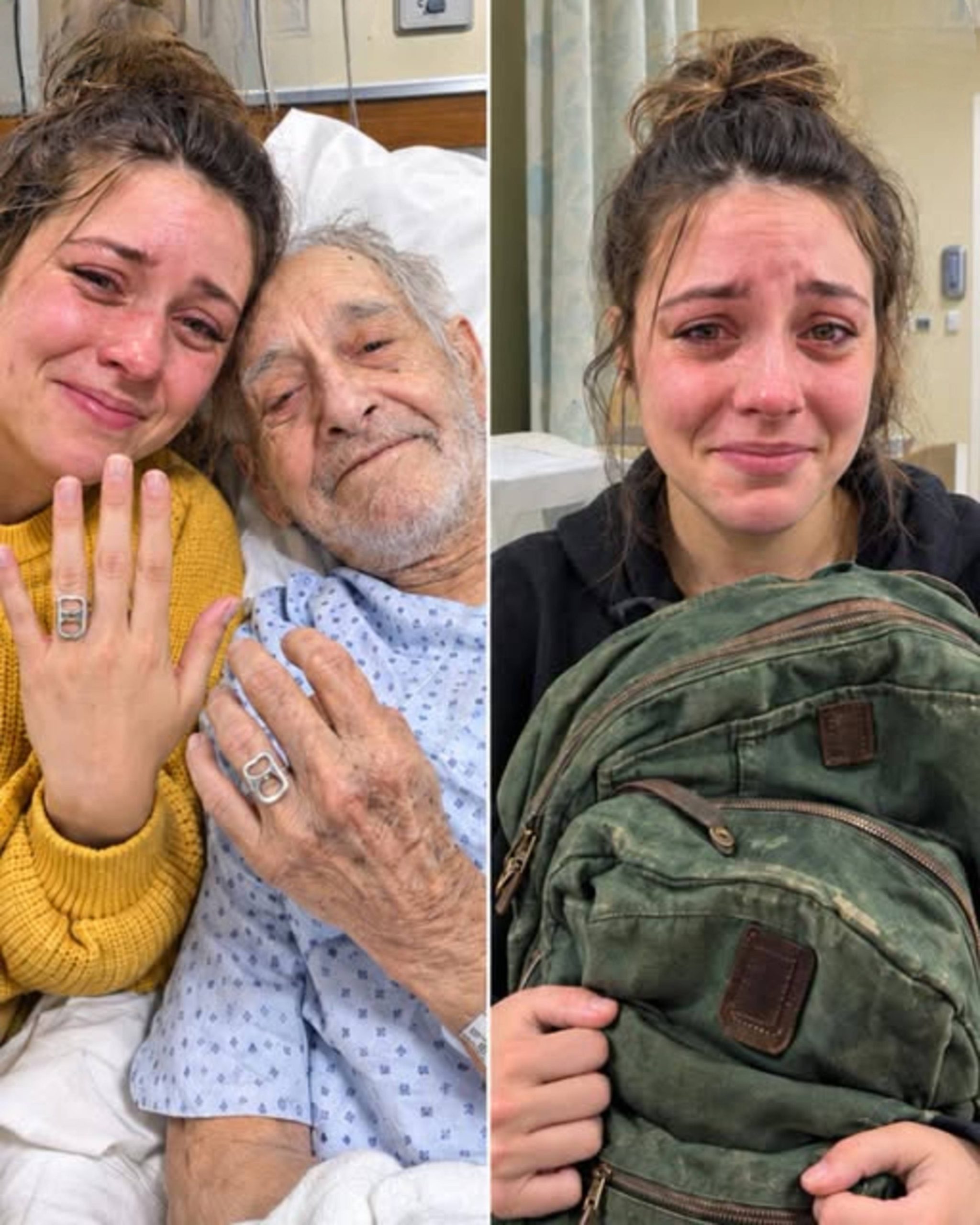
**I married a dying stranger so he wouldn’t leave this world alone. For seven days, I was his wife. Then his lawyer handed me Thomas’s old green backpack and said, “He wanted you to know the truth.” I expected secrets, money, maybe family. Instead, I found places.**
The first envelope said **Bus Stop**.
That was all.
No date.
No explanation.
Just two words written in Thomas’s careful handwriting across cream-colored paper, tucked inside the faded green backpack his lawyer had placed in my lap less than an hour after my husband died.
*My husband.*
I had been married to Thomas for seven days.
The word still sounded strange in my head, like a coat I had borrowed from someone else’s closet.
The attorney stood beside the empty hospital bed, one hand resting on the backpack strap.
“Sarah,” he said gently, “Thomas wasn’t who you thought he was.”
I looked at the bed.
The pillow still held the dent of his head.
His peppermint tea sat untouched on the tray table.
The soda can pull tab he’d used as my wedding ring circled my finger, light as a joke and heavy as a vow.
“What truth?” I asked.
The attorney’s mouth trembled slightly.
“He said you would understand better if you opened it alone.”
Then he left.
That was how Thomas did things.
Softly.
Sideways.
Never pushing a door open when he could leave it unlocked and let you choose.
I unzipped the backpack with shaking hands.
There was no money.
No jewelry.
No legal papers that made me rich or trapped me in some strange obligation.
Only envelopes.
Dozens of them.
Each labeled with a place.
**Bus Stop.**
**Grocery Store.**
**Airport.**
**Laundromat.**
**Park Bench.**
**Waiting Room.**
**Hospital Chapel.**
At the very bottom sat a battered notebook with bent corners, but I didn’t open it yet.
I picked up the first envelope.
**Bus Stop.**
I opened it.
Inside was a photograph.
An old bus shelter on a rainy street.
A young man sat beneath it.
I recognized Thomas immediately, though he looked impossibly different.
Younger.
Thinner.
Alive in a way that hurt to see.
Beside him sat an elderly woman with a grocery bag in her lap.
On the back of the photograph, Thomas had written:
*She was waiting for Bus 14. It never came.*
Underneath that was another sentence.
*So I stayed.*
I stared at the words.
I remembered Thomas once telling me that he didn’t like leaving people alone when they were scared.
At the time, I thought he was talking about hospitals.
Apparently, he had been talking about his whole life.
I opened the next envelope.
**Grocery Store.**
Inside was another photograph.
Thomas stood beside an older man outside a supermarket.
The man was holding a paper bag.
On the back:
*He forgot his wallet.*
Then:
*I paid for his groceries.*
I frowned.
There was no explanation.
No amount.
No dramatic revelation.
Just a small act that would have disappeared from anyone else’s memory.
But there were dozens of envelopes.
And suddenly I understood.
These weren’t places where Thomas had lived.
They were places where Thomas had **stopped**.
Places where he’d seen someone who needed something.
Someone who was invisible to everyone else.
I opened another.
**Laundromat.**
A woman asleep beside a washing machine.
**Park Bench.**
A little boy sitting alone with a red backpack.
**Airport.**
A man staring at a departure board.
**Waiting Room.**
A teenage girl crying into her sleeves.
Every photograph contained Thomas somewhere in the background.
Sometimes he was sitting beside someone.
Sometimes he was handing them something.
Sometimes he was simply there.
I couldn’t understand it.
Why had he never told me?
Then I opened the envelope labeled **Hospital Chapel**.
Inside was a photograph of Thomas sitting alone in a wooden pew.
His head was bowed.
The back said:
*This was the first place I asked God for enough time to make things right.*
I stopped breathing for a moment.
There was another sentence.
*I didn’t know how little time I had.*
I finally opened the notebook.
The first page contained a date from twelve years earlier.
And beneath it:
**“I almost died today.”**
I sat down.
Thomas had been twenty-nine.
He had survived an accident that left him hospitalized for weeks.
According to the notebook, the experience changed him.
Not because he suddenly became religious.
Not because he discovered some grand purpose.
Because while lying in that hospital bed, he watched people come and go.
Doctors.
Nurses.
Families.
Visitors.
And people who had no one.
He wrote:
*Everyone thinks the important thing is what you do with your life.*
*Maybe the important thing is what you do when you notice somebody else’s.*
I kept reading.
The entries stretched across years.
Thomas had built a private habit.
Whenever he saw someone struggling, he helped if he could.
He paid for groceries.
Bought bus tickets.
Sat beside strangers.
Returned lost wallets.
Helped people fill out forms.
Bought meals for people sleeping outside.
Visited nursing homes.
He never photographed himself helping them.
He photographed the places afterward.
That was why the envelopes were labeled with locations.
The places were his memories.
Not trophies.
I turned another page.
And then I saw my name.
**Sarah.**
My hands began to shake.
I read the entry.
It was dated three months before we met.
Thomas had been sitting at a bus stop.
He wrote:
*Today I saw a woman crying.*
*She wasn’t asking for help.*
*She wasn’t talking to anyone.*
*She just looked exhausted.*
I knew immediately.
It was me.
I remembered that day.
I had been coming home from the hospital after my mother’s death.
I had sat at a bus stop for almost an hour because I didn’t want to go home yet.
I remembered a man sitting several feet away.
A stranger.
He hadn’t spoken to me.
But when my bus arrived, he’d stood and held the door open.
I had thanked him.
I hadn’t remembered his face.
Until then.
It was Thomas.
I kept reading.
*I wanted to ask if she was okay.*
*I didn’t.*
*Sometimes helping means knowing when not to interfere.*
My eyes filled with tears.
The next entry was dated two weeks later.
*I saw her again.*
Then another.
*She’s carrying grief like it’s something she owes the world.*
And another.
*Today I finally said hello.*
I covered my mouth.
Our first meeting.
The coffee shop.
The terrible joke he told.
The way he asked if the chair across from me was taken.
I had thought it was coincidence.
It wasn’t.
But the notebook revealed something even more painful.
Thomas hadn’t known he was going to die when we met.
His illness had been diagnosed later.
Aggressive.
Advanced.
Too late.
He had less than a year.
And then, near the end of the notebook, I found the entry that explained everything.
*I don’t want to die surrounded by machines.*
*I don’t want my last memories to be hospital walls.*
*But more than anything, I don’t want to leave this world without knowing whether I ever made someone feel less alone.*
Then:
*Sarah does that for me.*
I couldn’t read anymore.
I closed the notebook.
For seven days, I had been his wife.
Seven days of hospital corridors.
Seven days of doctors speaking quietly.
Seven days of holding his hand.
Seven days of pretending we had years instead of days.
We had married because Thomas told me he didn’t want to die alone.
I thought I was giving him something.
Companionship.
Dignity.
A little piece of normal life.
But now I wondered whether I’d misunderstood.
Maybe he hadn’t married me because he was afraid of dying alone.
Maybe he married me because he had spent his entire life making sure other people didn’t have to.
And when his own time came, someone finally did the same for him.
I returned to the envelopes.
There was one left.
It wasn’t labeled with a place.
It simply said:
**Sarah.**
I opened it.
Inside was a single photograph.
Thomas and me.
At the hospital.
The day we got married.
I was laughing.
He was smiling at me.
Neither of us looked sick.
On the back he had written:
*This is the only place I ever wanted to stay.*
Underneath:
*With you.*
I broke down.
Not because I had lost a husband I’d known for thirty years.
I hadn’t.
I had lost a man I’d known for seven days.
But somehow, those seven days had become enormous.
They contained a lifetime of meaning I hadn’t understood while he was alive.
The next morning, I took the green backpack home.
I didn’t put it in a closet.
I placed it beside my front door.
And every few weeks, I opened one envelope.
I visited the place.
The bus stop.
The park bench.
The grocery store.
The laundromat.
I didn’t always know who Thomas had helped there.
Sometimes I found nothing.
Sometimes I met people who remembered him.
One elderly woman at a bus stop recognized his photograph immediately.
“Thomas,” she whispered.
Then she smiled.
“He used to wait with me.”
A man at the grocery store remembered him paying for his food years earlier.
A nurse remembered him sitting with frightened patients who had no visitors.
Each person had a different story.
But they all described the same man.
He never stayed long.
He never asked for praise.
He simply noticed.
And helped.
And left.
Months after his death, I finally understood the truth his lawyer had been trying to give me.
Thomas’s secret wasn’t that he’d been rich.
He wasn’t.
It wasn’t that he’d had another family.
He hadn’t.
His secret was that he had spent years quietly collecting proof that ordinary kindness mattered.
The places weren’t evidence of what he owned.
They were evidence of where he had **loved people he barely knew.**
And somehow, after all those years, he had left one final place for himself.
Me.
I still wear the soda-tab ring.
People sometimes stare at it.
They probably assume it’s sentimental.
It is.
But now I know what it really means.
Thomas didn’t leave me money.
He left me a map.
A map made of bus stops, grocery stores, hospital rooms, benches, airports, and ordinary corners where somebody needed another human being to stay a little longer.
So that’s what I try to do now.
I stop.
I notice.
I stay.
Because Thomas taught me something in seven days that most people never learn in a lifetime:
**You don’t need to save the whole world to make your life matter. Sometimes you only have to make sure one person doesn’t feel alone when they need you most.**