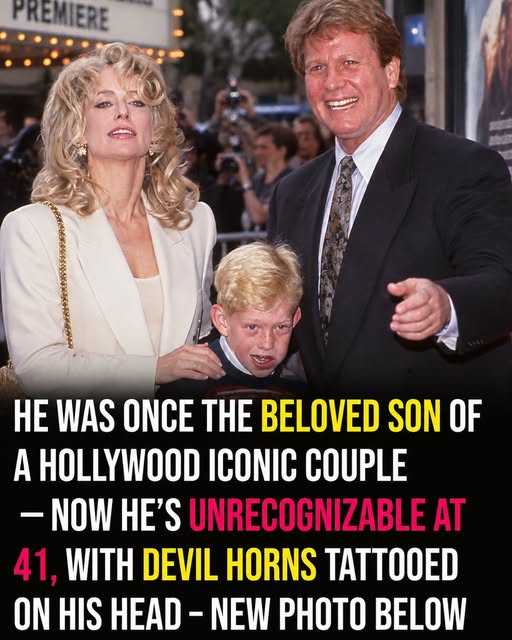
Farrah Fawcett was dying, and everyone thought they knew what mattered most to her.
They were wrong.
In the final chapter of her life, the Hollywood icon was no longer thinking about the fame that had made her a household name. She wasn’t thinking about the photographs, the red carpets, the magazine covers, or even the role that had transformed her into one of the most recognizable faces of her generation.
She was thinking about her son.
One name.
One unfinished prayer.
One person she had spent a lifetime trying to protect.
**Redmond.**
Farrah Fawcett’s public life had been dazzling. She became an international symbol of beauty and celebrity, a woman whose image seemed almost impossible to separate from the era that made her famous.
But behind the cameras was a very different Farrah.
Motherhood changed her.
Her only child, Redmond, became the center of a private world that existed far away from Hollywood’s expectations. She spoke of how becoming a mother softened her, grounded her, and forced her to confront parts of herself that fame had allowed her to ignore.
For Farrah, Redmond wasn’t an accessory to her celebrity.
He was her son.
The person she loved when nobody was watching.
The person whose struggles could hurt her more deeply than any criticism ever could.
And their family life was far from simple.
Her relationship with Ryan O’Neal was complicated by instability, conflict, and painful arguments. Their son grew up surrounded by emotional turmoil that was often impossible to keep separate from the pressures of celebrity.
For a child caught between two complicated parents, the world could become confusing very quickly.
As Redmond grew older, his struggles became increasingly serious.
Addiction entered the picture.
So did legal problems.
And Farrah found herself facing one of the most devastating experiences a parent can endure: watching someone they love make choices that are destroying their life while being unable to simply reach in and make everything stop.
She could advise him.
She could plead with him.
She could try to protect him.
She could stand beside him through another crisis.
But she could not live his life for him.
That helplessness became its own kind of suffering.
And then Farrah became sick.
Cancer began consuming the strength that had once carried her through decades of work and public scrutiny. Her illness became a very public battle, but the deepest part of that battle remained intensely personal.
Even as her own body failed her, her thoughts continued returning to her son.
That is what makes the final chapter of her life so painful.
A mother who had spent years trying to save her child was now facing a reality she could not negotiate with.
She was running out of time.
There would be no endless supply of second chances.
No guarantee that she would be there the next time Redmond needed her.
No promise that she could make one more phone call, offer one more piece of advice, or stand between him and another mistake.
And perhaps that is why the name associated with her final moments carries such emotional weight.
**Redmond.**
According to accounts of her final days, it was the name closest to her heart as her strength disappeared.
Not Hollywood.
Not fame.
Not the legacy of a glamorous career.
Her son.
The child she had loved through every difficult chapter.
The child she could not simply stop worrying about.
The child she still wanted protected even when she could no longer protect him herself.
There is something uniquely painful about a parent watching a child struggle.
Parents can endure their own suffering in ways they never imagined possible. But seeing their child suffer can make even extraordinary strength feel useless.
Farrah had faced the cameras.
She had faced criticism.
She had faced cancer.
But none of those battles carried the same emotional weight as the fear of leaving her son behind.
She knew that when she was gone, the world would continue.
People would remember the actress.
They would remember the photographs.
They would remember the smile, the hair, the fame, and the iconic image that had become part of American pop culture.
But she was not leaving behind only a public legacy.
She was leaving behind a son.
And for a mother, that can be the only legacy that matters.
The tragedy of her story is that love could not solve everything.
Farrah could not cure addiction with devotion.
She could not erase legal troubles with money or influence.
She could not make every destructive choice disappear.
But she could continue loving her son.
And she did.
Until her final days.
Until her body had almost nothing left to give.
Until the woman the world knew as Farrah Fawcett became simply a mother worrying about her child.
Her story reminds us that celebrity can create distance between a person and the public, but it cannot erase the most ordinary human fears.
A mother still worries.
A mother still hopes.
A mother still wonders whether her child will be okay after she is gone.
And sometimes, when everything else has been stripped away, there is only one name left to say.
**Redmond.**
A final expression of love.
A final concern.
A final hope that someone, somewhere, would keep fighting for the child she had never stopped fighting for herself.
Farrah Fawcett spent much of her life being looked at by the world.
But in the end, she was not thinking about being remembered.
She was thinking about the person she loved most.
And perhaps that is the truest portrait of her that could ever exist—not the actress, not the icon, not the woman on the posters, but the mother who, even at the very edge of her own life, was still trying to protect her son.