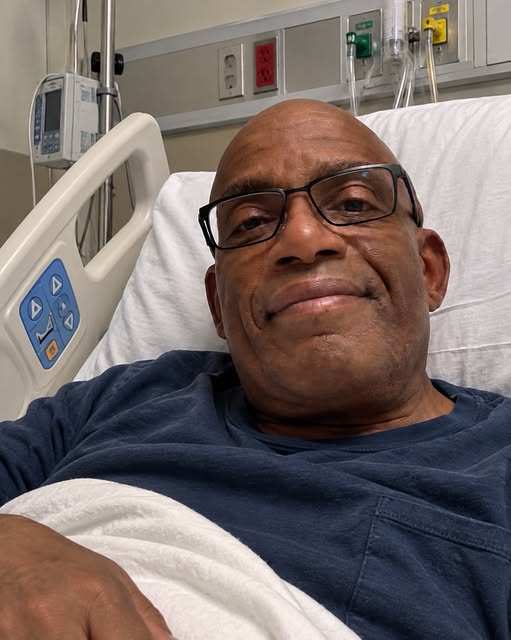
He was almost gone.
While viewers were told Al Roker was simply “recovering,” his body was reportedly fighting a silent war that nearly killed him.
Blood loss.
Emergency surgeries.
A pulmonary embolism.
Complications that seemed to arrive one after another.
And a wife trying to shield the man she loved from the full terrifying reality because she feared that knowing just how close he was to death might make him lose the will to fight.
When Al Roker quietly disappeared from *Today* in late 2022, viewers noticed.
They knew he wasn’t well.
They knew he was recovering.
But most people watching from home had no idea how serious the situation had become.
There was no dramatic television announcement explaining every detail.
No way for viewers to see what was happening behind the hospital doors.
Instead, there was an absence.
An empty space where Roker’s familiar smile and unmistakable energy had been.
And behind that absence, his family was living through one of the most frightening periods of their lives.
A pulmonary embolism reportedly triggered a cascade of complications.
What began as one medical crisis became several.
Severe ulcers.
Massive internal bleeding.
Rapid blood loss.
Emergency procedures.
Doctors were fighting to stabilize him while his body continued losing blood at a terrifying rate.
According to accounts of the ordeal, there were moments when replacing the blood he was losing became an urgent race against time.
His family could only watch.
They could ask questions.
They could hope.
They could pray.
But they couldn’t control what happened next.
For two days, the future they knew seemed to hang by a thread.
Two days can sound like nothing on a calendar.
But inside a hospital room, when someone you love is critically ill, two days can feel like an entire lifetime.
Every phone call carries new fear.
Every doctor entering the room can change everything.
Every hour without improvement feels longer than the one before it.
And through it all was his wife, Deborah Roberts.
She faced a terrible decision.
How much should Al know?
How much truth could he handle while his body was already fighting for its life?
Roberts chose, at least for a time, to protect his spirit.
She didn’t want him overwhelmed by the full horror of what was happening.
She believed his mindset mattered.
His determination mattered.
His willingness to keep fighting mattered.
Perhaps she understood something that families often learn in moments of medical crisis: sometimes hope becomes part of the treatment, even when nobody can measure it on a chart.
So while doctors worked on his body, she tried to protect the part of him that still believed he was going to get home.
There were no guarantees.
That was the terrifying part.
He wasn’t simply taking a break from television.
He wasn’t just missing a few broadcasts.
He was fighting to survive.
And eventually, slowly, his body began to respond.
The surgeries were behind him.
The bleeding was controlled.
The immediate crisis began to recede.
But surviving the worst moment doesn’t mean you immediately return to the person you were before it happened.
Recovery can be its own battle.
There is weakness.
Fear.
Frustration.
The realization that the body you once trusted can suddenly become unpredictable.
And there is the psychological weight of knowing how close you came to not making it home.
When Roker finally returned to the *Today* set in early 2023, the moment carried far more weight than a television comeback.
Colleagues cried.
Viewers cried.
Roker himself seemed deeply moved.
For people watching, it wasn’t simply nostalgia.
They weren’t celebrating the return of a familiar television personality.
They were watching a man who had disappeared from their screens because he was fighting for his life—and who had somehow found his way back.
The applause meant something different.
Every smile carried memory.
Every hug carried relief.
The empty chair that had worried viewers for weeks was no longer empty.
He was there.
Alive.
Standing.
Talking.
Laughing.
And that alone felt extraordinary.
The experience also changed the way Roker spoke about health.
The ordeal became a reminder that serious medical problems don’t always arrive with the kind of warning people expect.
Sometimes the body whispers before it screams.
Sometimes symptoms are easy to dismiss.
Sometimes people convince themselves they’ll deal with something tomorrow.
But tomorrow can become an emergency faster than anyone expects.
Roker’s story gave those warnings a human face.
It wasn’t about television anymore.
It was about paying attention.
About knowing your body.
About taking unusual symptoms seriously.
About understanding that even someone who appears strong, energetic, and healthy can suddenly find themselves in a fight they never saw coming.
And perhaps that is why his return felt so emotional.
People weren’t simply happy to see Al Roker back at work.
They were grateful to see him alive.
The man who had once walked into the studio as though it were any other morning had returned carrying a different understanding of time.
The ordinary things looked different.
A conversation.
A laugh.
A walk.
A morning at work.
A hug from someone you love.
Things that once seemed routine can become precious after you’ve come close to losing them.
His experience also revealed something about the people surrounding him.
Behind every public comeback is often a private army of people who never left.
Family members sitting in hospital rooms.
Doctors working through impossible hours.
Loved ones making decisions while terrified.
People choosing optimism when they have every reason to be afraid.
Deborah Roberts wasn’t able to fight the illness for him.
But she could help him believe there was still something worth fighting toward.
And sometimes that is its own form of courage.
When Al Roker eventually returned to television, he didn’t simply come back from an absence.
He came back from the edge.
The missing weeks had contained fear, blood loss, surgeries, uncertainty, and the possibility that he might never return to the life everyone recognized.
Instead, he walked back into the studio.
And suddenly a familiar face looked different.
Not because he had changed physically.
Because everyone watching understood what it had taken for him to be there.
He had stared down mortality.
He had been forced to confront how fragile an ordinary morning can be.
And he came back with a message that reached far beyond the television audience:
Don’t assume your body will always give you another warning.
Don’t ignore something because you’re busy.
Don’t convince yourself that a strange symptom will simply disappear.
And don’t underestimate the value of listening when your body tells you something isn’t right.
Because sometimes the quietest warning is the one that matters most.
And sometimes getting back to an ordinary morning isn’t ordinary at all.
Sometimes it’s a second chance.