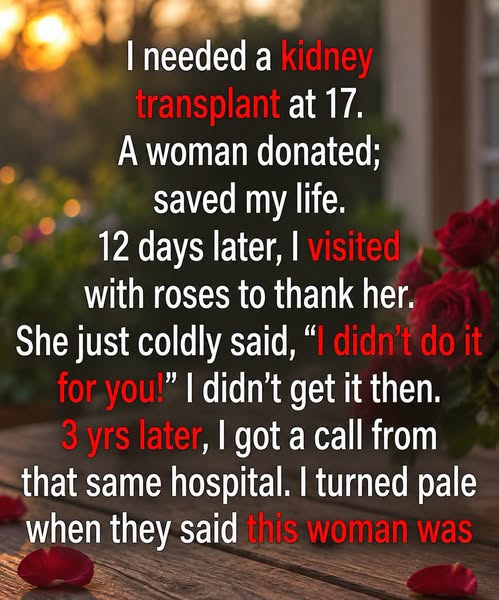
At 17, I was given a kidney and a second chance at life.
I remember the hospital room, the strange mixture of fear and hope, and the overwhelming knowledge that somewhere beyond the walls, another person had made a decision that would keep my heart beating.
To me, it was the purest kind of sacrifice.
Someone had given me part of herself so that I could keep living.
So when I finally met my donor, I expected a moment of simple gratitude. I expected tears, maybe an embrace, perhaps the kind of conversation people imagine when they think about an act of extraordinary generosity.
Instead, after my tearful “thank you,” she looked at me and said words I would spend years trying to understand.
“I didn’t do it for you.”
The sentence hit harder than I was prepared for.
For a moment, I didn’t know what to say.
I had built the entire story in my head around her being a hero and me being the grateful recipient. I thought the gift had been about saving my life.
Now she seemed to be telling me that I hadn’t even been the reason.
Was she being cruel?
Was she angry?
Did she regret what she had done?
I left that encounter carrying a question that became almost impossible to put down.
What kind of person gives someone a second chance at life and then refuses to call it an act of love?
For years, I replayed those six words.
“I didn’t do it for you.”
Sometimes I heard bitterness in them.
Sometimes regret.
Sometimes even resentment.
I wondered whether I had somehow misunderstood the entire meaning of the transplant. I wondered whether gratitude could become another form of obligation, whether I was supposed to spend my life trying to repay something that could never truly be repaid.
But the truth was waiting somewhere I couldn’t yet see.
Years later, I learned what had been hidden behind that sentence.
She had once had a son.
And she had lost him.
He had wanted to become an organ donor. He had made his wishes known, but when the moment came, she couldn’t accept it. Grief overwhelmed her. Fear took control. She refused to allow his organs to be donated.
She was a mother watching her child disappear.
And in that moment, she couldn’t imagine giving away any part of him.
The decision stayed with her.
Not loudly.
Not dramatically.
But like a fault line beneath everything else.
She carried the knowledge that someone else might have lived because of something her son had been willing to give—and she had said no.
Perhaps she could never forgive herself.
Then I came along.
A seventeen-year-old whose life was hanging in the balance.
And something about me reminded her of him.
Not necessarily my face.
Maybe my age.
Maybe the way I spoke.
Maybe something impossible to explain.
Whatever it was, she saw a second chance where she had once believed there could never be one.
And this time, when a life was waiting on the other side of a decision, she chose differently.
That was the meaning of her words.
She hadn’t done it for me.
Not entirely.
She had done it for the son she had lost.
She had done it for the decision she wished she could change.
She had done it because somewhere inside her grief was a promise that the next time she had the power to help another person live, she would not let fear make the choice for her.
Suddenly, her words didn’t sound cold anymore.
They sounded broken.
And strangely human.
My kidney had come from a place of grief as much as generosity.
My second chance had grown out of her attempt to make peace with the first life she couldn’t save.
The realization changed the way I understood the gift.
I stopped thinking of myself as someone who had simply received an organ from a stranger.
Our lives had become connected by something neither of us had chosen.
She had lost a son.
I had nearly lost my life.
And somehow, through a decision born from both sorrow and courage, part of her story had continued inside mine.
Then came another twist.
I learned she was terminally ill.
And she was alone.
The woman who had given me years was approaching the end of hers with almost no one beside her.
For a long time, I had thought I owed her something.
How could anyone receive a gift like that without feeling indebted?
But when I heard she was dying, I finally understood that the debt I had imagined was the wrong way to look at it.
I didn’t need to repay her.
I needed to be there.
So I went to see her.
She looked smaller than I remembered.
Illness had taken away some of the strength in her face, and her breathing had become labored. The room was quiet except for the sounds of machines and the occasional movement of nurses outside the door.
I sat beside her.
At first, neither of us said much.
There were no perfect words.
No speech large enough to contain seventeen years of gratitude, confusion, grief, and understanding.
So I simply stayed.
I held her hand.
We sat together through the silences.
And as her breathing grew weaker, I realized something that had taken me almost a lifetime to understand.
Presence was its own kind of gift.
She had given me years.
I could give her companionship.
She had helped me remain in this world.
I could make sure she didn’t have to leave it feeling completely alone.
There was nothing I could say that would make her grief disappear. I couldn’t return her son. I couldn’t rewrite the decision that had haunted her.
But I could let her know that her choice had mattered.
Not just because I survived.
Because I lived.
I grew up.
I made memories.
I loved people.
I experienced ordinary mornings and terrible days and beautiful moments she would never know about.
Her decision had become a life.
Mine.
And now, sitting beside her, I understood the final piece of the story.
She had once been unable to let go of her son.
Years later, she had given part of herself so someone else’s child could hold on.
Maybe that was why she had said she didn’t do it for me.
Maybe, in some complicated way, she had been doing it for both of us.
For the son she lost.
For the person I was still becoming.
And perhaps for the woman she wanted to become herself.
As I held her hand near the end, there was no transaction between us.
No debt.
No repayment.
Just two lives connected by loss and survival.
She had given me a future.
All I could give her was a hand to hold while she faced the end of hers.
And somehow, that felt like enough.
She had spent years carrying the weight of a decision she wished she could undo.
But as her eyes grew heavy, I hoped she could finally put some of that weight down.
She had saved a life.
She had kept a promise she never got to make to her son.
And when the moment finally came for her to let go, she didn’t have to do it alone.
I stayed beside her.
And in that final silence, I understood what her first words had really meant.
She hadn’t done it for me.
She had done it because, once before, she had lost someone she loved—and this time, she chose to let another life continue.
I was that life.
And in the end, perhaps the greatest gift wasn’t the kidney.
It was the chance she gave both of us to understand what it meant.