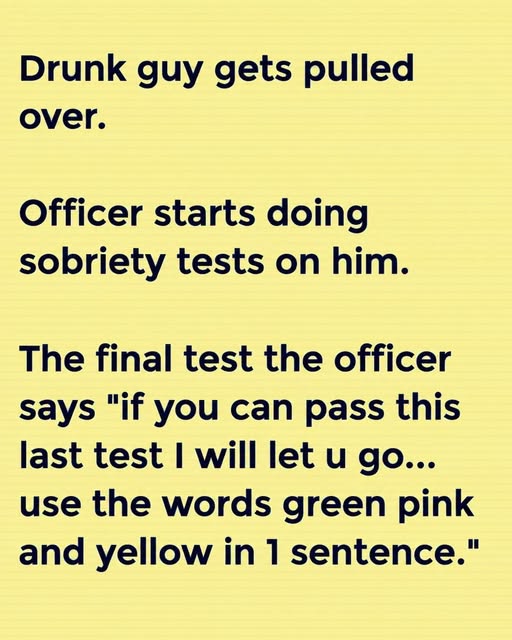
He thought the worst thing he’d face was a fine.
A ticket. A lecture. Maybe a few hours of embarrassment before he could go home, sleep it off, and convince himself the whole thing had been blown out of proportion.
Then the lights hit.
Blue and red reflections flooded the rearview mirror. Sirens sliced through the quiet night, and suddenly every careless joke, every shrug, every confident “I’m fine to drive” collapsed beneath the weight of what could have happened.
Because the truth was brutally simple.
Another car could have appeared around the corner.
A child could have stepped into a crosswalk.
A cyclist could have been riding along the shoulder.
A family could have been driving home, completely unaware that one reckless decision had placed their lives in the hands of someone who had convinced himself he was still in control.
He hadn’t hurt anyone.
That was the part that would stay with him.
Not because it made him innocent, but because it reminded him how close he had come to needing a completely different kind of conversation.
The officer’s questions sounded ordinary, but they landed differently now.
Where had he been?
How much had he had to drink?
Where was he going?
Had he realized how fast he was driving?
He answered, but somewhere between the questions and the silence that followed, the night stopped feeling like an inconvenience.
It started feeling like a warning.
At the station, the fluorescent lights seemed almost painfully bright. The jokes he’d made earlier were no longer funny. The confidence he’d carried into the driver’s seat had evaporated. He began replaying the drive in his mind, searching for the exact moment when a normal evening had turned into something that could have ended permanently.
There wasn’t one dramatic moment.
That was what frightened him.
It had happened gradually.
One drink became another.
Confidence became carelessness.
Carelessness became a decision.
And a decision became a vehicle moving through darkness with someone else’s life potentially sitting in its path.
When he finally walked out of the station, he felt smaller.
But strangely, he also felt more solid.
The cold morning air didn’t feel like punishment. It felt like a debt he hadn’t quite been forced to pay.
He stood there for a moment, breathing in the sharp air, and kept seeing what never happened.
Twisted metal that wasn’t there.
Glass scattered across pavement that remained perfectly clean.
A phone call no parent had to make.
A hospital room nobody had to enter.
A family that never received the worst news of their lives.
Those imaginary scenes followed him home.
They haunted him more than any fine could have.
Because a punishment has an ending.
A warning doesn’t.
In the days that followed, he became aware of things he’d previously treated as background noise.
Headlights approaching in the opposite lane.
Pedestrians waiting at crosswalks.
Children holding their parents’ hands near busy roads.
Cars leaving bars and restaurants late at night, sometimes drifting uncertainly toward the street.
Every one of them seemed to carry the same silent question:
What if?
What if another car had been coming?
What if someone had stepped into the road?
What if he had reacted half a second too slowly?
What if the night had ended differently?
He didn’t tell the story as some wild night that had gone wrong.
He didn’t turn it into a funny story about getting pulled over.
He didn’t exaggerate it for friends or use it as proof that he’d somehow gotten away with something.
There was nothing to brag about.
He carried it instead like a quiet scar.
It changed the way he looked at responsibility. He began making plans before drinking instead of trusting himself to make good decisions afterward. He stopped treating impaired driving as a personal gamble and started understanding what it really was: a decision that could place strangers into consequences they never agreed to face.
The most difficult part was accepting that good intentions would never have protected anyone.
He could have thought he was careful.
He could have believed he was capable.
He could have insisted he knew his own limits.
None of that would have mattered to the family in the other car.
They wouldn’t have cared how responsible he normally was.
They wouldn’t have cared whether he meant to hurt anyone.
If something had happened, the result would have been measured in lives changed forever.
And that realization stayed with him.
Months later, he could still remember the sound of those sirens.
Not as the sound of police coming for him.
As the sound of consequences arriving before tragedy did.
That distinction changed everything.
He eventually understood that the night had given him something few people ever receive: a chance to confront the worst possible outcome without first having to live through it.
He had been given the opportunity to learn from an accident that never happened.
And he knew how rare that was.
The real lesson wasn’t fear of being caught.
It wasn’t the fine, the embarrassment, or the uncomfortable morning afterward.
It was understanding how close he had come to becoming the moment that split someone else’s life into before and after.
One careless decision can become another person’s lifelong memory.
One shortcut can become a funeral.
One confident sentence—“I’m fine to drive”—can become words someone spends years wishing they could take back.
He was fortunate.
But he no longer confused fortune with permission.
From that night forward, the road looked different.
And so did he.