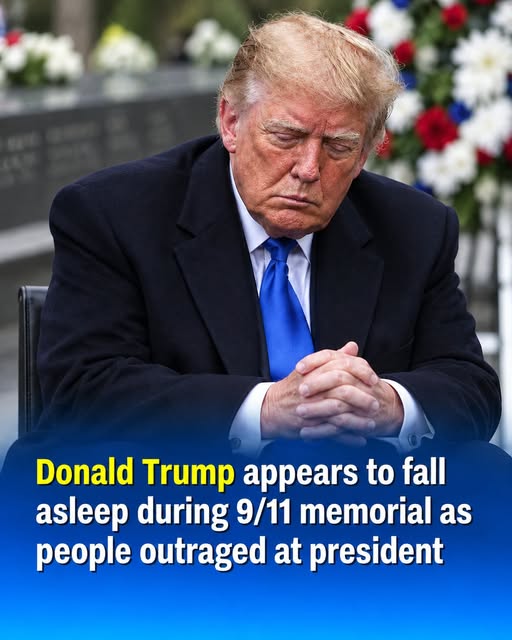
Donald Trump’s eyes closed at a 9/11 memorial, and within moments, the internet erupted. Cameras appeared to catch the former president sitting motionless, his eyes drooping as America paused to remember nearly 3,000 people who lost their lives. Viewers quickly began asking the same question: was Trump actually falling asleep during one of the most solemn moments of the year? What might have looked like a few seconds of fatigue to some became, for others, a deeply disrespectful image that spread across social media at lightning speed.
At the Pentagon ceremony, Trump sat among officials, families, and survivors as the names of the victims were read aloud. Then the cameras focused on him, capturing an expression that critics immediately interpreted as drowsiness. Posts and comments flooded the internet, with people accusing him of nodding off while the country mourned. The image became more than just another political controversy. For his opponents, it was turned into a brutal metaphor — a president seemingly “asleep at the wheel” while standing at a ceremony dedicated to remembering the consequences of one of the darkest days in American history.
Supporters, however, pushed back against the accusations, arguing that a brief moment with someone’s eyes closed proves very little. They pointed out that long memorial ceremonies can be physically and emotionally exhausting, and that cameras can freeze a single expression into an image that creates an entirely different impression. But online, the debate quickly moved beyond what actually happened in those few seconds. The moment became another battlefield in the never-ending argument over Trump’s behavior, his public image, and the way he chooses to speak about September 11.
The controversy arrived at an especially sensitive moment because Trump was already facing criticism over another dramatic 9/11 story involving Ground Zero. In recent remarks, he claimed that “big, strong” firefighters had carried him from a damaged or creaking building near the World Trade Center site. He also described bringing a construction crew to help with the enormous recovery effort in the rubble after the attacks. Trump presented the story with absolute confidence, insisting that his recollection was “exactly accurate.”
But that account immediately attracted renewed scrutiny. Critics questioned key details of the story and whether Trump’s description matched the documented events surrounding Ground Zero in the aftermath of the attacks. The controversy became even more personal when Trump’s own nephew publicly rejected the account, describing it as offensive and untrue. Other commentators and reporters characterized the story as a bizarre or “weird lie,” arguing that the details seemed impossible to reconcile with what is known about the chaotic days following September 11.
Trump, for his part, has refused to retreat. Rather than quietly walking back the claims, he has continued insisting that his version of events is correct. That has only intensified the dispute, turning an already emotional subject into another fierce political confrontation. To critics, the issue is not simply whether Trump remembers a moment differently after so many years. They argue that repeatedly presenting disputed personal memories as undeniable fact raises larger questions about credibility, especially when those memories involve one of the most heavily documented tragedies in modern American history.
That is why the images from the Pentagon ceremony have taken on such a powerful meaning online. The closed eyes, the disputed Ground Zero story, the accusations from critics, and the defense from supporters have all collided around a single date that carries enormous emotional weight for Americans. September 11 is a day filled with personal memories, family stories, sacrifice, grief, and national trauma. Even the smallest gesture by a public figure can therefore become loaded with significance.
For many viewers, seeing Trump apparently struggling to keep his eyes open during the ceremony felt deeply uncomfortable. They saw a former president standing at a memorial dedicated to lives lost and interpreted his expression as indifference. Others warned against judging someone’s intentions from a few seconds of television footage. But regardless of which interpretation is correct, the image had already escaped into the public conversation, where nuance often disappears almost instantly.
The larger fight is now becoming less about one photograph or one disputed memory and more about how Trump’s relationship with September 11 will be remembered. His supporters see his stories as recollections from someone who was in New York during an extraordinary moment and who believes he contributed in his own way. His critics see a pattern of exaggerated claims and questionable memories that should be challenged rather than accepted at face value.
Between the drowsy optics at the Pentagon and the increasingly disputed account of what happened around Ground Zero, the argument over Trump and September 11 is becoming sharper by the hour. One side sees an unfair political attack built around a fleeting image and contested memories. The other sees something far more serious: a public figure whose words and actions, even on a day of national mourning, continue to generate controversy.
And that may be why this latest episode has resonated so strongly. September 11 is not an ordinary political talking point. It remains a wound in the American national memory, and millions of people still remember exactly where they were when the attacks happened. Any claim about that day carries enormous emotional weight. Any apparent sign of disrespect can trigger outrage. And any story about personal involvement at Ground Zero is bound to face intense scrutiny.
Whether Trump actually fell asleep during the Pentagon ceremony may remain a matter of interpretation. Whether every detail of his Ground Zero recollection can withstand scrutiny is another question entirely. But together, the two controversies have created a powerful political spectacle — one in which a few seconds of footage and a disputed story have reopened a much larger debate about memory, respect, truth, and the way one of America’s darkest days should be remembered.