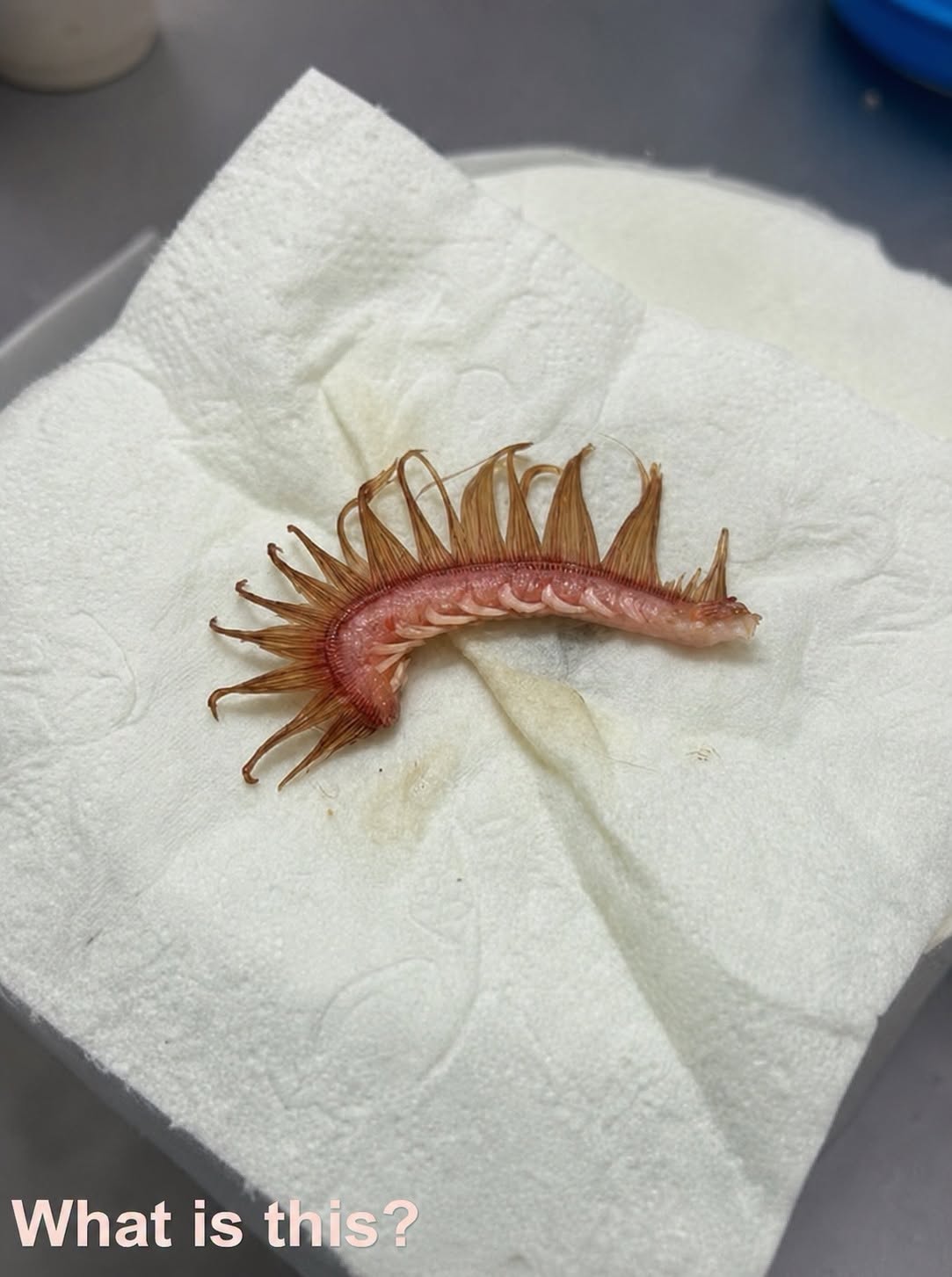
Fear slammed into the room before the door even closed. One strange shape tangled in our dog’s fur, and suddenly the entire atmosphere felt dangerous. We didn’t say the worst possibilities out loud, but both of us were already bracing for disaster. Each second stretched longer, each glance at that tiny, twisted object tightening the knot in our chests.
We hovered over our dog like two panicked detectives, desperately trying to solve a mystery we were probably half-inventing. Under the harsh light, the object looked completely unfamiliar. It seemed attached to his fur in a way that made it impossible to tell what we were looking at. Our minds immediately filled in the blanks with every horror story we had ever heard.
Parasites. An infection. Something embedded beneath the skin. Something that had been growing unnoticed while our dog went about his perfectly normal day.
The possibilities multiplied faster than we could dismiss them. We imagined parasites burrowing unseen, infections spreading silently, and the cold fluorescent lights of an emergency veterinary clinic at two in the morning. Every frightening scenario seemed suddenly plausible simply because we couldn’t identify the tiny thing in front of us.
Meanwhile, our dog remained completely unconcerned.
He sniffed the floor. He wandered from one spot to another. He looked at us with the same trusting expression he always had, seemingly unable to understand why his humans had transformed into anxious investigators. To him, nothing was wrong. To us, those few centimeters of tangled fur had become the center of the universe.
The more we stared at it, the more frightening it seemed.
That is the strange power of uncertainty. When we don’t know what something is, our minds rarely choose the most boring explanation. Instead, they reach for the possibilities that demand the most attention. A harmless object becomes suspicious. A tiny bump becomes a warning. A strange mark becomes evidence of something much worse.
Finally, my girlfriend reached out carefully. She pinched the mysterious object between her fingers and began pulling it free. For a moment, neither of us breathed.
Then it came loose.
And the entire nightmare collapsed.
It wasn’t a tick.
It wasn’t a parasite.
It wasn’t an infection.
It was a pair of soggy fake eyelashes.
They had somehow become tangled in our dog’s fur, transformed by moisture, hair, and our increasingly frantic imaginations into what looked like a tiny biological threat.
For several seconds, we simply stared.
Then we started laughing.
Not the polite kind of laughter, either. It was loud, shaky, uncontrollable laughter—the kind that arrives after intense fear and feels almost like your body is releasing everything it had been holding inside. We laughed because the situation was ridiculous, because we had been so convinced something terrible was happening, and because our dog had spent the entire ordeal completely unaware that he had become the star of our imaginary medical emergency.
The room that had felt so tense only moments earlier suddenly felt lighter.
The eyelashes sat harmlessly between our fingers, looking even more absurd now that we knew what they were. All the terrifying possibilities we’d created had vanished in an instant. Nothing had changed about the dog. Nothing had changed about the room. Only our understanding had changed.
And perhaps that was the most memorable part.
The experience became a quiet lesson in how quickly imagination can turn uncertainty into catastrophe. When something looks unfamiliar, fear can rush in to fill the empty spaces. We can build entire stories around a single unexplained detail, convincing ourselves that the worst possibility must be the most likely one.
Sometimes, though, the frightening mystery really is just something ridiculous caught in your dog’s fur.
That night, the fake eyelashes became an inside joke we would remember whenever one of us started catastrophizing. A strange little reminder that not every mystery has a terrifying answer, and that sometimes the thing causing the most fear is simply the story our minds have created around it.
Most importantly, our dog was fine. He went right back to sniffing the floor as though nothing had happened, completely unaware that he had just put two grown adults through several minutes of unnecessary emotional torture.
And as we watched him wander away, still perfectly happy, we couldn’t help laughing again.
Fear had entered the room first.
But laughter was what finally stayed.