Most people never see it.
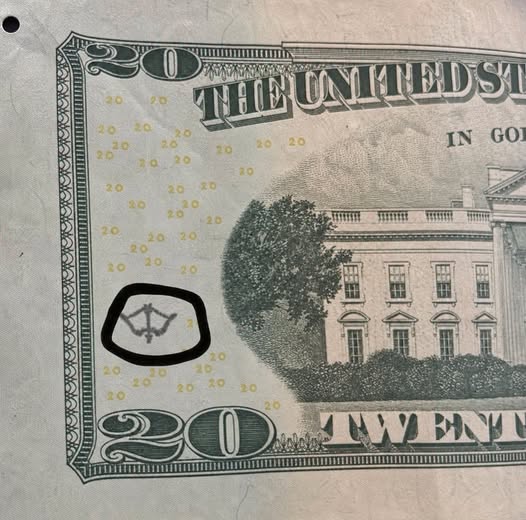
You can handle a $20 bill hundreds of times without ever noticing the strange little shape hiding among its intricate lines.
Then one day, you look closer.
There it is.
A tiny shape that almost resembles a bow and arrow.
Too precise to be random, you might think.
Too perfectly placed to be an accident.
And suddenly, an ordinary banknote you’ve probably carried countless times becomes a miniature mystery.
What is it?
A secret code?
A printing mistake?
A hidden symbol placed there intentionally?
Social media has turned discoveries like this into instant rabbit holes. One person notices an unusual mark, another claims it’s incredibly rare, and before long, someone has connected it to secret societies, hidden messages, or supposed clues buried inside the nation’s currency.
The more you stare at it, the more convincing it becomes.
Your eyes insist that the shape is real.
And it is real.
The question is what it actually means.
The answer is considerably less mysterious—and, in its own way, more fascinating.
That little “bow and arrow” shape isn’t a secret mark of power, a hidden message, or a shortcut to instant wealth.
It’s the collision of two remarkable things: the incredible complexity of modern currency design and the human brain’s almost unstoppable desire to recognize patterns.
A $20 bill isn’t a blank sheet with a few pictures printed on it.
It contains an extraordinary amount of fine detail.
Lines cross and curve.
Borders contain repeating patterns.
Portraits are built from incredibly intricate engraving and printing techniques.
Tiny letters, numbers, security elements, textures, and decorative details are layered together across a relatively small piece of paper.
When all of those elements overlap, strange shapes are inevitable.
Add folds, wrinkles, fading, ink variation, stains, shadows, or simple wear from years of being carried in a wallet, and those shapes can become even more pronounced.
Suddenly, a few ordinary lines can look like an arrow.
Or a letter.
Or an animal.
Or a face.
Or a symbol that seems so familiar you become convinced someone intentionally placed it there.
This phenomenon isn’t unique to money.
It’s something the human brain does constantly.
We see faces in clouds.
Animals in rock formations.
Shapes in tree branches.
Figures in shadows.
The brain is essentially trying to turn incomplete information into something recognizable.
And in many situations, that ability is useful.
Recognizing patterns quickly has helped humans navigate uncertain environments for thousands of years.
But the same instinct can also convince us that unrelated lines must have a deeper connection.
That’s where the mystery of the $20 bill begins.
Someone sees the shape.
Someone else gives it a name.
The name makes the shape easier to recognize.
Then other people start looking for it.
And once enough people know what they’re supposed to see, they begin seeing it too.
The discovery can suddenly feel universal.
But recognition doesn’t automatically prove intention.
That’s an important distinction.
A shape can be real without being deliberately hidden.
And something can look incredibly precise while simply being the accidental result of multiple design elements meeting in the same small space.
This is also why collectors don’t determine whether a bill is valuable simply because someone spotted an unusual-looking mark.
Serious collectors generally look for things that can be documented and verified.
That can include genuine printing errors, unusual serial numbers, recognized design varieties, condition, scarcity, and collector demand.
A mysterious-looking shape by itself usually isn’t enough.
The average strange-looking bill is simply a bill that has lived a little.
It’s been folded.
Stuffed into a wallet.
Pressed against coins.
Exposed to moisture.
Handled thousands of times.
Maybe its ink has faded slightly.
Maybe a crease has changed the way two lines appear.
Maybe the paper has stretched or worn down in a way that makes a tiny detail suddenly stand out.
None of that means you’ve discovered a hidden fortune.
But it doesn’t make the discovery meaningless either.
Because there’s something fascinating about suddenly noticing an object you’ve seen your entire life.
Think about how many $20 bills pass through people’s hands every day.
They buy groceries.
Pay for meals.
Change hands at stores.
Disappear into wallets and cash registers.
Most people never stop to study them.
We recognize the denomination and move on.
The bill becomes background noise.
Until one tiny detail interrupts that routine.
And suddenly, you’re looking.
Really looking.
You notice the patterns.
The textures.
The tiny lines.
The strange little shapes that were there all along.
That’s perhaps the most interesting mystery of all.
The secret wasn’t necessarily hidden in the money.
It was hidden in plain sight because we weren’t paying attention.
So the next time you notice a strange “bow and arrow” shape on a $20 bill, you don’t need to assume you’ve uncovered a conspiracy.
You also don’t have to dismiss the discovery as pointless.
Take a closer look.
Compare it with another bill.
Notice how wear and lighting change what you see.
And if you believe you’ve found a genuine printing error or collectible variety, have it evaluated using established collecting criteria rather than viral claims.
Because sometimes the most valuable thing about an ordinary object isn’t what it can buy.
It’s what it can make you notice.
That tiny shape may not be a secret code.
It may not lead to hidden wealth.
It may not have been placed there for you to discover.
But it can still teach you something remarkable about perception.
We walk through a world filled with details we barely notice.
Then, every once in a while, something makes us stop.
And when we finally choose to look closely, the ordinary can become mysterious all over again.