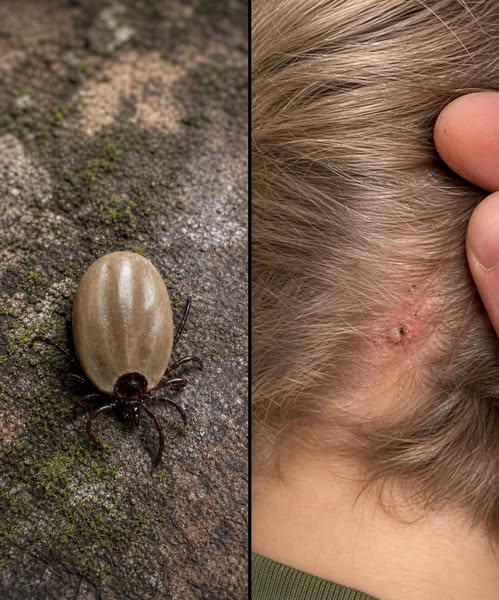
Finding a tick on your child can feel like a horror scene unfolding in slow motion.
The moment you notice that tiny body attached to their skin, your mind can race through every frightening possibility.
Lyme disease.
Paralysis.
Serious infection.
Even the worst outcomes you don’t want to imagine.
Your stomach drops. Your hands suddenly feel less steady. And for a few seconds, that tiny creature can seem like the most terrifying thing in the world.
But this moment does not have to end in panic.
What you do during the next few minutes matters far more than the frightening possibilities running through your head. Staying calm, removing the tick properly, cleaning the area, and paying attention afterward can turn a terrifying discovery into a manageable plan.
The sight of a tick can feel like a verdict.
It isn’t.
Most tick bites do not result in serious illness, and finding a tick doesn’t automatically mean your child has been infected with a disease. The actual risk depends on factors such as the type of tick, where the exposure happened, how long it may have been attached, and whether illness develops afterward.
The first priority is simple: remove it.
Using fine-tipped tweezers, grasp the tick as close to the skin as possible. Pull upward with steady, even pressure rather than twisting, crushing, or jerking it. The goal is to remove the entire tick while avoiding unnecessary irritation to the skin.
Once it is out, clean the bite area and your hands.
That small sequence of actions can immediately replace panic with something much more useful: control.
If possible, take a clear photograph of the tick before disposing of it. You can also make a note of where your child may have encountered it and roughly when you discovered it. Those details can be useful if questions arise later.
You don’t need to become an amateur disease detective.
You simply need to preserve the information that might help a healthcare professional evaluate the situation.
The next several days are where awareness becomes important.
A small red bump immediately after a tick is removed can simply be a local reaction or irritation. What deserves closer attention is a rash that expands, new or persistent fever, unusual fatigue, headache, or other symptoms that make your child seem genuinely unwell.
The key is not to panic over every mark.
It’s also not to dismiss meaningful changes.
Parents know their children better than almost anyone. If your child suddenly seems unusually tired, confused, weak, feverish, or simply not like themselves, that’s worth taking seriously and discussing with a healthcare professional.
And if the tick was attached for an uncertain amount of time, you aren’t sure what kind of tick it was, or you live in an area where tick-borne illnesses are common, contacting your child’s doctor can help determine whether any additional steps are appropriate.
The important thing is not to turn the following days into a constant inspection.
Repeatedly checking your child’s skin every few minutes won’t make the uncertainty disappear.
Instead, observe normally.
Pay attention.
Keep track of anything unusual.
And seek medical advice when something doesn’t look right.
There is also an important lesson beyond the bite itself: prevention can make these encounters less likely.
After outdoor activities, especially in areas with tall grass, brush, or wooded trails, check children for ticks. Look carefully around areas that are easy to miss, including the scalp, behind the ears, neck, waist, and other skin folds.
Clothing and outdoor habits can help too.
Using appropriate insect repellent, wearing suitable clothing, staying on maintained paths, and checking the body after coming indoors can all reduce exposure.
None of these precautions guarantee that a tick will never be found.
But they can lower the chances.
And perhaps that’s the most reassuring part of the entire experience.
A tick is frightening because it is tiny, unfamiliar, and associated with illnesses people understandably fear.
But fear itself is not protection.
Knowing what to do is.
Remove it carefully.
Clean the area.
Record the important details.
Watch for meaningful symptoms.
Contact a healthcare professional when you’re concerned.
That is a plan.
And having a plan changes everything.
The sight of a tick on your child can make your imagination run toward disaster, but the presence of a tick is not a prediction of what will happen next.
Most importantly, don’t blame yourself.
Ticks can be incredibly difficult to notice, and even careful families can occasionally find one after an outdoor adventure.
What matters is what you do once you discover it.
You don’t need to assume the worst.
You don’t need to ignore the possibility of illness either.
You simply need to respond calmly, thoughtfully, and promptly.
Because in those first few minutes, the most powerful thing a parent can do isn’t panic.
It’s act.