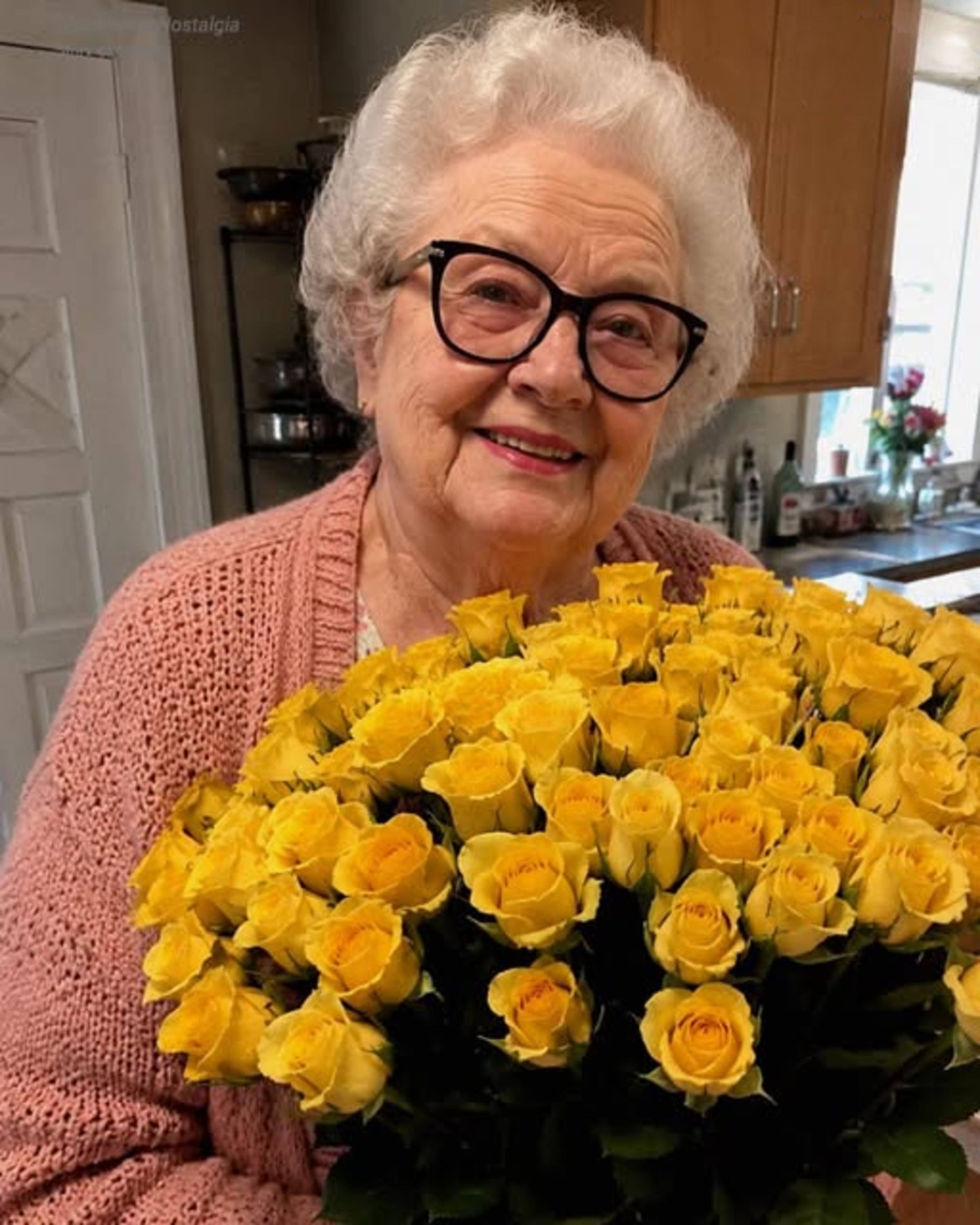
Fifty-six yellow roses arrived on the anniversary I’d spent most of my life observing alone.
They filled the doorway when the deliveryman handed them to me, their bright petals almost too cheerful for a day that had always carried a quiet ache.
Hidden among them was a crooked paper rose, old and faded.
I almost tossed it aside.
Then I noticed something on its stem.
Something so small that, at first, I thought I was imagining it.
But the moment I saw it clearly, I was no longer standing in my kitchen.
I was back in 1970.
Back at the train station.
Back in the yellow dress.
Back beside the man who had been my husband for only two days—and who then disappeared from my life for fifty-six years.
The deliveryman had already turned toward his van when I called after him.
“Excuse me. Are you sure these are for me?”
He turned around.
“Ma’am?”
I pointed at the flowers.
“Are you sure these are for me?”
He checked the clipboard in his hand.
“Mary?”
“Yes.”
“Then they’re yours.”
He smiled politely, handed me the delivery receipt, and walked back toward his van.
I stood there for another moment, staring at the enormous bouquet filling both my arms.
*Yellow roses.*
*Dozens of them.*
I carried them carefully into the kitchen, afraid I might drop one.
I found my largest vase and set it on the counter.
Before arranging them, I counted the roses.
Once.
Then again.
I thought perhaps I’d miscounted.
I hadn’t.
**Fifty-six.**
My fingers stopped on the final stem.
I stared at the number.
My throat tightened.
*Today would have been my 56th wedding anniversary.*
Fifty-six years.
A number so large that sometimes it didn’t feel real.
For most of my life, I had marked the date quietly.
No anniversary dinner.
No card.
No flowers.
No husband beside me.
Just a date on the calendar that refused to disappear.
I had learned not to talk about it much.
People eventually stopped asking.
Friends married.
Friends divorced.
Friends became widows.
Children grew up and moved away.
Life continued.
But every year, when that date came around, I remembered.
I remembered the wedding.
The train station.
The yellow dress.
And the promise.
I filled the vase with water and began separating the stems.
The roses were beautiful.
Fresh.
Perfect.
Expensive, judging by the size of the arrangement.
I wondered who had sent them.
Maybe someone from the neighborhood.
Maybe an old friend.
Maybe one of my nieces or nephews.
I had no idea.
Then something sharp scraped my thumb.
“Ow.”
I pulled my hand back.
I looked for a thorn.
There wasn’t one.
Instead, something yellow and crumpled was wedged between the fresh roses.
**Paper.**
I carefully reached into the bouquet and eased it free.
It was a flower.
A rose.
But not a real one.
It had been folded from faded yellow paper.
Badly.
One side leaned farther out than the other.
The petals were uneven.
The center was slightly crushed.
The stem had been reinforced with a narrow strip of brittle tape that looked as though it had been there for decades.
I almost laughed.
It was honestly terrible.
Compared with the fresh roses surrounding it, the little paper flower looked almost ridiculous.
For a moment, I wondered if it was some kind of joke.
Then I noticed something written near the bottom of the stem.
My hands stopped moving.
I leaned closer.
There was a letter.
Then another.
And suddenly I recognized the handwriting.
My heart began pounding.
I sat down.
The paper rose trembled between my fingers.
“No,” I whispered.
I looked at it again.
*My husband.*
*The man who had been missing for 56 years.*
My mind refused to accept what my eyes were telling me.
Could it really be James?
The man who had been my husband for only two days, yet somehow remained my husband for the next fifty-six years?
James and I had married in my parents’ backyard.
There had been no grand venue.
No expensive decorations.
No enormous guest list.
He had been home on leave, and we both knew we didn’t have much time.
There were only twenty-three guests.
My parents.
A few relatives.
Some neighbors.
A handful of friends.
There was one crooked cake that leaned slightly to one side because my mother had tried to make it herself.
She cried through nearly the entire ceremony.
James teased her afterward.
“I’m borrowing your daughter. I’m not stealing her.”
My mother pointed a cake knife at him.
“You bring her back happy.”
James looked at me.
Then he smiled.
“That’s the plan.”
I still remembered the way he looked at me when he said it.
Like there was no possibility in the world that anything could go wrong.
Like the future was already written.
Like we’d have decades.
Children, maybe.
A little house.
Arguments over money.
Holidays.
Gray hair.
Grandchildren.
The ordinary things people don’t appreciate enough until they’re gone.
Two mornings later, I stood with him at the station.
I wore the yellow dress he’d liked so much.
He had told me the color made me look happy.
I told him it was just a dress.
He disagreed.
“You look like sunshine.”
I rolled my eyes.
“You’re getting sentimental.”
“I’m married now. I’m allowed.”
Before boarding, he kissed me.
Then he held my hands and said, “Next anniversary, I’ll buy you the biggest bouquet of yellow roses I can find.”
I smiled.
“You’d better.”
Then I added, “I married you for flowers.”
He laughed.
That laugh stayed with me.
Because it was the last time I ever heard it.
Weeks later, his unit came under heavy fire.
Men died.
Others disappeared.
Families waited beside telephones.
Letters stopped arriving.
Days became weeks.
Weeks became months.
Then the official notice came.
James was listed missing.
Not dead.
Not alive.
Missing.
Those words became the center of my life.
I learned how cruel the word “missing” could be.
There was no funeral.
No grave.
No final goodbye.
There was simply an empty space where a person was supposed to be.
His closest friend, Adrian, eventually came home.
I remember the day he came to my parents’ living room.
He looked older than he had when he’d left.
Much older.
He sat down without taking off his coat.
His hands were locked tightly between his knees.
My mother brought him coffee.
He didn’t touch it.
I knew before he spoke that something was wrong.
Because he wouldn’t look at me.
And for the first time in my life, I understood that sometimes the hardest part of losing someone isn’t hearing that they’re gone.
It’s never knowing exactly what happened.
Adrian finally lifted his eyes toward me.
And whatever he was about to tell me would change the rest of my life.
But sitting there decades later, holding that crooked paper rose in my kitchen, I realized something even more frightening.
Maybe Adrian hadn’t known everything.
Maybe someone else had.
Because the handwriting on that faded stem belonged to James.
And if James had somehow kept his promise after fifty-six years, then the question wasn’t simply who had sent me the roses.
The question was where he had been all this time.