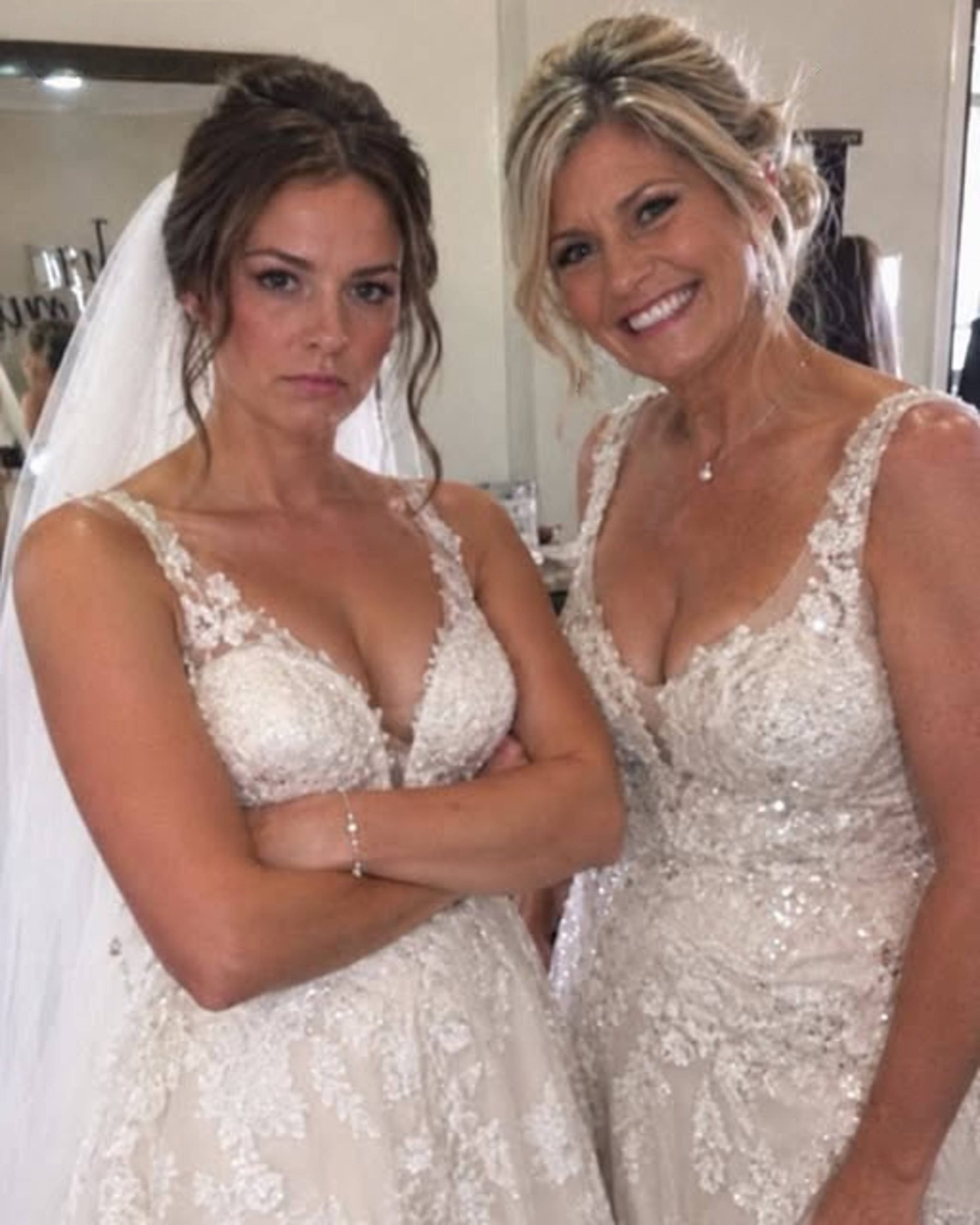
I spent months telling myself my dress was only “similar” to my daughter-in-law’s.
Same color.
Same length.
Same kind of lace.
But surely not close enough to matter.
That was the story I told myself every time the thought made me uncomfortable.
I believed it right up until my son left his bride standing alone on the dance floor and held out his hand to me.
My name is Carol, and I need to admit something I’m not proud of.
When my son David got engaged, some ugly, small part of me wasn’t ready to stop being the most important woman in his life.
I didn’t say that out loud, of course.
I wouldn’t have even admitted it to myself at first.
I smiled when he called me and said Rachel had accepted his proposal.
I screamed.
I cried.
I hugged him when I saw him.
I told everyone at work that my only son was getting married.
I showed people the engagement photos.
I told my friends how beautiful Rachel was and how lucky David was.
I even told Rachel how happy I was for them.
And I meant it.
Mostly.
The problem was that every happy moment seemed to come with a second feeling underneath it.
Fear.
A quiet, embarrassing fear that I was slowly becoming less important.
David had always been close to me.
It was just the two of us for most of his childhood, and I had worked hard to give him a stable life.
I worked full-time at a dental office and took whatever extra shifts I could find.
There were years when I came home exhausted, kicked off my shoes, and still had to figure out dinner, laundry, homework, and bills.
David learned to make grilled cheese before most kids his age knew how to use a stove.
He would stand on a little chair beside me and insist on helping.
When he was older, he became the kind of child who noticed when I was tired.
He’d make me tea.
He’d leave a note beside my coffee.
He’d sit next to me on the couch without asking whether I wanted company.
We had our own little routines.
On Friday nights, we’d order pizza, sit on the couch, and watch terrible action movies until one of us fell asleep.
Sometimes we’d laugh at how ridiculous the movies were.
Sometimes we barely spoke.
Those ordinary nights became some of the most important memories of my life.
When he went to college, he called me almost every night.
Sometimes it was for five minutes.
Sometimes it was an hour.
He’d tell me about classes, roommates, professors, girls.
And whenever something really important happened, I was the person he called.
When he got his first real job, I was the first person he called.
When he got promoted, I was the first person he called.
When he was sick, he called me.
When he was excited, he called me.
For years, I never questioned my place in his life.
Then Rachel came along.
And she wasn’t rude.
That would have made things easier.
If she had been arrogant or dismissive, I could have told myself that she wasn’t good enough for my son.
But she wasn’t.
She was kind.
Annoyingly kind, if I’m being truthful.
She remembered my birthday.
She brought me soup when I got the flu.
She asked about my work.
She remembered stories I’d told her months earlier.
She never complained when David invited me to dinner.
She never acted irritated when he called me while we were together.
She even encouraged him to spend time with me.
There was nothing obvious I could dislike about her.
And that made my feelings even harder to justify.
Because the problem wasn’t Rachel.
The problem was me.
David started calling her first.
He asked her opinion before mine.
When he bought a new car, I found out afterward.
When he started talking about buying a house, he said things like, “Rachel and I want a big kitchen,” and “Rachel thinks we should stay near the city.”
Every sentence seemed to begin with Rachel.
And I noticed.
I noticed every single time.
I would smile and say, “That sounds wonderful.”
But inside, a little voice would whisper:
*He doesn’t need you the way he used to.*
Then they got engaged.
The wedding planning started almost immediately.
Rachel wanted a small ceremony at a restored farmhouse outside town.
Nothing too formal.
About eighty guests.
She wanted flowers that looked natural instead of perfectly arranged.
She wanted long tables instead of a traditional ballroom setup.
She talked about warm lights, homemade desserts, and dancing outside if the weather was good.
It sounded beautiful.
And she included me in everything.
Cake tasting.
Flowers.
Venue tours.
Dress discussions.
She would send me pictures and ask what I thought.
I appreciated it.
I really did.
But I also felt something strange every time she called me “Mom” in conversation.
It reminded me that she was becoming family.
And somehow, that also reminded me that my son was becoming someone else’s husband.
I couldn’t make every planning appointment because of work.
One afternoon, while scrolling through Pinterest, I found a board Rachel had apparently forgotten was public.
On it was her wedding dress.
At least, I assumed it was hers because several nearly identical gowns were pinned.
Ivory.
Floor-length.
Soft lace across the bodice.
A fitted waist.
A simple neckline.
Nothing dramatic.
Nothing covered in jewels or enormous layers of fabric.
It was elegant and understated.
Exactly Rachel’s style.
I stared at the screen longer than I should have.
There was something about that dress that bothered me.
Not because it was ugly.
Quite the opposite.
It was beautiful.
I imagined Rachel walking down the aisle wearing it.
I imagined David seeing her.
And then, almost immediately, I imagined myself standing beside them.
I closed the app.
I didn’t mention the dress to anyone.
Two months later, I went shopping for my own dress.
My sister-in-law, Diane, came with me.
She knew I was nervous about the wedding, although I never told her exactly why.
The first few stores were uneventful.
Blue.
Green.
Burgundy.
One dress was too flashy.
Another made me look washed out.
A third was comfortable but looked more appropriate for a business dinner than a wedding.
Diane kept bringing dresses into the fitting room.
“What about this one?”
“No.”
“Too dark?”
“Way too dark.”
“Try this.”
“I look like I’m going to a funeral.”
We laughed.
For a while, it felt normal.
Just two women shopping for a wedding.
Then I saw it.
The dress was hanging at the end of a rack.
Ivory.
Floor-length.
Soft lace.
Elegant without being flashy.
I stopped.
Diane noticed immediately.
“Oh,” she said.
I touched the fabric.
It was almost exactly the kind of dress Rachel had saved on her Pinterest board.
I knew that.
I knew it immediately.
And for one brief second, I almost walked away.
Instead, I pulled it from the rack.
“Try it,” Diane said.
I hesitated.
“Carol.”
“What?”
“It’s a dress.”
“I know.”
“Then try it.”
So I did.
When I stepped out of the fitting room, Diane stared at me.
“Wow.”
I looked in the mirror.
And that’s when the excuses started.
It wasn’t Rachel’s dress.
Not technically.
The lace pattern was different.
The neckline wasn’t exactly the same.
The waist was slightly different.
The sleeves weren’t identical.
I told myself all of that.
I repeated it in my head like evidence in a courtroom.
*It’s similar.*
*Lots of women wear ivory.*
*It’s a wedding.*
*I’m the mother of the groom.*
*I deserve to look beautiful too.*
And underneath all those excuses was the thought I didn’t want to acknowledge:
*Maybe David will notice me.*
Not instead of Rachel.
I told myself that wasn’t what I meant.
But maybe just enough to remind him that I was still his mother.
Still important.
Still part of the center of his life.
Diane tilted her head.
“You really like it.”
I smiled.
“I do.”
She looked at me for another second.
“Are you sure?”
I knew exactly what she was asking.
I pretended not to.
“Of course.”
She didn’t argue.
Neither did I.
I bought the dress.
And for months afterward, whenever I thought about it, I told myself the same thing.
It was only similar.
Nothing more.
I wasn’t trying to compete with Rachel.
I wasn’t trying to overshadow her.
I wasn’t trying to make the wedding about me.
At least, that’s what I wanted to believe.
I even convinced myself that if anyone noticed the similarity, they’d laugh it off.
Mother of the groom.
Bride.
Ivory dresses.
A coincidence.
That’s all.
But deep down, I knew there was something I wasn’t admitting.
Because every time I imagined walking into that farmhouse wearing the dress, I didn’t just picture how I would look.
I pictured David seeing me.
And that should have been enough to make me stop.
It wasn’t.
I kept the dress hanging in my closet.
I bought shoes.
I chose jewelry.
I planned my hair.
And each time I prepared for the wedding, I pushed the uncomfortable feeling farther away.
Until the wedding day arrived.
And I discovered that some choices don’t stay small just because you refuse to name what motivated them.
Sometimes you can spend months calling something a coincidence.
Then one moment arrives when everyone else can see what you’ve been trying not to see yourself.
For me, that moment happened on the dance floor.
And it started with Rachel standing alone.