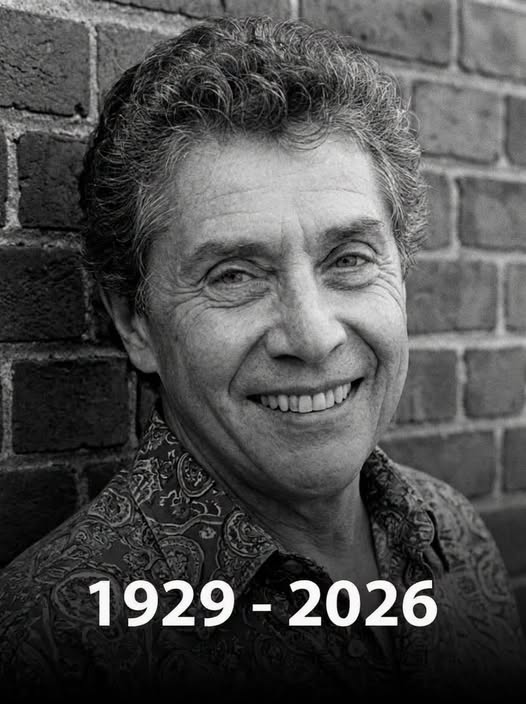
The news hit like a punch to the chest. A quiet death, at 97, for the man who once commanded giants.
Henry Fonda.
Katharine Hepburn.
A young Bette Midler, terrified on her first set.
He shaped them, challenged them, listened to them, and then stepped quietly into the shadows. Mark Rydell was never the loudest name in Hollywood, and perhaps that was exactly how he preferred it. While actors stood beneath the lights and audiences remembered their faces, he remained just beyond the frame, guiding performances that would become part of American cinematic history.
Now the stories are pouring out, filled with memories of long conversations, difficult scenes, unexpected encouragement, and a director who understood that great performances could not always be forced. But one secret about his final years has left even his closest friends stunned: the man who spent his life helping others find their voices had become increasingly private himself, choosing distance from the noise of Hollywood while continuing to work quietly with the people who sought his wisdom.
He was never the loudest name on the marquee, yet Mark Rydell altered the course of American film from just behind the camera’s edge. His influence was rarely about demanding attention. It was about creating an environment where actors could take risks without feeling exposed, where uncertainty could become discovery, and where a performance could evolve naturally instead of being manufactured.
Actors spoke of him with a kind of reverence usually reserved for lost parents: the director who listened, who waited, who believed they had one more truth to give when everyone else was ready to move on.
That patience became one of his greatest strengths.
Rydell understood that actors could sense when they were being pushed into something false. He knew that sometimes the most powerful direction was not another instruction, but another question. A pause. A suggestion. A moment that allowed the performer to find the emotion themselves.
With Henry Fonda, that sensitivity became especially powerful.
Fonda’s fragile rage in *On Golden Pond* was not simply the product of a great actor reading brilliant dialogue. It was part of a larger emotional architecture that required trust. The character had to be difficult without becoming cruel, vulnerable without becoming sentimental, and aging without losing his sense of pride. Rydell helped create the space for those contradictions to exist simultaneously.
The result was a performance that carried extraordinary emotional weight.
Fonda could be angry, funny, stubborn, frightened, and deeply loving within the same story. The film’s emotional power came partly from the tension between those qualities. Rydell understood that people rarely fit neatly into one emotion, especially when they are confronting age, family, regret, and the fear of losing control.
Then there was Katharine Hepburn.
A performer whose screen presence had already become legendary, Hepburn did not need anyone to teach her how to command an audience. What she needed was a director capable of meeting that force without trying to overpower it.
Rydell did.
Her fierce tenderness, intelligence, humor, and emotional strength became part of the texture of his work. He knew when to step forward and when to disappear, allowing an actor of enormous personality to occupy the frame without making the direction itself visible.
And then came Bette Midler, still young and terrified on her first set.
For an emerging performer, a film set can feel overwhelming. There are cameras, lights, crew members, schedules, expectations, and the knowledge that every mistake may be preserved forever. A young actor can easily become trapped between trying too hard and being too frightened to try at all.
Rydell recognized something in Midler.
Her raw, unvarnished humanity was not something that needed to be polished away. It needed protection.
He helped her find the confidence to trust what was already there—the instinct, vulnerability, humor, and emotional unpredictability that could not be manufactured by technique alone.
That approach became part of his signature.
He did not simply want actors to perform.
He wanted them to reveal something.
That distinction may sound subtle, but it can completely change what audiences experience. A performance can be technically flawless and still feel empty. Another can contain imperfections and still feel alive. Rydell consistently seemed drawn toward the second kind—the kind that breathes, hesitates, surprises, and occasionally breaks open.
He understood that performance was a living, breakable thing.
It could disappear if handled too aggressively.
It could become artificial if every movement was controlled.
But with patience, trust, and the right environment, an actor could reach somewhere deeper than the obvious emotion.
Fonda’s fragile rage.
Hepburn’s fierce tenderness.
Midler’s raw humanity.
Those moments were not accidents.
They were coaxed, protected, and fought for by a man who understood that directing was often less about controlling a performance than knowing when to get out of its way.
That philosophy made Rydell different from the stereotypical image of the Hollywood director barking instructions from behind a monitor. His authority came from understanding people. He knew that actors could be frightened, insecure, exhausted, stubborn, or uncertain—and that none of those things necessarily meant they were failing.
Sometimes they simply needed another chance.
Another take.
Another conversation.
Another few minutes to find what they had not yet found.
That patience could produce something cameras could not capture through force.
It could produce truth.
Over the course of his career, Rydell worked in an industry that changed dramatically around him. Hollywood became faster. Production became more commercialized. Technology transformed filmmaking. Publicity became louder. Directors became celebrities in their own right.
But Rydell’s approach remained rooted in something older and more human.
Listen.
Observe.
Wait.
Then act when the moment is right.
In his final years, as Hollywood grew louder and faster, Rydell grew quieter but never bitter. He increasingly kept himself away from the red-carpet machinery and the endless demand for public appearances. Instead, he spent more time mentoring younger filmmakers and sharing what he had learned through decades of working with some of the industry’s most formidable personalities.
Those conversations often happened far from cameras.
Small rooms.
Private gatherings.
Long discussions about storytelling, actors, fear, failure, and the strange responsibility of directing another human being.
There was no spectacle.
No flashbulbs.
No need to announce the lesson to the world.
Just experience being passed from one generation to another.
That may ultimately be one of the most important parts of Rydell’s legacy.
Film history often celebrates finished products. The awards. The performances. The famous scenes. The names printed above the title.
But filmmaking is also shaped by the people who make others better.
The directors who know when to challenge.
The mentors who know when to encourage.
The collaborators who understand that a fragile idea sometimes needs protection before it can become something powerful.
Rydell was one of those people.
His career was therefore not simply a list of films and famous names. It was a network of relationships, each one leaving something behind.
An actor remembers a conversation.
A filmmaker remembers a piece of advice.
A performer remembers being given another chance.
Years later, that lesson appears somewhere else—in another film, another scene, another young actor who finally finds the courage to trust themselves.
That is how influence survives.
Not always through monuments.
Sometimes through people.
In a sense, Rydell’s quietness in later life was consistent with the way he had worked all along. He never needed to stand in the center of the frame. He understood that the director’s greatest achievement could be making everyone else look extraordinary.
The audience watches the actor.
The actor remembers the director.
And the director disappears into the work.
As his life drew toward its final chapter, there was something fitting about him becoming even more removed from Hollywood’s noise. He had spent decades watching the industry chase the next big thing, the next star, the next success. He knew that fame could be temporary and that trends could disappear almost overnight.
What remained were the performances.
The faces frozen in light.
The scenes that continued to speak decades after they were filmed.
Those were the things that mattered.
And now, with his death at 97, a chapter closes on a gentler, more patient kind of directing.
A style built less on ego and more on trust.
Less on volume and more on observation.
Less on commanding actors and more on helping them discover what they already carried inside themselves.
The Hollywood he leaves behind may be louder than the one he entered. It may move faster, promote harder, and demand constant visibility. But the lessons of his career remain remarkably timeless.
Listen to people.
Give them room.
Protect vulnerability.
And never assume that the first performance is the deepest one.
Sometimes the truth arrives on the third take.
Sometimes it appears after a long silence.
Sometimes it emerges only when an actor finally stops trying to impress anyone.
Rydell knew how to wait for those moments.
That was his gift.
His death closes the door on a remarkable life, but it does not close the conversation he spent decades creating. His work continues every time those films are watched, every time an actor studies Fonda or Hepburn or Midler, and every time a young filmmaker learns that directing is not simply about telling people what to do.
It is about understanding people well enough to help them become more truthful.
What remains are the faces he transformed, frozen in light, still speaking for him.
Henry Fonda.
Katharine Hepburn.
Bette Midler.
And countless others whose performances carry traces of a director who believed the camera could capture something deeper when the person in front of it was given enough freedom to be human.
Mark Rydell spent much of his career standing just outside the spotlight.
Perhaps that is exactly where he belonged.
Because when the lights went on, he wanted the audience to see them.
Now that he is gone, the most fitting tribute may be to look back at those faces and understand what was happening just beyond the frame.
A quiet man was listening.
Waiting.
Guiding.
And helping some of the greatest performers of his generation tell the truth.