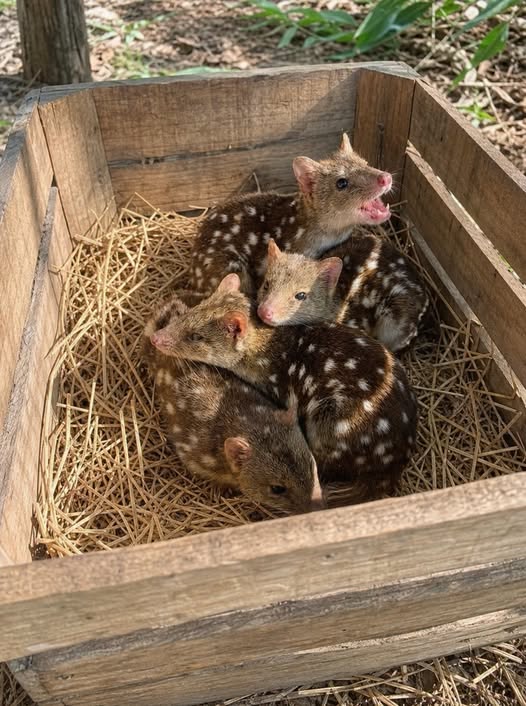
Hope roared back into the outback.
For years, the western quoll was little more than a whisper in the Australian landscape—a memory preserved in old records, a set of fading tracks pressed into red dust, a predator that seemed destined to disappear from places where it had once belonged. Its decline was not sudden. It was the result of years of habitat destruction, introduced predators, changing landscapes, and the relentless pressure of a world that had become increasingly hostile to a small, nocturnal hunter.
Then, inside the remote protection of Mt Gibson Wildlife Sanctuary, researchers opened a pouch and saw something that conservationists never dare take for granted: tiny, living proof that a species can come back.
There, hidden against the body of a mother, were pouch young.
Small. Vulnerable. Almost impossibly fragile.
But alive.
Cameras flashed. Researchers watched closely. Hearts raced as the reality sank in. In the darkness of the Australian night, a species that had spent decades fighting for survival was producing a new generation. It wasn’t just another wildlife sighting. It was a moment that seemed to push back against one of conservation’s most painful fears—the idea that once a species falls far enough, recovery may no longer be possible.
The newborn western quolls at Mt Gibson Wildlife Sanctuary are more than a conservation milestone. They are a living rebuttal to the belief that decline is always a one-way road toward extinction. Their arrival represents what can happen when conservation stops being about simply protecting the last surviving animals and becomes an effort to rebuild the conditions those animals need to thrive.
For decades, western quolls faced a brutal combination of threats. Their habitat shrank. Predators such as feral cats placed enormous pressure on native wildlife. Human development and environmental change disrupted the ecosystems these animals depended on. As their range contracted, every remaining population became increasingly precious.
Saving a species under those conditions requires more than good intentions.
It requires patience.
It requires planning.
And sometimes, it requires rebuilding an entire landscape around the animals that once called it home.
At Mt Gibson, ecologists didn’t simply open the gates and hope nature would somehow repair itself. They redesigned the conditions around the animals. They worked to secure safe den sites, restore vegetation, manage threats, and create an environment where native species could move, hunt, shelter, and reproduce with fewer of the pressures that had pushed them toward disappearance.
And then they watched.
Motion-activated cameras became silent observers scattered across the sanctuary. Night after night, they recorded animals moving through the darkness—sometimes only briefly appearing in the frame before disappearing again into the bush. Every image became a small piece of evidence. Every movement helped researchers understand whether the animals were surviving, adapting, and beginning to establish themselves.
Among those animals was Aang, a western quoll whose nighttime appearances became especially memorable.
Through the camera lenses, researchers could see something that statistics alone could never fully capture: personality, movement, curiosity, and behavior. Aang wasn’t simply a data point representing a conservation program. Aang was an individual animal navigating a landscape that had been carefully prepared for a second chance.
And then came the pouch young.
For a researcher, seeing a mother carrying new life is a powerful confirmation that the effort is working. Reproduction means more than survival. It means the animals are beginning to establish a future that does not depend entirely on human intervention.
That distinction is everything.
A species surviving because humans constantly rescue individual animals is one thing. A species beginning to reproduce, raise young, and establish itself within restored habitat is something much more hopeful. It suggests the possibility of a self-sustaining population—a future where conservation can gradually shift from emergency protection toward long-term recovery.
Every healthy mother matters.
Every newborn joey matters.
Every nighttime image matters.
And together, they begin to tell a much larger story.
The return of the western quoll also matters because predators have a role in ecosystems. These animals are not simply beautiful creatures that conservationists want to keep alive for sentimental reasons. They are hunters, and hunters help shape the balance of the environments they inhabit. Their return can contribute to restoring ecological relationships that disappeared alongside them.
That is why a tiny animal inside a pouch can represent something much larger than itself.
It represents a landscape beginning to heal.
It represents science meeting patience.
It represents the possibility that conservation does not always have to end with a protected remnant population clinging to survival. Sometimes, with enough effort, it can lead to genuine recovery.
The road ahead is still long. A handful of newborn quolls cannot erase decades of habitat loss or eliminate every threat facing Australian wildlife. Predators, disease, environmental pressures, and changing conditions can still challenge recovering populations. Conservation success is rarely permanent unless the work continues.
But that is precisely why these young quolls matter.
They provide something every long conservation project desperately needs: evidence that the effort is producing life.
Each grainy nighttime image captured by a motion-activated camera is a tiny window into a world most people never see. Each mother moving silently through the darkness is a reminder that recovery often happens quietly, away from crowds and headlines. And each joey growing safely inside a pouch is a message written in the language of survival.
The western quoll was once a fading presence in the Australian wild.
Now, there are new tracks in the dust.
New movements in the darkness.
New lives waiting to emerge.
And perhaps the most powerful lesson is not simply that the quoll came back.
It is that when humans give a damaged ecosystem enough protection, space, and time, nature can sometimes do something extraordinary with that opportunity.
Each healthy mother, each new joey, and each flicker of movement caught on a camera becomes part of a quiet revolution.
Proof that extinction is not always inevitable.
Proof that lost hunters can return.
And proof that sometimes, against extraordinary odds, hope really can roar back into the outback.