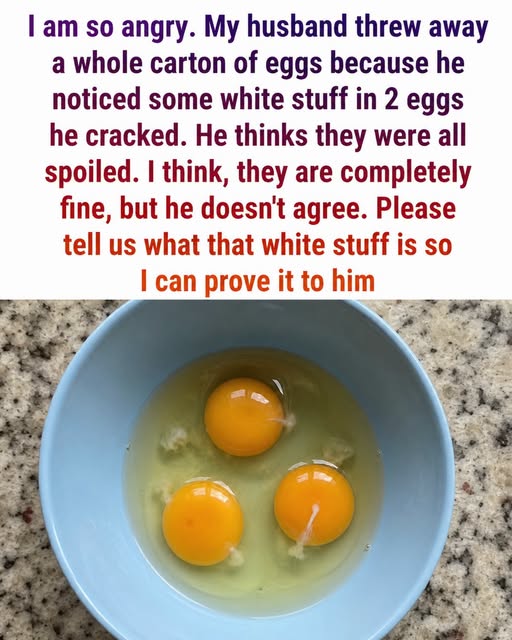
That strange white string in your egg is not the horror story you’ve been secretly dreading. It’s not a baby chick, not a worm, not some quiet sign your kitchen hygiene has finally failed. And no, it isn’t something that means the egg has gone bad simply because you can see it. It’s something far stranger—and far more important. Because once you discover what that little white strand actually is, and what it can reveal about freshness, safety, and the eggs you’re feeding your family, you may never crack a shell the same way again.
For generations, people have opened an egg, noticed that odd white, rope-like strand attached to the yolk, and wondered what on earth they were looking at. Some assume it is part of the yolk itself. Others pull it out immediately, convinced that anything that looks stringy must belong in the trash. The shape can certainly make it look unusual enough to trigger suspicion, especially when you weren’t expecting to find anything inside the perfectly smooth, familiar egg.
But that little white string has a name: **chalaza**.
And it is completely normal.
The chalaza isn’t a defect, contamination, or danger sign. It is essentially the egg’s built-in suspension system—almost like a tiny biological seatbelt designed to keep the yolk where it belongs. There are typically two twisted, cord-like strands of protein extending from opposite sides of the yolk. Their job is to anchor the yolk within the egg white and help keep it centered rather than allowing it to freely bounce around inside the shell.
Think about what an egg goes through before it reaches your kitchen. It can be collected, transported, boxed, moved onto store shelves, carried home, and placed in the refrigerator. Yet the yolk remains suspended in the middle, protected by layers of albumen and the shell. The chalaza is one small but remarkably effective part of that natural design.
In a fertilized egg, this suspension has an even more important purpose. The yolk provides nutrients for a developing embryo, while the surrounding structures help protect it. Keeping the yolk positioned properly gives the developing chick a stable environment as the egg changes over time.
But in the egg sitting in your refrigerator, there is no developing chick hiding inside simply because you can see a chalaza.
For the vast majority of grocery-store eggs, especially unfertilized eggs, the chalaza is simply doing its ordinary biological job. When you scramble the egg, fry it, boil it, or bake with it, the strand cooks along with the rest of the egg white. It doesn’t suddenly become something dangerous. It simply blends into the cooked egg, often disappearing without you even noticing.
In fact, you’ve probably eaten it thousands of times without realizing it.
That strange, ropey piece you may have carefully removed with a fork or spoon was not some foreign object invading your breakfast. It was part of the egg all along. And because it is made primarily of protein, there is generally no reason to remove it for safety. Some cooks remove the chalaza when making delicate dishes because they prefer a smoother appearance or texture, but that is a matter of preference—not because the chalaza is harmful.
And here is where the story gets even more interesting.
That little white strand can also provide a clue about **freshness**.
A firm, clearly visible chalaza is generally associated with a fresher egg. As an egg ages, the internal structures gradually weaken. The egg white becomes thinner, the yolk becomes less securely held, and the chalaza can become less distinct. It may still be present, but it can appear looser and less pronounced.
That means the very thing that once made you suspicious may actually be telling you something useful.
Fresh eggs often have thicker whites and more noticeable internal structure. When cracked onto a plate, the white tends to hold together more closely around the yolk. Older eggs spread more easily because the albumen gradually loses some of its firmness. The chalaza is just one visible part of that larger process.
Of course, freshness and safety are not exactly the same thing. An egg can look perfectly normal and still require proper handling, while an unusual-looking egg is not automatically unsafe. Storage conditions, shell integrity, expiration or best-by information, and whether the egg has been properly refrigerated all matter. If an egg has an unmistakably rotten smell, unusual discoloration, a damaged shell, or other clear signs of spoilage, the safest choice is to discard it.
But the presence of a chalaza by itself is not a reason to panic.
Quite the opposite.
So the next time you crack open an egg and see that ghostly spiral clinging tightly to the yolk, take a second before reaching for the trash can. You’re not looking at a worm. You’re not discovering a hidden chick. And you’re not witnessing your kitchen hygiene fail in real time.
You’re looking at a tiny piece of natural engineering that has been protecting the yolk exactly as it was designed to do.
That odd white string has been there all along, quietly performing its job while you cooked breakfast, baked cakes, made omelets, and scrambled eggs. It never needed an explanation because it never caused a problem.
Now you know what it is.
And perhaps the funniest part is that the thing you once thought looked disturbing may actually be one of the quietest clues that the egg in front of you is fresh.
So the next time you crack a shell and see that little white cord wrapped around the yolk, drop the worry, keep the egg, and get on with breakfast. Sometimes the strangest-looking parts of ordinary food are not signs that something has gone wrong—they’re proof that nature was working exactly as intended.